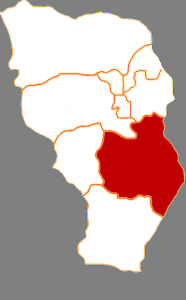
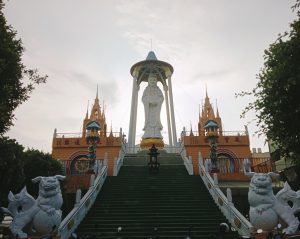
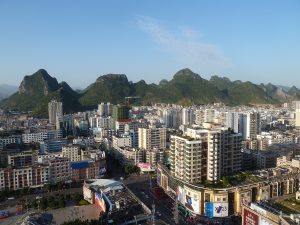
The minibus rattles over the last mountain pass before dawn, headlights cutting through mist that clings to the ridgelines of northern Guangdong. Below, the Dong River catches the first pale light, threading through a valley where limestone karsts rise like broken teeth. I am heading for Heyuan, a place most travelers skip on the bullet train between Guangzhou and Shenzhen, but where the ground literally holds the past — dinosaur eggs by the thousand, Hakka roundhouses that have withstood centuries, and a reservoir so vast it creates its own weather.
Getting There and Moving Around
High-speed rail drops you at Heyuan East Station, a glass-and-steel box surrounded by orange groves. From the forecourt, the city bus network fans out, but the routes that matter — to the dinosaur museum, to Wanlu Lake, to the Hakka enclosures in the hills — run on schedules written for commuters, not visitors. I learned the hard way: arrive on a weekend and the 201 bus to the museum fills with school groups by 8:30 a.m. A ride-hailing app works in the urban core, but drivers cancel the moment they see a destination up a winding county road. The reliable move is to hire a private car for the day; negotiate a flat rate before you get in, and make sure the driver knows the mountain gates close at dusk.
- High-speed train to Heyuan East from Guangzhou South: roughly 1 hour 20 minutes.
- City bus 201 connects the station to the Dinosaur Museum; first departure around 7:00 a.m., last return near 6:00 p.m.
- Private car hire for a full day covering museum, lake, and one Hakka village: typical range 400–600 yuan, fuel and tolls included.
- Mountain roads to Ke Tianxia and nearby enclosures are paved but narrow; drivers honk at every blind curve.
Heyuan Dinosaur Museum: Eggs in the Rock
The museum sits at the foot of a quarry where farmers first stumbled upon clutches of fossilized eggs in the 1990s. Inside, the air smells of limestone dust and air-conditioning. Glass cases hold eggs the size of grapefruits, their shells cracked open by time, revealing mineralized embryos — tiny femurs, delicate ribs. The star specimen is a nest of 43 eggs arranged in a perfect spiral, each one tilted as the mother positioned it. I stood there while a guide explained that Heyuan holds the Guinness record for the largest collection of dinosaur eggs in the world, but the real thrill comes outside: a short trail leads to the exposed strata where you can see cross-sections of eggs still embedded in the red sandstone, waiting for the next typhoon rain to wash them free.
- Open daily except Mondays; morning hours are quieter.
- Allow two hours for the main hall and the outdoor fossil wall.
- Bring a hat and water — the quarry trail has no shade.
- Photography allowed without flash; tripods need a permit from the front desk.
Wanlu Lake: Water That Swallows Hills
Wanlu Lake is not a lake in the usual sense — it is the Xinfengjiang Reservoir, a drowned valley system stretching over 370 square kilometers. From the main dock at Xinfengjiang Town, ferries push out into water so clear you can count the submerged bamboo stalks ten meters down. I took the mid-morning cruise that threads between islands: one crowned with a Taoist shrine, another given over to a monkey troop that raids unattended backpacks. The boat stops at a floating restaurant where the kitchen steams whole river fish with pickled mustard greens and sliced ginger. The flesh falls off the bone in white flakes, sweet and clean, tasting of the mountain springs that feed the reservoir. After lunch, the captain cuts the engine and we drift while he points out the submerged peaks — former hilltops now twenty meters below the surface — and tells stories of the villages that were relocated when the dam gates closed in the autumn of the late 1950s.
- Ferry departures from Xinfengjiang Dock every hour from 8:30 a.m. to 3:30 p.m.
- Standard cruise loop: 2.5 hours, includes one island stop and the floating restaurant.
- Weekends in the autumn harvest season bring tour groups; weekdays are calm.
- Pack a light windbreaker — the water surface cools fast when clouds gather.
Ke Tianxia and the Hakka Roundhouses
Ke Tianxia — “Hakka World” — is a cluster of tulou-style enclosures perched on a terrace above the Dong River. Unlike the famous Fujian tulou, these are built of rammed earth mixed with river pebbles, giving the walls a speckled texture like coarse salt. The largest, Guangfu Enclosure, has three concentric rings: an outer defensive wall, a middle corridor of bedrooms, and an inner courtyard where a single banyan tree shades a stone altar. I arrived during the Double Ninth Festival, when families return to sweep the ancestral tablets and share steamed rice cakes dyed red with beet juice. An elderly woman pressed a warm cake into my palm, insisting I eat it before the incense burned down. The courtyard echoed with Mahjong tiles clicking, grandchildren darting between pillars, and the low murmur of Hakka dialect — a language that sounds like Cantonese spoken through a bamboo tube. Visitors are welcome to walk the corridors, but you do not enter bedrooms uninvited, and you never step on the threshold stone; it is considered the spine of the house.
- Best visited during the spring plowing festival or the autumn harvest festival for open-house hospitality.
- Wear flat shoes — the rammed-earth floors are uneven and slick when damp.
- Ask before photographing family altars; some households allow it, others consider it disrespectful.
- Local guides can be hired at the village entrance for 100 yuan; they hold keys to locked ancestral halls.
Eating in Heyuan: River, Mountain, and Preserved Flavors
Heyuan cuisine sits at the intersection of Hakka salt-curing and Cantonese lightness. At a riverside stall near the Dong River bridge, I watched the owner pull a live grass carp from a net, scale it with a spoon, and drop it into a wok of boiling broth thick with fermented bean curd, dried tangerine peel, and pickled yardlong beans. The soup turned milky within minutes. Served in a cracked porcelain bowl, the fish meat was sweet, the broth salty-sour with a lingering heat from white pepper. Another morning, I joined a breakfast queue for lei cha — thunder tea — where a wooden pestle pounds green tea leaves, roasted peanuts, sesame seeds, and fresh mint into a paste, then hot water is whisked in until it froths. You sip it alongside a plate of shredded vegetables, tofu cubes, and crispy rice crackers. The flavor is grassy, nutty, slightly bitter, and entirely waking. Do not order the “tourist set” at the museum cafe; it uses frozen fish and pre-ground tea powder. Walk five minutes to the alley behind the bus station where the delivery tricycles park — that is where the locals eat.
- Signature dish: Dong River steamed fish with fermented bean curd and pickled beans.
- Breakfast staple: lei cha (thunder tea) with assorted vegetable toppings.
- Snack: salt-baked chicken wrapped in lotus leaf, sold from bamboo baskets at market stalls.
- Avoid restaurants with picture menus in three languages; follow the smell of wood smoke.
Mistakes That Cost Time and Face
I once tried to hike from the museum to Wanlu Lake along the old county road, trusting a map that showed a dashed line. The path vanished into a landslide scar, and I spent three hours bushwhacking through thorny vines before a farmer on a motorbike hauled me back to the highway. Another time, I walked into a Hakka ancestral hall during a funeral vigil, camera raised, not realizing the white cloth over the doorway meant mourning. The silence that followed was heavier than any reprimand. Learn the signals: red paper on a gate means celebration; white means grief. Do not touch the stone lions at village entrances — they are guardians, not statues. And never refuse a cup of tea offered by an elder; take it with both hands, sip once, and set it down. The tea may be bitter, but the gesture is the only currency that matters in these hills.
- No public trail connects the museum and the lake; use the road or the ferry.
- White cloth or paper on a doorway = mourning; do not enter or photograph.
- Red couplets on a gate = wedding or festival; you may be invited in, but wait to be asked.
- Accept tea with two hands; one hand signals dismissal.
- Carry small denomination cash — mountain vendors and temple donation boxes do not take mobile pay.