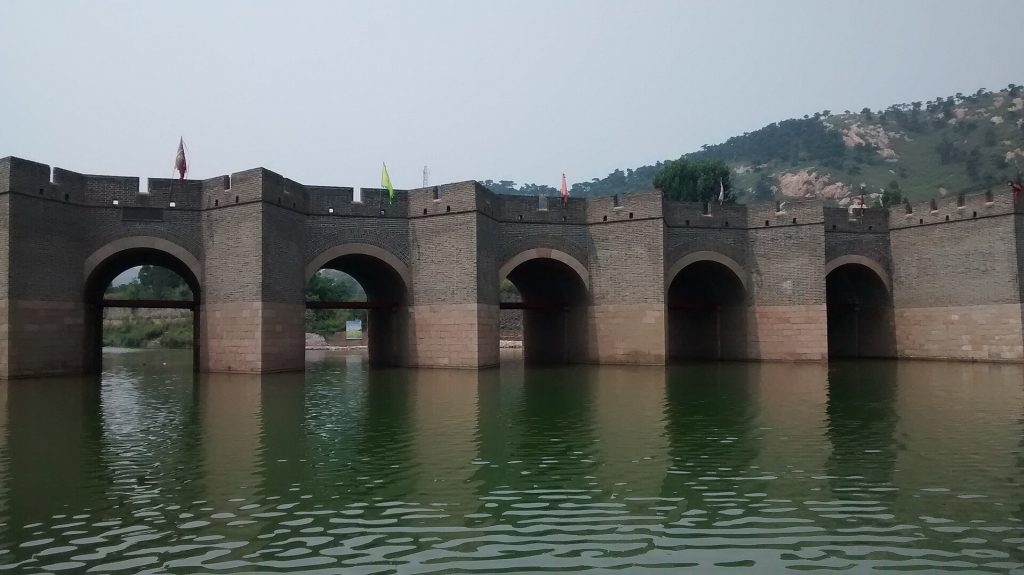
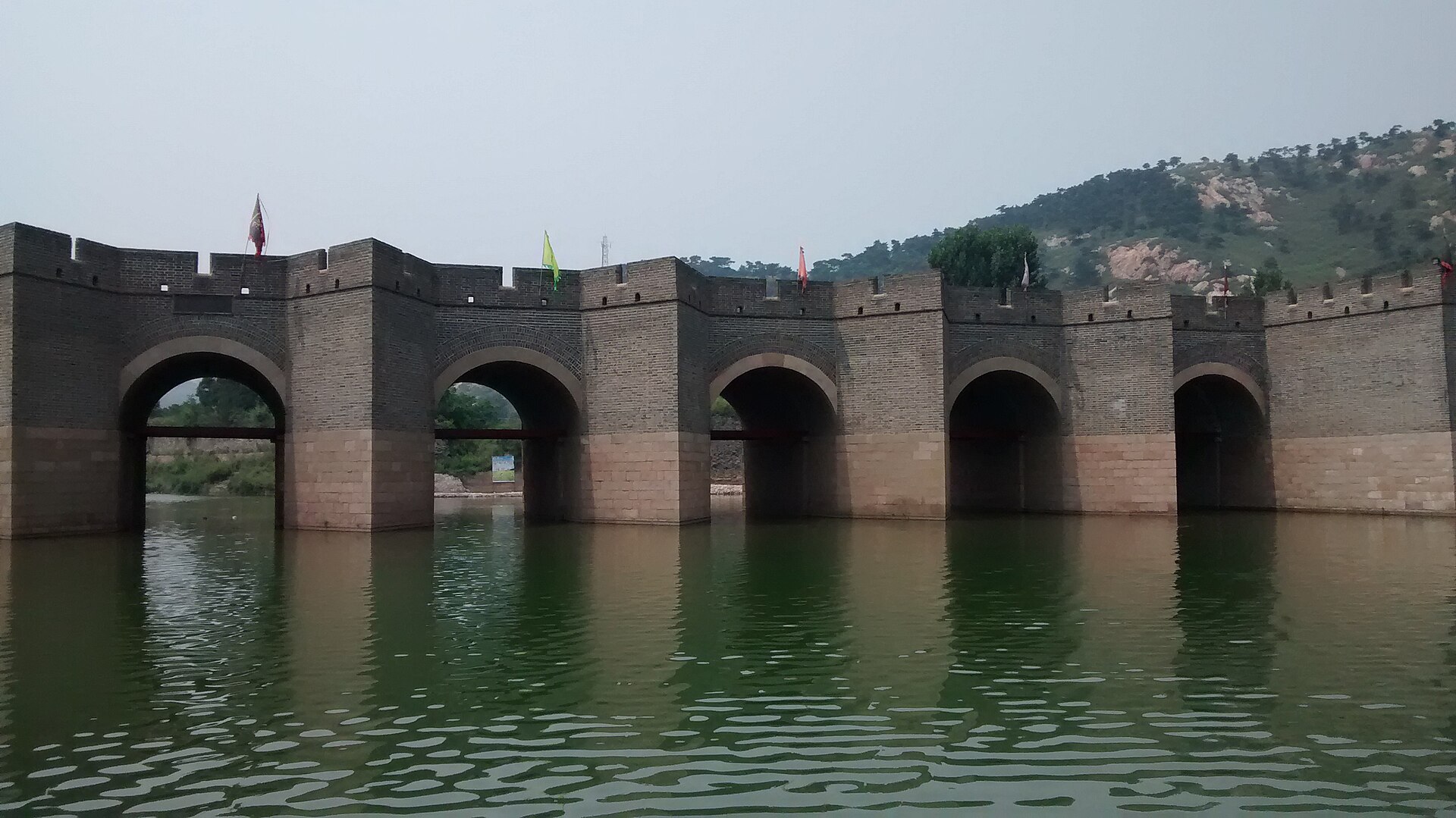
The minivan’s tires crunch over loose gravel as we turn off the main road near Suizhong County, the white wall snaking along the ridge ahead disappearing into a stand of pine. Ahead, the Jiu River cuts a brown slash through the valley floor, and the Wall doesn’t just cross it — it sits on top of it, nine arched gates letting the current rush through. My driver kills the engine. Steam rises from the hood in the cool autumn air. No ticket booth in sight yet, just an elderly woman selling roasted sweet potatoes from a bamboo basket beside a faded UNESCO plaque.
Getting There Without a Tour Bus
Most people reach Jiumenkou as a side trip from Shanhaiguan, about thirty kilometers south. The high-speed train drops you at Shanhaiguan Station by mid-morning if you catch the early bullet from Beijing or Shenyang. From the station forecourt, ignore the touts offering “private car, very cheap.” Walk two blocks west to the official taxi queue. A metered ride to the scenic area runs roughly forty to fifty yuan one way, twenty minutes if traffic moves. Agree on a return pickup time before the driver pulls away — cell service gets spotty near the river.
If you’re driving yourself, take the G1 Jingha Expressway to the Suizhong exit, then follow S214 north. Signage switches to brown tourist markers about five kilometers out. The parking lot sits at the base of the western hill; a shuttle bus (ten yuan) ferries visitors to the main gate, but the walk is only fifteen minutes on a paved path beside the river. I walked it both times. The sound of water through the arches grows louder with each step.
Walking the River Gates
The nine arches — jiu men — are the reason you came. Each span is about six meters wide, faced with dressed stone that has darkened to the color of old tea. Water shoots through fast, even in the dry season, churning white around the piers. The Ming builders laid the foundation directly on bedrock in the riverbed, then stacked the superstructure on top. You can still see the drainage holes at the base of each pier, clogged now with silt and plastic bottles.
Start at the western end. The restored watchtower there has a steep internal staircase — wooden treads, iron handrail — leading to a platform where a signal cannon once sat. The view downstream shows the Wall marching up the opposite slope, watchtowers punctuating the ridge every few hundred meters. Upstream, the river bends away toward the mountains. Spend twenty minutes on that platform. Watch a kingfisher dive. Listen to the water echo inside the stone ribs.
Climbing the Flanks
Two routes fan out from the river section. The eastern spur climbs toward Xiaohekou, wild and unreconstructed. Loose bricks shift underfoot. Thorn bushes grab at sleeves. No guardrails. I turned back at the third tower when fog rolled in — navigation becomes guesswork fast. The western spur toward Sandaogou is the one most visitors take. Restored in the early 2000s, it has even steps, merlons rebuilt to chest height, and a ticket checkpoint at the second tower. Allow ninety minutes round trip if you go to the fourth tower and back. The gradient is steady but not brutal; a fit sixty-year-old passed me on the descent.
- Wear trail shoes with grip. The restored bricks are polished smooth by thousands of soles.
- Carry a liter of water. No vendors on the wall itself.
- Bring a wind layer. The river gorge funnels cold air even in late spring.
- Toilets only at the main gate and the parking lot.
Eating in the Village
Just outside the main gate, a row of farmhouse restaurants lines the access road. Menus are handwritten on red paper taped to the window. Order the stewed river fish — carp from the Jiu, slow-braised with ginger, scallion, and a splash of dark vinegar until the bones soften. Served in a clay pot, skin side up, the meat falls off in flakes. Pair it with cornmeal steamed buns (wowo tou) and a plate of cold fiddlehead ferns tossed in garlic and chili oil. The ferns are foraged on the hills you just climbed.
Don’t expect English menus. Point at what the table next to you is eating. The proprietor will bring a bowl of millet porridge on the house if you linger over tea. Payment is cash only; WeChat Pay works but the QR code is often smudged by steam.
Timing and Seasons
Late autumn — after the National Day holiday, before the first hard freeze — is ideal. The crowds thin to a trickle. Maples on the ridges turn the color of brick dust. Morning mist clings to the river until nine or ten, then burns off to sharp blue. Spring brings wild apricot blossoms in the valley, but also weekend tour groups from Dalian and Jinzhou. Summer is hot, humid, and thick with mosquitoes breeding in the slow pools below the arches. Winter closes the upper spurs when ice coats the steps; the river gates stay open but the wind off the water cuts through a down jacket.
Arrive at the gate by nine. The ticket office opens at eight-thirty, but the shuttle doesn’t start until nine. If you walk in, you beat the first busload. Buy the combined ticket (wall + small museum near the gate) — the museum holds a few Ming-era arrowheads and a scale model showing how the water gates functioned. Takes twenty minutes.
What Locals Know
The old woman selling sweet potatoes? Her grandson works the ticket scanner. Ask her which tower has the best sunset — she’ll point to the third on the western spur, where the ridge flattens into a natural platform. She’ll also warn you about the “shortcut” trail some hikers try to take down the eastern face. It ends in a cliff band. Two years ago a group from Beijing spent the night there before mountain rescue reached them.
If you have an extra hour, walk the riverbank path downstream five hundred meters. A stone footbridge crosses to a small temple dedicated to the River God. Incense burns year-round. Fishermen cast nets from the bank at dusk. No tourists. Just the sound of water through nine stone throats, same as it was when the Ming generals stood here watching the Manchu banners approach across the ford.