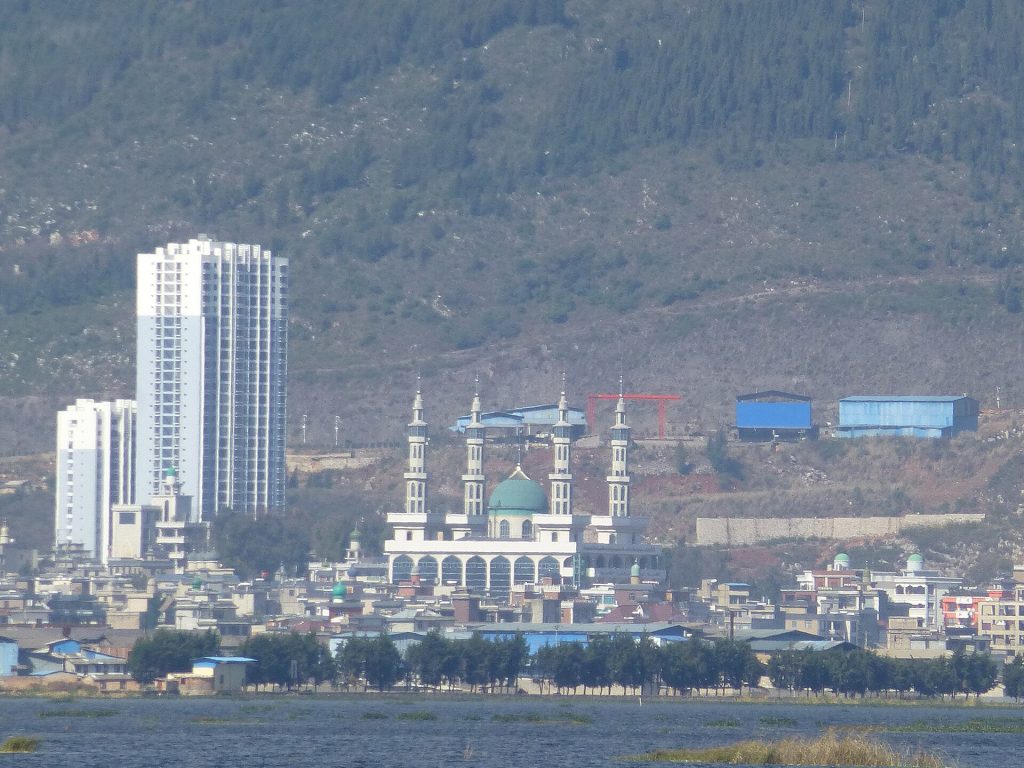
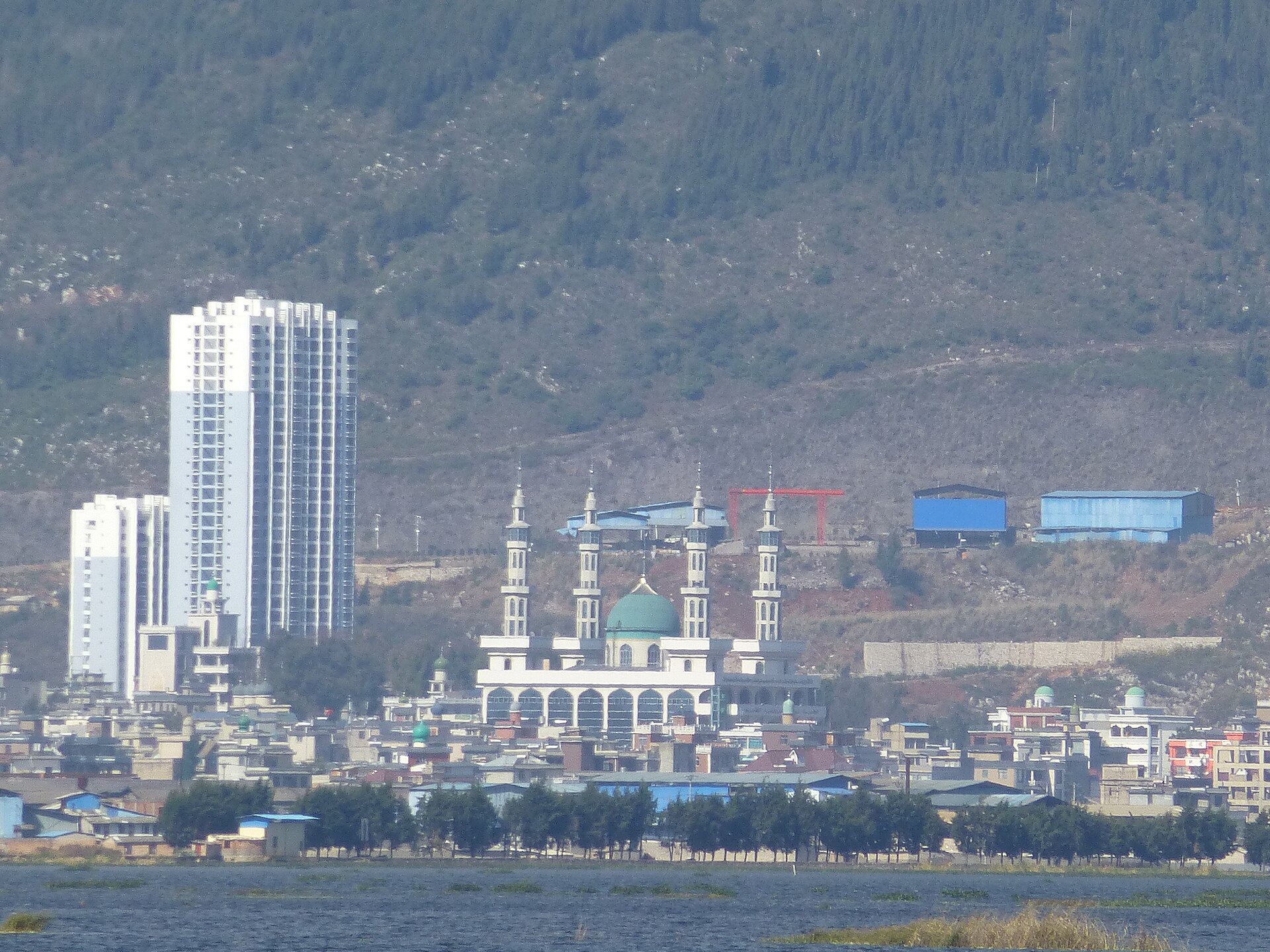
The minaret of the Great Mosque catches the first light before the roosters in the courtyard start up. Down by the lake dike, an old man in a Mao suit casts a hand line into water so still it reflects the western hills like a mirror. I am standing on the same stretch of concrete promenade where, twenty minutes ago, a convoy of electric three‑wheelers rattled past loaded with crates of bitter greens bound for the morning market. Tonghai does not announce itself. It simply exists in the fold between the water and the mountains, waiting for anyone willing to slow down.
Getting oriented in the valley
Tonghai sits in a basin fed by Qilu Lake, ringed by ridges that cut it off from the next county in every direction. The administrative center, Xiushan Subdistrict, clings to the southern edge of the plain, a mile of vegetable fields separating the bus station from the shoreline. Most visitors arrive on a bus from Yuxi or Kunming and step out onto a grid of narrow lanes where Hui bakeries, Mongol tea stalls, and Han noodle shops share the same block. There is no tourist office, no glossy map. The best orientation is a walk south from the station toward the lake: when the road ends at the dike, you have found the spine of the town.
Walking the dike and the lake villages
The southern dike doubles as a promenade. Elderly couples practice tai chi beside teenagers on shared bicycles; fishermen mend nets in the shade of willow trees planted decades ago for erosion control. Concrete ramps every few hundred meters drop down to tiny harbors where wooden punts are moored. If you follow the dike west past the last ramp, the path narrows to a dirt track that skirts reed beds. In the winter months, when the water recedes, migrant gulls settle on the exposed mudflats and the air smells of wet loam and woodsmoke.
Turn inland at any village gate and you enter a different rhythm. In the Hui settlements, the call to prayer echoes from white‑tiled minarets, and courtyards smell of cumin and lamb fat. In the Mongol hamlets higher up the slopes, yurts have given way to brick houses, but families still ferment mare’s milk in blue plastic barrels behind the kitchen. A polite nod and a few words of Mandarin — or the local dialect if you have picked any up — usually earn an invitation to sit on a stool and share a bowl of salted tea.
Xiushan Hill: temples, views, and a quiet climb
Rising directly behind the county seat, Xiushan Hill is less a mountain than a wooded knoll draped in cypress and camellia. A stone stairway climbs past a Confucian shrine, a Guanyin pavilion, and a cluster of Daoist altars where incense coils hang from the eaves year‑round. The ascent takes twenty minutes at a steady pace. At the summit, a flat terrace opens onto the whole valley: the lake a sheet of jade, the patchwork of rice paddies, the grid of the town, and beyond them the blue ridges that mark the border with Eshan. I have sat there through a sudden summer shower, watching the rain march across the water in dark bands while the temple bells drowned the thunder.
Bring water. There are no vendors on the hill after the small kiosk halfway up, which closes by mid‑afternoon. Wear shoes with grip; the moss on the upper steps turns slick after rain.
Market days and the rhythm of trade
Every fifth day — the lunar calendar governs the cycle, not the Gregorian one — the main square near the bus station swells into a market that spills into side alleys. Hui butchers hang whole carcasses from hooks; Mongol women stack dried cheese curds in bamboo baskets; Han farmers unload sacks of pink‑skinned garlic and bundles of firewood. The noise is a chorus of bargaining in three languages. This is the moment to buy a handful of fresh walnuts, a block of fermented bean curd wrapped in lotus leaf, or a straw hat woven from lake reeds. Arrive early, before the sun climbs the ridge, or the best produce vanishes into restaurant kitchens.
Eating in Tonghai: what lands on the table
The valley’s cuisine is a conversation between the lake, the pasture, and the paddy. Dishes arrive family‑style on lazy Susans in the larger restaurants, or in steel bowls at street stalls. Flavors run salty, sour, and mildly spicy — chili is present but never dominant.
- Qilu Lake fish stew — whole carp or crucian carp simmered with pickled mustard greens, ginger, garlic, and a splash of rice wine. The broth turns milky; the flesh falls off the bone.
- Hui hand‑pulled lamb noodles — broad wheat ribbons in a clear broth scented with star anise, coriander root, and rendered tail fat. Served with a side of raw chili paste and vinegar for adjusting.
- Mongol milk tea — brick tea boiled with salt, then churned with fresh milk and a spoonful of roasted barley flour. Thick, savory, warming.
- Fermented bean curd (doufu ru) — cubes aged in rice wine, chili powder, and Sichuan pepper. Eaten in tiny bites atop plain congee.
- Stir‑fried bitter greens — wild amaranth or mustard shoots flash‑fried with garlic, dried chili, and a pinch of sugar to balance the bite.
Home‑style method for the fish stew
Ordering in a restaurant: point to the tank of live fish and say “qing chao yu” (clean‑steamed fish) if you want a lighter preparation, or “suan cai yu” for the pickled‑greens stew. For noodles, ask for “da mian” (big noodles) and specify “bu yao la” if you cannot handle chili. Most menus have no English; a photo on your phone of the dish you want works better than translation apps.
Beginner mistakes: ordering only one dish for a table — portions are sized for sharing. Drinking the milk tea cold; it is meant to be sipped steaming. Refusing the bowl of chili paste on the side — locals judge the kitchen by how well you customize your own bowl.
Sleeping, moving, and practical knots
Accommodation clusters around the bus station and the lake dike. Family‑run guesthouses (often called “jiudian” but really two‑story courtyard homes) charge roughly the price of a bowl of noodles per night per bed. Hot water is solar‑heated; ask when the tank is full — usually late afternoon. A handful of newer hotels near the government compound have elevators and reliable Wi‑Fi, but they feel generic.
Local transport is a fleet of blue three‑wheel electric cabs. Flag one by waving a hand flat, palm down. A ride across town costs a few yuan; negotiate before you sit if the meter is “broken.” Bicycles can be rented from a shop beside the dike entrance — bring your passport as deposit. The lake loop is thirty kilometers of flat road, doable in a long morning if you start at dawn.
Cash is still king in the market and at street stalls. Mobile pay works in supermarkets and chain pharmacies. The nearest full‑service hospital is in Yuxi, forty minutes by car; the county clinic on Renmin Road handles minor cuts, stomach upsets, and altitude headaches (the valley floor sits around 1,700 meters).
What newcomers get wrong
They treat Tonghai as a day trip from Kunming, rushing the dike, the hill, and a lunch before the return bus. The valley reveals itself in the pauses: the way the light changes on the water at the hour of the goat (1–3 pm), the scent of roasting barley that drifts from a Mongol courtyard at dusk, the old imam who sweeps the mosque steps and nods at every passerby regardless of faith. They also assume the Hui and Mongol communities are tourist attractions. They are neighbors. Ask before you photograph a prayer hall; accept tea if it is offered; do not step on the threshold of a home. The respect you show is the only guidebook entry that matters.
When the last bus pulls away and the dike lights flicker on, the lake swallows the reflection of the hills whole. I finish my bowl of noodles, wipe the chili oil from my fingers, and walk back toward the guesthouse through lanes that smell of woodsmoke and damp earth. Tonghai does not need you to understand it. It only asks that you stay long enough to listen.