The minivan rattled down a narrow lane bordered by persimmon trees, their orange fruit heavy against the gray sky of late autumn. We had just left the Yinan County bus station, and the driver — a man with a cigarette tucked behind his ear — asked which “Tongjing” I wanted. Right. There is another Tongjing near Nanjing. This one, in the Linyi prefecture, spreads its attractions across a handful of villages rather than clustering them in a single scenic gate. I showed him a screenshot of 朱泉村 on my phone. He nodded, shifted gears, and we turned toward the spring-fed lanes of Zhuquan.
Getting oriented across scattered villages
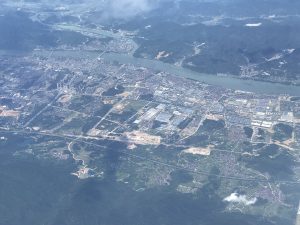
Tongjing Town (铜井镇) sits in the southern reaches of Yinan County. The administrative center is a modest grid of concrete shops and noodle stalls, but the reasons travelers come — Zhuquan Village, Hongshizhai reservoir resort, and the orchards of Maquan — lie kilometers apart in different directions. Treat them as separate day trips or book a car for the full loop. Public buses run from the county seat to the town center, but village-to-village hops require a hired driver, a shared van, or a sturdy pair of legs and plenty of time. When you message a driver or plug a destination into a ride app, always use the Chinese name: 朱泉村 for the historic spring village, 红石寨 for the lakeside cliffs, 马泉 for the fruit valleys. English spellings will send you to the wrong county.
Zhuquan Village: walking the spring lanes
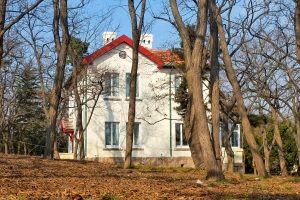
Zhuquan (朱泉村) grew around a cluster of artesian springs that push up through limestone, feeding stone troughs, lotus ponds, and narrow canals that thread between courtyards. The village was renamed during the Qing dynasty — formerly Quanshangzhuang — and the current layout dates largely from a restoration that finished around 2009, when residents moved into new housing nearby and the old lanes opened to visitors. You enter through a ticket gate, but inside there are no turnstiles at every alley. Stone paths wind past bamboo groves, weathered wooden doors, and wells where elderly women still rinse vegetables in water that never freezes.
Allow two to three hours. Start at the main spring pool where a small pavilion shelters a stele describing the hydrology. Follow the canal westward past the former ancestral hall, now a display of farming tools, then loop back via the lane lined with persimmon trees. In the tenth lunar month the fruit turns the branches into lanterns. Photographers arrive at dawn for mist rising off the water; by mid-morning tour groups from Linyi fill the central courtyard. If you want quiet, be on the path before 8 a.m. or linger after the last shuttle leaves.
Hongshizhai: cliffs, reservoir, and a cable car
Twenty minutes by car northeast of Zhuquan, Hongshizhai (红石寨) sits where a dam backs up the Yi River into a long, fingered reservoir. Red sandstone cliffs — the “red stones” of the name — drop vertically into the water. A plank road clings to the rock face, and a cable car hauls visitors to a viewing platform atop the ridge. The resort side has speedboats, a lakeside boardwalk, and a cluster of restaurants serving reservoir fish. The scenic area side keeps the hiking trails and a glass-floor observation deck that juts over the drop.
Come in the third lunar month when peach blossoms fringe the shore, or in the ninth when maples on the cliffs turn crimson. Summer weekends bring crowds from Linyi and Rizhao; the boat queue can stretch an hour. If you hike the ridge trail, wear shoes with grip — the sandstone dust turns slick after rain. The cable car runs roughly 8:30 a.m. to 5 p.m., but the last car down often leaves earlier if wind picks up. Buy a round-trip ticket unless you are prepared for a steep, exposed descent on foot.
Maquan orchards: picking fruit in the valleys
Maquan (马泉) spreads across shallow valleys southwest of the town center. The roads here are narrower, winding past terraced plots of apple, pear, and hawthorn trees. Most orchards operate as pick-your-own farms from the seventh lunar month through the first month of the following year. You pay an entry fee — usually a flat rate per person — then weigh and pay for what you harvest. Farmers set up simple shade tents with plastic tables where you can wash fruit, drink tea, and eat a bowl of hand-pulled noodles they cook over a gas burner.
Call ahead through your guesthouse host or a local contact. The best orchards don’t advertise online; they rely on repeat visitors and word of mouth. Ask for “老树苹果” — old-tree apples — which are smaller, knobbier, and far sweeter than the commercial varieties. Bring cash. Many older growers don’t use mobile payment. Wear long sleeves; the branches scratch, and the morning dew soaks through light fabric by 9 a.m.
Moving between sites: transport that works
Do not expect a tourist shuttle linking the three main spots. The most reliable method is hiring a driver for the day. Negotiate in the town center or ask your Zhuquan guesthouse owner to arrange one; they usually know a cousin or neighbor with a seven-seat van. A full circuit — town to Zhuquan, Zhuquan to Hongshizhai, Hongshizhai to Maquan, return to town — takes about five hours of driving and waiting, plus whatever time you spend at each stop. Agree on a price before you roll; a typical day runs a few hundred yuan, higher on holidays.
If you are traveling solo or as a pair, shared vans (面包车) wait near the Zhuquan ticket gate and the Hongshizhai parking lot. They leave when full, usually six to eight passengers. Flag one down, confirm the destination village name, and hand the driver ten or twenty yuan. No schedule exists. In the off-season you may wait thirty minutes. Bring water and a paper map or offline GPS; cell signal drops in the valleys around Maquan.
Where to sleep and eat
Zhuquan has the most developed lodging: a dozen courtyard guesthouses converted from the old residential lanes. Rooms are simple — brick beds with heated kang in winter, shared bathrooms in the cheaper ones, private in the pricier. Book through a Chinese platform or call the owner directly; English-language sites rarely list them. Meals come family-style: braised pork belly with chestnuts, stir-fried wild greens gathered from the hills, cornmeal steamed buns, and a light soup of tofu and spring water. Tell the host your dietary limits the night before; they shop at the morning market.
Hongshizhai offers lakeside hotels and a few homestays in the village behind the dam. Rooms face the water or the cliffs. Dinner here leans toward reservoir fish — steamed with ginger and scallion, or braised in brown sauce — plus cold cucumber salad smashed with garlic. Maquan has almost no formal lodging. Most visitors stay in Zhuquan or the town center and drive out for the day. If you want to sleep among the orchards, ask a farmer if they rent a spare room; some do, but expect a squat toilet and a rooster at 4:30 a.m.
Seasonal rhythm and common missteps
- Spring (second to third lunar month): peach blossoms at Hongshizhai, wild greens on Zhuquan menus. Rain makes stone paths slick; pack a light rain shell.
- Summer (fourth to sixth lunar month): hot, humid, mosquitoes at the reservoir. Boat queues peak. Start early, carry electrolyte drinks.
- Autumn (seventh to ninth lunar month): apple and hawthorn harvest in Maquan, maple color on Hongshizhai cliffs. Best overall window. Book guesthouses two weeks ahead.
- Winter (tenth to first lunar month): persimmons freeze-dry on Zhuquan trees, kang beds are warm, crowds vanish. Some orchards close; confirm before driving to Maquan.
Mistakes I have watched newcomers make: treating Tongjing as a single stop and budgeting two hours total; relying on a taxi app that cannot find village lanes; arriving at Hongshizhai at noon on a Saturday in the eighth lunar month and discovering the cable car line snakes for ninety minutes; paying for fruit in Maquan with a large bill and receiving no change because the farmer keeps no float. Learn the Chinese names, carry small bills, and build slack into the schedule. The springs, cliffs, and orchards will still be there when you arrive.