The minibus shudders to a halt on a gravel shoulder where the asphalt gives way to a fence line strung with razor wire. Ahead, the Tumen River slides slow and brown toward the Sea of Japan, no wider than a city canal. On the far bank, a single guard tower watches a dirt road that disappears into pine forest — no traffic, no lights, just the occasional figure leading a bicycle. A uniformed officer steps out of a booth, gestures to my passport, and taps his phone screen. The translation app crackles: “Purpose of visit?” I show the screenshot of my hotel booking. He nods, snaps a photo of the data page, and waves me toward the viewing platform. Five minutes later I am standing on a metal railing, looking across water that separates two worlds that share a language and a surname.
Getting There and the First Checkpoint
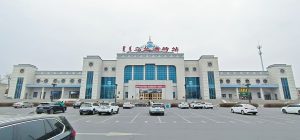
Trains from Yanji pull into Tumen station in forty minutes, rattling past cornfields and coal yards. The station square smells of grilled squid and diesel. Taxis cluster at the exit, but drivers shake their heads when you say “border” — they know the road ends at a police gate. The reliable way is the green minibus marked “Border Tourism” that departs from the lot beside the station every half hour. Fare is a few yuan. The driver hands you a paper wristband; keep it on. At the first checkpoint, an officer boards, collects every passport, and returns them after a minute. If your face does not read “local,” he will ask where you sleep and why you came. Have a screenshot of your reservation and a one-line answer in Chinese: “看边境” (look at the border). That phrase satisfies ninety percent of the questions.
- Train: Yanji → Tumen, 40 min, hard seat ¥15.
- Minibus: Station lot → Border Gate, ¥5, wristband required.
- Documents: Passport, Chinese visa, hotel screenshot, offline translation app.
The Viewing Platform and the River Walk
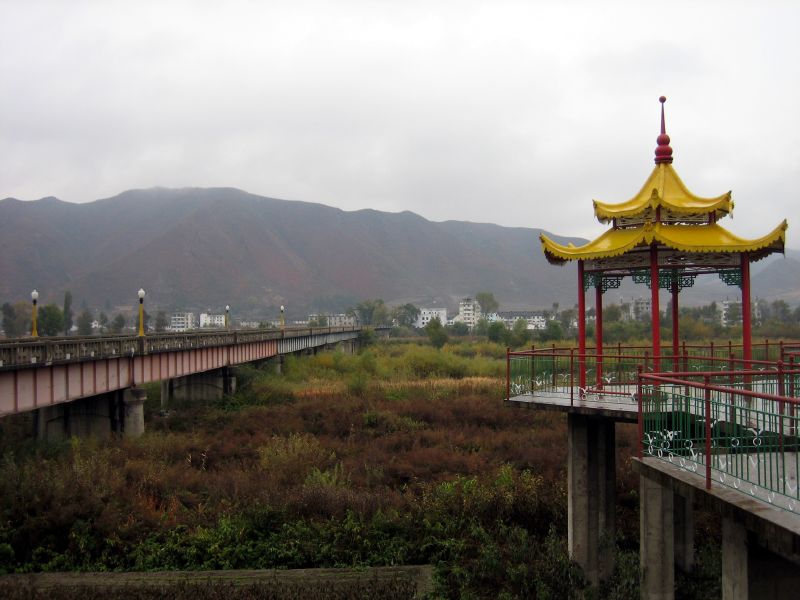
Past the gate, a paved path follows the river for two kilometers. Willow catkins drift in spring; in autumn the poplars turn the color of baijiu. The platform is a steel deck bolted to the bank, roofed with blue tin. Binoculars on coin-operated stands cost two yuan for thirty seconds — bring your own if you want a longer look. Through the glass you see North Korean farmers bending over rice paddies, their movements mirrored by Chinese farmers on this side. A loudspeaker on the far bank occasionally broadcasts a marching song; the sound carries flat across the water. No photos of the guard towers, no photos of the soldiers. Signs in red Chinese characters and Korean script remind you. The officers patrol in pairs, polite but firm. If you linger too long at one spot, one will tap your shoulder and point downstream. Keep moving.
Wonjong Border Market: The Only Place to Trade
Three kilometers upstream, the Wonjong Bridge spans the river — a steel arch painted faded blue. The Chinese side hosts a market that opens at dawn and folds up by early afternoon. Stalls sell dried pollack, pine mushrooms, ginseng roots wrapped in newspaper, and stacks of North Korean cigarettes in plain green packs. Vendors speak a Yanbian dialect laced with Korean; they calculate in yuan but quote “friend prices” in won if you show a North Korean coin. I bought a jar of wild honey — dark, resinous, with a spoon stuck in the lid — for fifty yuan. The vendor sealed it with tape and wrote “蜂蜜” on the lid in marker. Customs at the train station later waved it through without opening. Do not bring meat, fresh fruit, or anything with a political slogan. The x-ray belt at the station catches it every time.
- Market hours: Dawn to 14:00, busiest mid-morning.
- Cash only: Small yuan notes, a few North Korean won for novelty.
- Safe buys: Dried fish, mushrooms, honey, packaged tea, cigarettes.
- Prohibited: Fresh produce, meat, propaganda material, electronics.
Evening in Tumen: Noodles, Soju, and the Train Station Square
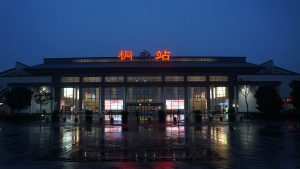
After the border closes, the town exhales. Neon signs flicker above restaurants serving Yanbian cold noodles — buckwheat strands in icy beef broth, topped with julienned cucumber, pear, and a boiled egg half. You snip the noodles with scissors at the table, splash vinegar and mustard oil, and slurp until the bowl rings. A bottle of Jinro soju costs twenty yuan at the corner store; locals pour it into metal cups and clink them with a two-handed grip. The station square fills with dancers: retirees in tracksuits moving to accordion versions of revolutionary songs, then switching to K-pop beats from a Bluetooth speaker. Join the circle if you like; they will hand you a fan and teach the steps. No one asks for ID here. The police presence melts into the background, replaced by the smell of cumin lamb skewers from a grill cart.
- Signature dish: Yanbian cold noodles (延边冷面) — buckwheat, beef broth, pear, cucumber, egg.
- Drink: Jinro soju or local corn liquor (高粱酒), served chilled in metal cups.
- Night activity: Square dancing at the train station plaza, starts after sunset.
- Late snack: Cumin lamb skewers (羊肉串) from the cart near the taxi stand.
What Newcomers Get Wrong
First mistake: assuming the border is a tourist attraction with opening hours. It is a military zone. The viewing platform may close without notice if tensions rise or if a VIP convoy passes. Second: relying on mobile data. The signal drops to a single bar at the river; offline maps and translation packs are essential. Third: photographing the wrong things. A soldier’s face, a guard tower close-up, the checkpoint booth — each earns a deletion order and a lecture. Fourth: skipping the market because “it’s just souvenirs.” The honey, the mushrooms, the dried pollack are better than anything in Yanji’s department stores. Fifth: expecting English. Even hotel receptionists switch to Korean or Mandarin. Learn to read “入境” (entry), “出境” (exit), “禁止拍照” (no photos), and “证件” (documents). Those four signs appear on every gate, every fence, every officer’s badge.
Seasonal Rhythms and the Lunar Calendar
Spring arrives late. In the third lunar month the river still carries ice floes; the market sells the year’s first pine mushrooms at triple the autumn price. Summer brings monsoon mist that hides the far bank — officers may restrict access to the platform for days. Autumn is the sweet spot: clear skies, golden poplars, and the Chuseok holiday when Korean-Chinese families picnic on the bank, sharing songpyeon rice cakes shaped like half-moons. Winter locks the river solid. The viewing platform empties; the minibus runs on a reduced schedule. If you visit in the twelfth lunar month, you might catch the ice-fishing festival — holes drilled through forty centimeters of ice, steam rising from pots of spicy fish stew. The border does not change, but the light on the water does, and that is what you come to see.