The minivan shuddered to a halt on a hairpin bend halfway up Taimu Mountain, the driver killing the engine to point at a slab of granite the size of a bus balanced on a needle point of rock. Mist clung to the pines, swallowing the valley below. A thermos of white tea sat warming on the dashboard, its steam mixing with the scent of wet stone and camellia oil. This is the northern edge of Fujian, where the mountains tumble straight into the Taiwan Strait, and the pace is set by the harvest calendar, not the tour bus schedule.
Getting There and Moving Around
Fuding sits at the top of Fujian, bordering Zhejiang. The high-speed rail station, Fuding Station, is a clean, modern box about twenty minutes by taxi from the old town center. Trains run the coastal line from Fuzhou in under two hours and from Wenzhou in forty minutes. If you are coming from Xiamen, the ride stretches to three and a half hours, so an overnight train or a flight into Wenzhou Longwan followed by a cross-border car hire often makes more sense.
Once you are in the city, the public bus network connects the main county seat to the Taimu scenic area and the coastal town of Shacheng. Buses leave from the station forecourt when they are full, not on a printed timetable. For the tea villages scattered along the 104 National Road — places like Panshi and Guanyang — a hired driver for the day costs roughly the same as a round-trip taxi to the mountain gate. Many guesthouse owners in the tea zones will pick you up from the station if you message them the night before; they know the unmarked turnoffs that GPS misses.
Taimu Mountain: The Stone Forest in the Clouds
The mountain is the reason most outsiders arrive. It is a Taoist sanctuary first, a scenic area second. The main gate opens at dawn, and the cable car begins running shortly after, but the real walking starts at the middle station. From there, a stone staircase climbs past the Heavenly Pool, a rectangle of black water reflecting the cliffs, toward the Five Old Men Peaks. The trail narrows to a single file along a ridge where iron chains are bolted into the rock. On a clear morning you can see the white caps of the strait; on a typical day you see only the gray vapor rolling over the rhododendrons.
Allow a full day if you want to reach the summit of Fuding Peak, the highest point. The descent via the Nine Dragon Waterfall path is steeper but quieter — fewer tour groups, more monkeys. Wear shoes with grip; the granite steps are polished smooth by decades of pilgrims’ feet. There are shrines tucked into caves where locals leave oranges and incense. Do not touch the offerings. Photography is allowed, but flash is frowned upon inside the older halls.
The White Tea Villages: Where the Harvest Sets the Rhythm
Fuding white tea — specifically Silver Needle and White Peony — grows on the slopes radiating out from the mountain. The picking window is tight: a few weeks in early spring, usually falling around the Qingming solar term. If you time your visit for that window, the villages smell of withering leaf. Families spread bamboo trays on rooftops and courtyards, turning the buds by hand. The air is sweet, grassy, slightly floral.
Most tea farmers welcome visitors who buy directly. A typical visit: you sit at a low table in a tiled courtyard house. The host rinses a gaiwan with boiling water, drops in a pinch of Silver Needle — fuzzy, silver-white buds standing upright — and flashes the first infusion out in three seconds. The liquor is pale apricot, clear as glass. It tastes of fresh hay, melon rind, and a lingering sweetness that coats the throat. White Peony, picked one bud and two leaves, gives a deeper body, a hint of dried jujube. Aged cakes, stored three years or more, turn medicinal, earthy, almost like a light pu-erh.
Do not expect a tasting menu with English labels. Point to the jar you want to try, nod, and sip. If you buy, they will wrap the tea in kraft paper and a bamboo basket. Prices vary wildly by grade and vintage; a modest cake of three-year White Peony for daily drinking is a safe starting point. Avoid vacuum-sealed bricks sold at highway rest stops — those are often blended with lower-grade leaf from neighboring counties.
Coastal Detour: Shacheng and the Mudflats
Thirty kilometers east of the county seat, the land flattens into tidal flats and fishing harbors. Shacheng is a working port, not a resort. At low tide the mud stretches to the horizon, dotted with bamboo stakes marking clam beds. Women in wide-brimmed hats dig for razor clams, their boots sucking at the sludge. The harbor market opens before sunrise. Styrofoam boxes hold swimming crabs, mantis shrimp, and the local specialty: sandworms, fat and pink, sold by the jin.
Find a stool at a streetside stall ordering “chao ha” — stir-fried clams with garlic, fermented bean paste, and a splash of rice wine. The shells pop open in the wok; you suck the meat out, chase it with a bowl of rice congee. There are no menus. Point at the tank, say “yi jin” (half a kilo), and watch the cook work. The bill is scribbled on a napkin. Cash only. After eating, walk the seawall toward the lighthouse. The wind off the strait cuts the humidity. You will see few other foreigners.
Where to Sleep: Guesthouses Over Hotels
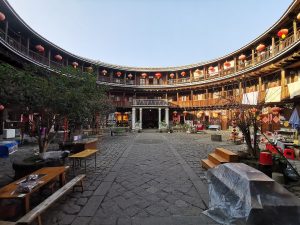
Chain hotels cluster near the high-speed rail station and the mountain tourist center. They are clean, impersonal, and often full during the spring tea festival. The better nights are spent in a family-run guesthouse in a tea village like Panshi or on the mountain’s lower slopes. These are usually converted farmhouses: tiled roofs, wooden beams, a courtyard with a persimmon tree. The host will likely be a tea farmer who rises at five to check the withering trays.
Book through WeChat — add the host’s QR code from a travel forum or a friend’s referral. Confirm the address in Chinese characters; the English map pins are often wrong. Ask if dinner is included. Most hosts will cook a home-style spread: steamed fish with ginger and scallion, stir-fried wild bamboo shoots, a pot of red-braised pork belly, and endless rounds of their own tea. You eat at a round table with the family. They will refill your bowl before it is empty. Refusing is polite once; accepting the second helping is expected.
Common Missteps
- Arriving during the May Day or National Day golden weeks. The mountain cable car queue stretches three hours; the tea villages are gridlocked. Aim for the weeks just before or after.
- Treating the tea ceremony as a performance. It is a transaction and a conversation. Drink what is poured, ask questions about the vintage, and buy something if you liked it. Walking away after three free cups without purchasing is noticed.
- Packing only light layers. The mountain summit runs ten degrees cooler than the coast, and the mist soaks through cotton in minutes. Bring a windproof shell and quick-dry trousers.
- Assuming English works outside the station. Download offline maps with Chinese labels, learn the characters for “tea” (茶), “mountain” (山), “station” (站), and “toilet” (厕所). A translation app with photo mode saves hours of charades.
- Skipping the local clinic for minor ailments. The county hospital in the city center has a foreign-friendly desk; village clinics stock herbal patches for sprained ankles from the mountain stairs. They are cheap, fast, and used by the guides themselves.
Seasonal Rhythms
Spring belongs to the tea. The hills turn neon green, the village lanes smell of drying leaf, and the price of a guesthouse doubles. Summer brings typhoons off the strait; the mountain trails close when the red flag flies. Autumn is quiet — persimmons orange on the trees, the harvest done, the tourists gone. Winter is cold and damp, not freezing, but the kind of chill that seeps into bones. The mountain temples burn thick incense for the Lunar New Year pilgrims. If you want solitude on the peaks, come in late autumn. If you want the tea at its freshest, come when the peach blossoms fall.