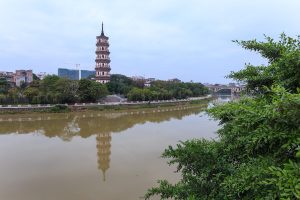
The minibus from Nanning’s Jiangnan station rattles past karst peaks that rise like broken teeth against the sky. Three hours later the road flattens, the Zuo River widens, and the driver pulls over beside a row of tiled shophouses where a vendor ladles steaming rice noodles into plastic bowls. This is Longzhou — no high‑speed rail, no airport terminal, just a sleepy border town where the past leans against every cracked wall.
Getting There and Moving Around
Most travelers arrive by long‑distance bus from Nanning’s Langdong or Jiangnan stations. The ride takes about three hours in dry season; monsoon rains can add an hour. Buses drop you at the small terminal on Jiefang Road, a five‑minute walk to the riverfront guesthouses. There is no taxi fleet — motorbike drivers cluster near the station, helmets dangling from handlebars. Agree on a price before you climb on; a ride across town costs roughly ten yuan. If you prefer your own wheels, rent a scooter from the shop beside the Friendship Bridge checkpoint. Bring your passport and a Chinese license or an international permit; the owner will photocopy both.
Where to Sleep
Accommodation clusters along the Zuo River embankment. The state‑run Longzhou Hotel on Renmin Road has clean rooms with air‑conditioning and a balcony that faces Vietnam’s mountains across the water. A few doors down, the family‑run Riverside Inn offers dorm beds and private doubles with shared bathrooms; the owner’s wife cooks a mean sour fish soup if you ask the night before. In the old quarter, two courtyard guesthouses occupy restored Qing‑era shophouses — wooden lattice windows, tiled courtyards, and a rooftop where you can watch the border lights flicker at dusk. Book by WeChat or call directly; online platforms rarely list these places.
What to See in a Day
Start at the former French consulate on Zhongshan Street. The two‑story brick building still bears the tricolor plaque above the door, though the interior now holds a modest exhibit of yellowed maps and black‑and‑white photos of the Sino‑French war. Walk north along the river to the “Little Great Wall,” a stone fortification that once blocked French gunboats. Moss covers the crenellations, and a narrow stair leads to a watchtower with a view of the Friendship Bridge and the Vietnamese town of Đồng Đăng across the water.
From there, duck into the alley behind the old customs house to find the modest courtyard where Deng Xiaoping stayed during the 1930 uprising. A single room displays a wooden desk, a cotton quilt, and a faded portrait. No English captions — just a handwritten Chinese placard. Ten minutes further west, the Ho Chi Minh residence sits shaded by a banyan tree. The structure is a simple stilt house with a bamboo floor; locals say the Vietnamese leader drank tea on the balcony while negotiating supply routes in the 1950s.
Finish at the Friendship Bridge checkpoint. Even if you don’t cross, the scene is worth an hour: traders pushing carts of mangoes, motorbikes loaded with plastic crates, customs officers waving green flags. Sit on the concrete parapet with a bottle of iced tea and watch the rhythm of a border that never fully sleeps.
Crossing Into Vietnam
The Friendship Bridge opens at 8 a.m. and closes at 6 p.m. daily, though hours shift during Tet and Chinese New Year. Chinese citizens use the dedicated lane with an ID card; foreign passport holders join the general queue. Have your visa printed — Vietnamese e‑visas work, but officers sometimes ask for the paper copy. On the Chinese side, fill out the departure card at the kiosk before the metal detector. On the Vietnamese side, the arrival hall is a single room with a currency changer offering poor rates; better to swap yuan for dong at the bank branch on Longzhou’s Renmin Road before you leave.
- Passport with valid Vietnamese visa
- Printed departure card (provided at Chinese exit hall)
- Cash yuan for last‑minute snacks or porter tips
- Light rain jacket — the bridge is exposed to sudden squalls
Food Stops Worth the Detour
Longzhou’s cuisine leans sour, spicy, and river‑fresh. Order a bowl of suān yú (sour fish) at the Riverside Inn: carp simmered with pickled bamboo shoots, wild tomatoes, and a handful of rice‑wine lees. The broth should be cloudy, tangy, and just salty enough to make you reach for a second spoonful. For breakfast, hunt down the stall near the bus terminal that serves mǐ fěn topped with minced pork, crushed peanuts, and a drizzle of chili oil — eat it standing, slurping fast before the noodles soften.
Vegetarians can ask for the tofu version — same broth, fried tofu triangles instead of fish. Avoid the “tourist set menu” advertised near the bridge; it’s usually reheated dishes from the morning market.
Local Rhythms and Unwritten Rules
Morning market on the riverbank starts before dawn. Vendors arrange live eels in blue basins, stack banana leaves, and shout prices in a mix of Zhuang and Southwestern Mandarin. If you want to photograph, ask first — a nod and a smile usually suffice. Evening brings square dancing on the plaza behind the county government building; join the back row if you know the steps, otherwise watch from the shadow of the banyan.
Border towns run on reciprocity. Shopkeepers remember faces. If you buy a bag of dried longan from the woman at the corner, she’ll slip an extra handful into your sack next time. Haggling is expected for souvenirs — start at half the quoted price — but never bargain over food at a family stall; it’s considered rude. And never point your chopsticks at the Friendship Bridge while eating; elders say it invites bad luck for the crossing.
Common Mistakes Newcomers Make
- Assuming the bridge is open 24 hours — it isn’t.
- Relying on ride‑hailing apps; no drivers operate here.
- Skipping cash — most guesthouses and market stalls don’t take mobile pay.
- Wearing sandals on the Little Great Wall stairs; the stone is slick with moss.
- Expecting English signage; bring a translation app with offline dictionaries.
Longzhou doesn’t perform for visitors. It simply exists — layered with consular ghosts, revolutionary whispers, and the daily clatter of trade across a narrow river. Stay two nights. Wake early, walk the embankment when mist clings to the water, and let the town reveal itself at its own pace.