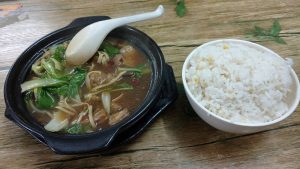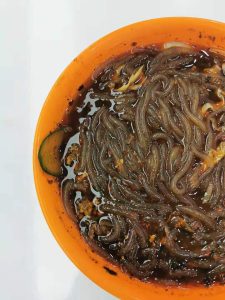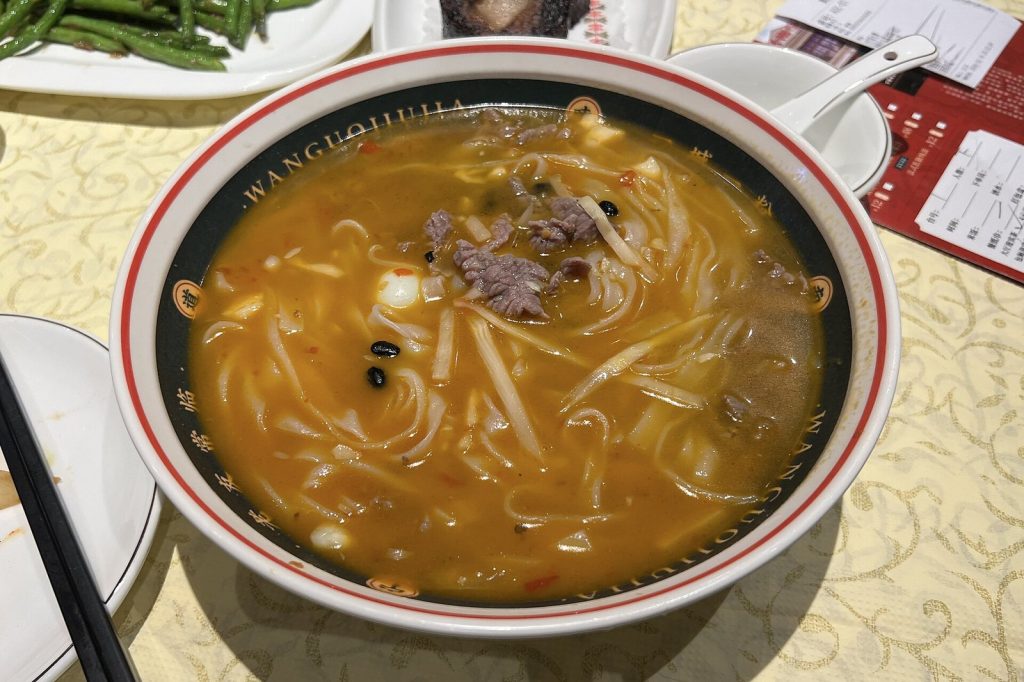
Guangxi is rice noodle country, and every city has its own bowl. Liuzhou has its pungent snail noodles, Guilin its marinated rice noodles. Nanning, the regional capital, has 老友粉 (lǎoyǒu fěn) — “old friend noodles”: a hot, sour, garlicky soup of rice noodles stir-fried together with sour bamboo shoots, fermented black beans and chili. It is the dish locals swear by when they have a cold, and the one they reach for at midnight.
If you are heading to Nanning in late October or November — a pleasant time, when the summer heat finally eases — this guide explains what laoyou noodles are, the story behind the name, how they are cooked, how to order, where to eat them and what to check for dietary needs.
What are laoyou noodles?
Laoyou noodles are a Nanning rice noodle (or wheat noodle) soup with a strong sour-spicy flavour. A Xinhua photo report from March 2024, photographed at a laoyou shop on Renmin West Road in Nanning, describes the basic method:
- Step 1: Heat a wok and add a little oil.
- Step 2: Stir-fry minced pork, chopped garlic, fermented black beans (豆豉 dòuchǐ) and shredded sour bamboo shoots (酸笋 suānsǔn).
- Step 3: Add cooking wine, soy sauce and vinegar and keep frying until fragrant.
- Step 4: Pour in stock and bring to the boil.
- Step 5: Add the rice noodles — or yi mein wheat noodles — and boil again.
- Step 6: Finish with chopped spring onion and ground pepper.
The result, as Xinhua puts it, is a bowl with soft noodles and a rich broth that is sour, spicy, savoury and fragrant. The key difference from most noodle soups is that the toppings are fried in the wok first and the noodles are cooked in that same flavoured broth, so every strand carries the garlic, bean and bamboo flavour.
You will see two names:
- 老友粉 (lǎoyǒu fěn): made with rice noodles.
- 老友面 (lǎoyǒu miàn): made with wheat noodles, often the springy fried yi mein (伊面).
Why “old friend”?
There are several versions of the story, and all are legends. Xinhua’s version: an old man visited the same Nanning teahouse every day. One day he stayed home with a cold. The teahouse owner fried garlic, fermented black beans, chili, sour bamboo shoots, minced pork and pepper, cooked a bowl of noodles and took it to his old friend. The man ate it, broke into a sweat and felt better — and the dish became “old friend noodles”.
China Youth Daily, in a 2025 feature on the city, tells a similar story of neighbours making a bowl for a sick friend, who cried out “old friend, come!” It adds that people in Nanning call male friends 友仔 (yǒuzǎi) and female friends 友女 (yǒunǚ), and that the city’s mayor has used the word 友 (“friend”) to sum up Nanning.
Because of that story, laoyou noodles are still seen as a warming, sweat-inducing bowl for chilly or damp days.
One of Guangxi’s “big three” rice noodles
A proposal to the Guangxi Political Consultative Conference, published on its website, describes laoyou noodles, Liuzhou luosifen and Guilin rice noodles as Guangxi’s “three great rice noodles”, and says laoyou noodles were created by local cooks more than seventy years ago. The dish has official heritage status: laoyou noodles were included in Nanning’s first batch of intangible cultural heritage items in 2007 and in Guangxi’s second regional list in 2008. In 2024 the Nanning government published 21 measures to support the laoyou noodle industry, including packaged products.
How do the three compare?
- **Liuzhou luosifen:** river snail broth, very pungent sour bamboo shoots, peanuts and fried tofu skin.
- **Guilin rice noodles:** round noodles with marinade (卤水), toppings and often little or no soup.
- Laoyou noodles: wok-fried garlic, black beans and sour bamboo shoots in a hot, sour, peppery soup. The bamboo-shoot aroma is there, but generally milder than in luosifen.
How to order
Laoyou shops in Nanning are usually small and fast. Order at the counter or scan the QR code on the table. Useful words:
- 老友粉 — laoyou rice noodles
- 老友面 — laoyou wheat noodles
- 猪肉 / 牛肉 / 猪杂 — pork / beef / pork offal topping (menus vary)
- 加蛋 — add an egg
- 少辣 / 不要辣 — less chili / no chili
- 少酸笋 / 不要酸笋 — fewer / no sour bamboo shoots
- 打包 — to take away
Some shops also offer a stir-fried, soupless version; ask 有炒的吗?(“Do you have a fried one?”). Prices vary by shop and topping; check the board and pay by Alipay or WeChat Pay.
What it tastes like
The first sip is hot and peppery, then sour from the vinegar and bamboo shoots, with a deep savoury note from the fermented black beans and garlic. The chili builds gradually. The rice noodles are soft and slippery; the wheat version is chewier. If you have tried and disliked luosifen’s smell, laoyou noodles are a gentler way into sour bamboo shoots — and you can always ask for fewer.
Where to eat laoyou noodles
- Nanning neighbourhood shops. The best bowls are usually in busy, unglamorous local shops. Search 老友粉 on a map app and pick a place with plenty of recent reviews.
- Food streets and night markets. Nanning’s late-night snack scene is a good place to try laoyou noodles alongside other Guangxi snacks. Check current opening times on map apps, as stalls change.
- Outside Nanning. Laoyou shops appear in other Chinese cities too, often under “Guangxi laoyou fen” signs, though the sour bamboo shoots are not always as good.
- Packaged versions. Supermarkets and online shops sell instant laoyou noodle kits — a souvenir option that travels better than fresh food.
Planning your trip? Start with our Nanning first-timer guide, add an autumn walk on Qingxiu Mountain, and see our Guangxi overview for the rest of the region. If you are travelling on to Yangshuo, try Guangxi beer fish too.
Dietary notes
- Pork: the classic version uses minced pork and often lard or pork stock. Beef versions exist, but that does not make them halal. See our halal food guide.
- Gluten: rice noodles themselves are wheat-free, but soy sauce usually contains wheat and 老友面 is a wheat noodle. Not reliable for coeliacs.
- Vegetarian: the broth is usually meat-based. Ask 有素的吗?(“Is there a vegetarian version?”), but expect few options.
- Spice and acidity: both adjustable; ask for less chili and fewer bamboo shoots if you have a sensitive stomach.
- Fermented foods: fermented black beans and sour bamboo shoots are central to the flavour.
- Alcohol: a splash of cooking wine is part of the classic method.
Common first-timer mistakes
- Expecting a mild, clear noodle soup. Laoyou noodles are punchy.
- Confusing laoyou noodles with luosifen. They share sour bamboo shoots, but laoyou has no snail broth.
- Ordering 老友面 when you wanted rice noodles — check the last character: 粉 is rice, 面 is wheat.
- Gulping the very hot broth too fast. It is meant to make you sweat, slowly.
FAQs
What does laoyou mean? 老友 means “old friend”. The name comes from a legend about a bowl of noodles cooked for a sick friend.
Are laoyou noodles spicy? Moderately, with a strong sour flavour. You can ask for less chili.
Do laoyou noodles smell like luosifen? They use sour bamboo shoots too, so there is a tangy smell, but most people find it milder than luosifen.
Are laoyou noodles gluten-free? The rice noodle version has no wheat noodles, but soy sauce is used, so it is not safe for coeliacs.
When is the best time to eat laoyou noodles? Any time — locals eat them from breakfast to late night — but they are especially welcome on cool or damp days.
Can I buy laoyou noodles to take home? Yes. Packaged kits are widely sold; check your home country’s food import rules first.
Before you go
Save 老友粉 and 少辣 on your phone, find a busy local shop, and order a steaming bowl. Hot, sour and full of garlic, laoyou noodles are the friendliest introduction to Nanning.
Sources
- Xinhua (xinhuanet.com), “广西南宁老友粉——舌尖上酸辣鲜香的非遗”, 21 March 2024 — legend and cooking method.
- Guangxi CPPCC website (gxzx.gov.cn), proposal on developing the Nanning laoyou noodle industry — “three great rice noodles”, history and heritage listings.
- China Youth Daily (cyol.com), “’老友’情牵话南宁”, 24 March 2025 — legend and local usage.
- Nanning Municipal Government, 2024 measures to promote the laoyou noodle industry (as reported by Tencent News, 1 April 2024).
Lovely China was founded in 2025 to publish practical English guides for travellers and expats in China. Questions or a broken link? Email [email protected].
Cover photo: N509FZ / Wikimedia Commons (CC BY-SA 4.0).