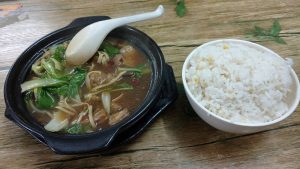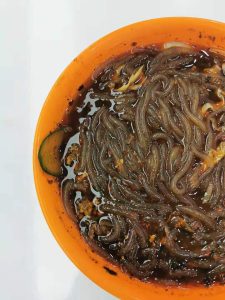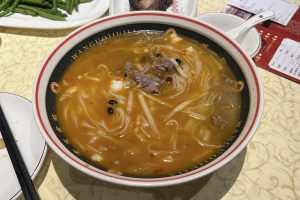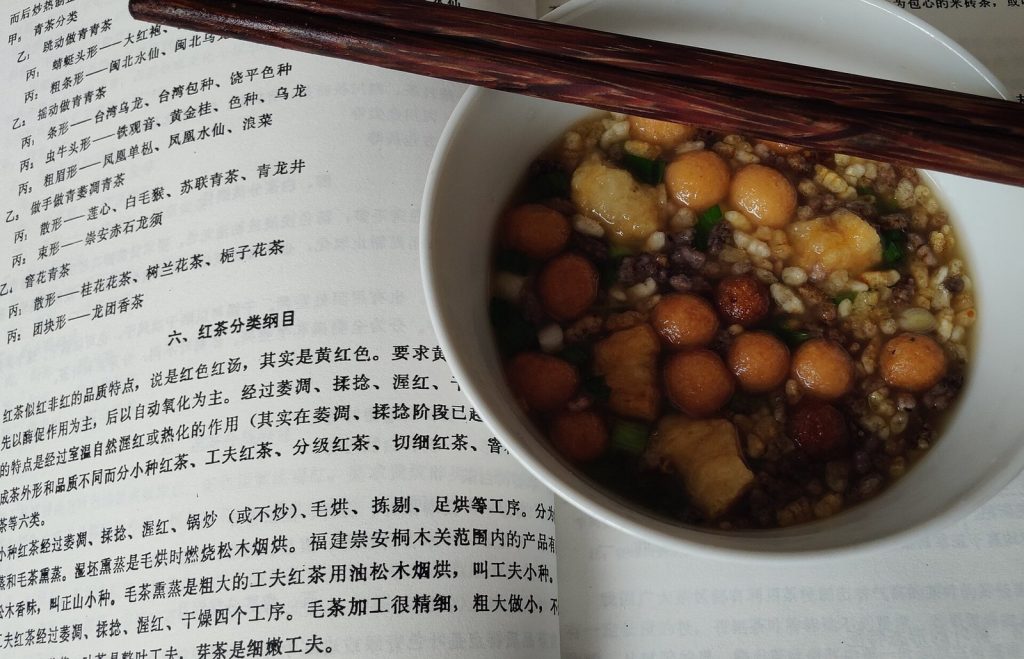
Ask for tea in Gongcheng, south-east of Guilin, and you may be handed something that looks more like soup: a bowl of murky green-brown liquid, sharp with ginger and garlic, salty rather than sweet, scattered with puffed rice, fried dough bits and peanuts. This is 油茶 (yóuchá), oil tea — breakfast, snack and social ritual for the Yao people of north-eastern Guangxi, and one of the most surprising things you can drink in China.
Late October and November, when the Li River mornings turn cool, are a good time to try it. This guide explains what Gongcheng oil tea is, how it is made, how to drink it, where to find it in and around Guilin, and what to check if you have dietary needs.
What is oil tea?
China’s national intangible cultural heritage website describes Yao oil tea as a drink made by putting tea leaves, ginger, garlic and other ingredients into an iron wok, pounding them repeatedly, then adding hot water and boiling — a process known as 打油茶 (dǎ yóuchá), “beating oil tea”. The heritage listing says the custom developed among the Yao people of the Nanling mountain corridor as a way of coping with a damp, humid mountain climate.
The Guangxi regional government’s heritage page on Gongcheng oil tea gives more detail:
- The tea leaves are picked around the Qingming and Guyu periods in spring.
- They are soaked briefly in boiled water to reduce smokiness and bitterness.
- A little lard is heated in the tea wok, then ginger, garlic and the soaked leaves are briefly fried.
- Everything is pounded to a paste, water is added and boiled until it tastes strong, and salt is added.
- The tea is strained through a bamboo strainer into bowls and sprinkled with chopped spring onion and coriander.
- It is served with small dishes of puffed rice (米花), crunchy fried dough bits (脆果), fried peanuts, toasted rice and fried soybeans.
A 2024 Guangxi Daily report adds that the pounding is done with a mallet shaped like the number 7, and that oil tea is sometimes served with aiye ba, a mugwort rice cake.
The “oil” in the name can confuse visitors. 油茶 is also the Chinese name for Camellia oleifera, the tea-oil camellia, and some families fry the leaves in tea-seed oil. But the drink itself is not oily tea — it is a savoury, pounded tea broth.
Why Gongcheng?
Oil tea is drunk across Yao and other communities of northern Guangxi, but Gongcheng Yao Autonomous County is its best-known home. According to the national heritage listing, the county’s old name was 茶城, “Tea City”. It was founded in AD 618 and renamed Gongcheng in AD 621; the Yao autonomous county was set up in 1990.
The heritage status is substantial:
- 2008: Gongcheng oil tea making was added to Guangxi’s second regional intangible heritage list, according to the Guangxi government’s heritage page.
- 2021: “Tea customs (Yao oil tea customs)” was added to China’s fifth batch of national intangible cultural heritage, as an extension item from Gongcheng.
- 2022: Yao oil tea customs were included as part of “Traditional tea processing techniques and associated social practices in China”, inscribed on UNESCO’s Representative List of the Intangible Cultural Heritage of Humanity, as reported by the Guangxi Ethnic Affairs Commission.
The national listing says the custom is mainly found in Gongcheng and in Guanyang, Ziyuan and Longsheng counties, in Zhongshan and Fuchuan counties of Hezhou, and among Yao communities in Hunan and Guangdong. Similar oil teas are made by neighbouring peoples in northern Guangxi too — the cover photo is a bowl from Sanjiang.
“One cup bitter, two cups astringent”
Gongcheng has a saying about oil tea: 一杯苦、二杯呷、三杯四杯好油茶 — “the first cup is bitter, the second astringent, the third and fourth are good oil tea.” The Guangxi government page explains that after the first pot is drunk, water is added and the leaves boiled again, up to five or six times, with the flavour mellowing each round.
In other words, don’t judge oil tea on the first sip. Expect to be offered several bowls, especially in a home or a traditional shop. Guangxi Daily notes that oil tea has its own etiquette and is used to welcome honoured guests, and that it is jokingly called “Chinese coffee”.
What it tastes like
The first taste is bitter green tea, then a hit of ginger and garlic heat, then salt and a savoury, slightly smoky depth. The toppings change everything: puffed rice softens and goes sweet-crisp, peanuts add crunch, fried dough bits soak up the broth. It is warming, filling and, to most first-timers, very unexpected. Think of it as a tea-flavoured soup rather than a drink.
How to order and drink it
In Guilin and Gongcheng, oil tea shops (油茶店) often serve it as a set: a pot or bowls of tea plus small dishes of toppings and snacks. Useful words:
- 油茶 — oil tea
- 恭城油茶 — Gongcheng oil tea
- 打油茶 — making / “beating” oil tea (also used for an oil tea gathering)
- 米花 / 脆果 / 花生 — puffed rice / fried dough bits / peanuts
- 少放姜 — less ginger
- 不要猪油 — no lard
- 再来一碗 — one more bowl
How to drink: add toppings to your bowl a spoonful at a time, sip, and top up. Shops may offer snacks such as rice cakes or dumplings alongside. Prices and set sizes vary; check the menu. Pay with Alipay or WeChat Pay.
Where to try oil tea
- Guilin city. Oil tea shops are common in Guilin; a Gongcheng official quoted by Guangxi Daily in 2024 put the number of oil-tea-focused shops across Guilin at more than 1,800. Search 恭城油茶 or 油茶 on a map app near your hotel and look for places with many recent reviews. It makes a good breakfast before a Li River cruise or a change from a bowl of Guilin rice noodles.
- Gongcheng County. The source. It lies south-east of Guilin’s city centre; check road and bus options in a map app or with your hotel, and look for oil tea for breakfast in town.
- Longsheng and Sanjiang. Both are on the heritage map of oil tea customs or close to it, and both pair well with rice terraces and Dong villages. See our Longsheng guide and Sanjiang guide.
- Hezhou. Zhongshan and Fuchuan counties also appear on the listing; our Hezhou guide covers the area.
Want to compare with another unusual savoury tea? Try Tibetan yak butter tea. For the bigger picture, see our Chinese tea culture guide.
Dietary notes
- Lard: the traditional method described by the Guangxi government uses a little lard. Vegetarians, vegans and Muslim travellers should ask 用猪油吗?(“Do you use lard?”) and request 不要猪油.
- Caffeine: oil tea is made from real tea leaves and is strong, especially the first bowls.
- Garlic and ginger: both are central and fairly intense.
- Nuts and soy: peanuts and fried soybeans are standard toppings — important for anyone with allergies. Ask for toppings on the side.
- Gluten: fried dough bits and some snacks may contain wheat; puffed rice is rice-based.
- Salt: it is salty; go easy if you watch your sodium.
Common first-timer mistakes
- Expecting a sweet milky drink or a delicate green tea.
- Judging it on the first bowl. The saying promises it gets better.
- Dumping all the toppings in at once, so they go soggy.
- Forgetting allergy checks — peanuts are almost always involved.
FAQs
What is youcha? Oil tea: a savoury drink made by frying and pounding tea leaves with ginger and garlic, boiling them with water and serving with crunchy toppings.
Is oil tea made with oil? A little fat (lard or tea-seed oil) is used to fry the leaves, but the drink is a tea broth, not oil.
Is Gongcheng oil tea UNESCO-listed? Yao oil tea customs are part of the UNESCO-inscribed element “Traditional tea processing techniques and associated social practices in China” (2022).
Is oil tea vegetarian? Not always — lard is traditional. Ask for a version without it.
When do people drink oil tea? Traditionally every morning, and also for guests and gatherings.
Can I buy oil tea to take home? Packaged oil tea products are sold in Guilin; check your home country’s food import rules.
Before you go
Save 恭城油茶 and 不要猪油 on your phone, find a busy oil tea shop for breakfast, and give it at least three bowls. Bitter, salty and warming, Gongcheng oil tea is a taste of the Guangxi mountains you will not find anywhere else.
Sources
- China Intangible Cultural Heritage Network (ihchina.cn), “茶俗(瑶族油茶习俗)”, fifth national batch, 2021.
- Guangxi Zhuang Autonomous Region Government portal (gxzf.gov.cn), “油茶制作工艺(恭城油茶)”, 27 February 2024.
- Guangxi Ethnic Affairs Commission (mzw.gxzf.gov.cn), report on the 2022 UNESCO inscription.
- Guangxi Daily via CRI Guangxi (gx.cri.cn), “油茶,是生活也是文化”, 20 August 2024.
Lovely China was founded in 2025 to publish practical English guides for travellers and expats in China. Questions or a broken link? Email [email protected].
Cover photo (oil tea from Sanjiang, Guangxi): Klemhao / Wikimedia Commons (CC BY-SA 4.0).