Northern Chinese cities on a municipal heating network can feel indoors-warm in late December even when the street is harsh. Many southern and eastern cities do not work that way. Visitors who pack for the number on a weather app, then spend a week in Shanghai, Hangzhou, Nanjing, Chengdu, Chongqing, Guangzhou, or Shenzhen, are often surprised by damp indoor cold: a hotel room that needs the air-conditioner set to heat, a cafe where you keep your sweater on, a night’s sleep that wants an extra layer.
This is a visitor packing and indoor-comfort guide. It is not a repeat of northern China heating season for expats, which is written for expats around northern heating-season start dates. If you will live in a north-China apartment, read that piece as well. If you are only travelling for late December 2026 or New Year 2027, stay here.
The heating line is orientation, not a hotel promise
People often mention the Qinling–Huaihe line as a rough north–south divide for municipal radiator heating. It is a useful mental map. It is not a guarantee about your specific hotel, sleeper train, or Airbnb-style stay. Some southern buildings have modern central systems. Some northern rooms feel dry and overheated. Some guesthouses everywhere rely on a wall unit the host has to show you how to start.
Do not invent official start dates for southern “heating,” indoor legal temperature standards, or energy prices. In many of the cities English-speaking visitors actually book—Shanghai, Hangzhou, Suzhou, Nanjing, Chengdu, Chongqing, Guangzhou, Shenzhen—winter comfort is often a combination of air-conditioner heating, a space heater, or simply more clothing.
Damp cold is the other half of the story. A room at a mild-looking temperature can feel colder than a dry, radiator-warm northern hotel at a similar number, because moisture and wind leak matter. Pack for that feeling, not for a stereotype that “the south is warm.”
Hotels: find the heat, then sleep
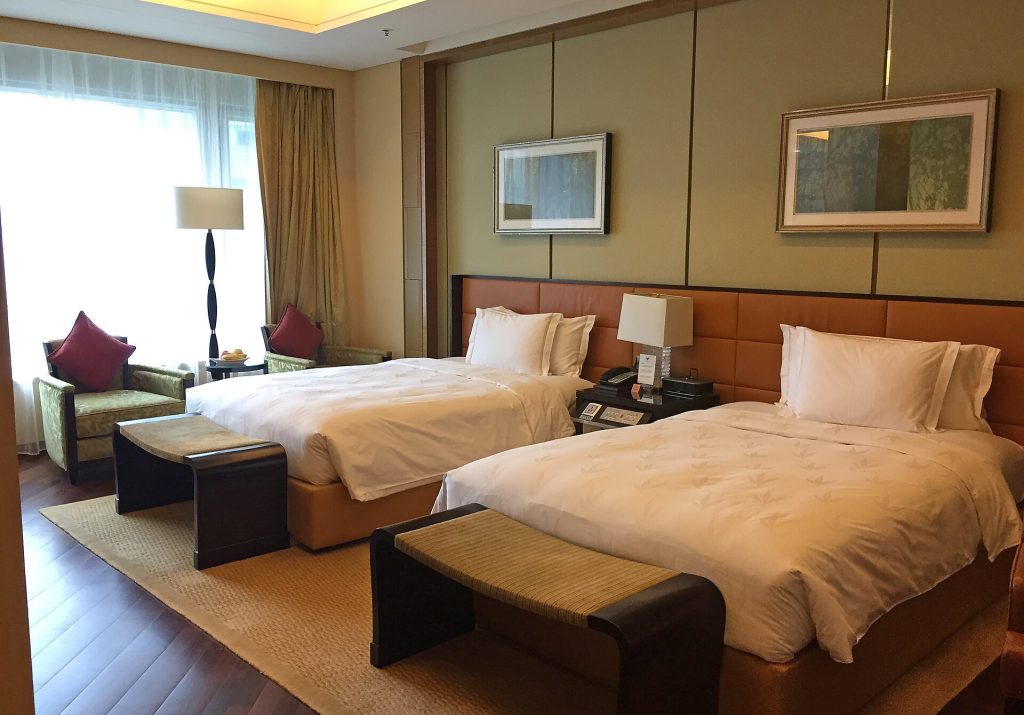
On arrival, locate the air-conditioner or heating unit before you go out. Many wall units have a heat mode that is not the same as the cooling mode you used in summer, and some remotes are only labelled in Chinese or with small icons. Ask the desk to switch it on and to confirm it is allowed; a few properties restrict portable heaters for safety. If the room will not warm, speak to the desk early, not at 1 a.m. hotel registration for foreigners and hotel desk foreign card vs Alipay are the wider desk conversations; warmth is a reasonable request, not a confrontation.
A warm shower, dry socks, and a layer you can sleep in will do more than a dramatic complaint. If you are sensitive to dry air, northern radiator rooms may actually bother you in the other direction; southern damp is a different discomfort. Neither is a medical diagnosis we will invent.
What to pack, concretely
- A warm mid-layer and a windproof outer layer, even if the forecast looks “mild”
- A merino or fleece layer you can wear indoors
- Closed shoes that can take wet pavements, plus socks you can change
- Indoor slippers or thick socks for hard hotel floors
- A compact sleep layer, because duvets vary
- Lip balm and a small moisturiser if you also visit the dry north in the same trip
If your itinerary mixes Beijing or Harbin with Shanghai or Chengdu, pack for both interiors: a radiator-dry north and a damp south. Beijing late December and New Year planner and Harbin late December first-visit planner assume serious outdoor cold. Shanghai first-visit guide and Hangzhou first-visit guide assume a softer but wetter winter. Chengdu, as the late-December planner notes, sits in the damp-cool middle for many visitors.
Trains, restaurants, and expectations
High-speed carriages are usually heated; stations can be drafty. Restaurants may blast heat or leave a door open. Carry the mid-layer rather than checking it into a bag you cannot reach. At night, last-metro walks are colder than the map suggests; the last-train companion article still applies.
Around 1 January, some buildings change hours, but they do not suddenly grow radiators. New Year’s Day vs Spring Festival for visitors is the holiday explainer. Comfort remains on you and the room you booked.
Recheck nothing more official than your hotel’s own facilities list if you care a lot about heating type; some booking pages mention air-conditioning without saying it has a heat mode. When in doubt, message the property in official chat before you arrive. Lovely China orients travellers; we do not set municipal heating policy.
Related Lovely China reading
For payments, start with Alipay and WeChat Pay hub and WeChat Pay vs Alipay for tourists. For trains, keep high-speed rail first-timers guide and 12306 passport signup for foreigners handy. City hubs: Beijing first-visit guide, Shanghai first-visit guide. Connectivity: roaming vs local SIM honest guide, pocket Wi-Fi vs eSIM for China, offline maps for foreigners. Bookmark China travel tools page.
Practical checklist
- Confirm official rules on the relevant government, park, airline, or bank page near your travel week
- Screenshot bookings, tickets, and QR codes while you still have stable Wi-Fi
- Save hotel and attraction names in Chinese characters in your phone notes
- Carry passport, a backup payment method, and a small cash float (why cash is still needed)
- Test one small mobile payment before you rely on wallets at a gate or taxi
- Keep the China travel tools page page bookmarked for related Lovely China hubs
FAQ
Will my Shanghai or Chengdu hotel have radiators like Beijing?
Not necessarily. Many southern and eastern rooms use air-conditioner heating or a portable unit. Ask the desk to show the heat mode on arrival.
How is this different from the northern heating-season expat article?
That sibling is for expats and municipal heating dates in the north. This page is a visitor packing and indoor-comfort guide for cities that often lack radiator heating.
What should I pack if I visit both Beijing and Shanghai in one trip?
Pack for both interiors: a dry, radiator-warm north and a damper southern room, plus a windproof outdoor layer for each city’s streets.
Notes for late 2026 travellers
Late December 2026 and the New Year week into 2027 bring colder mornings, earlier sunsets, and holiday crowds in many city hubs. Pack real winter layers in the north, and leave extra time on weekends and around 1 January.
This article does not invent ticket prices, opening hours, processing times, consular fees, or official statistics. When a number matters, verify it on the official site, app screen, or ticket board near your travel week.
If an official rule page disagrees with this guide, follow the official page. Lovely China orients English-speaking travellers; we are not an immigration, banking, or medical authority.