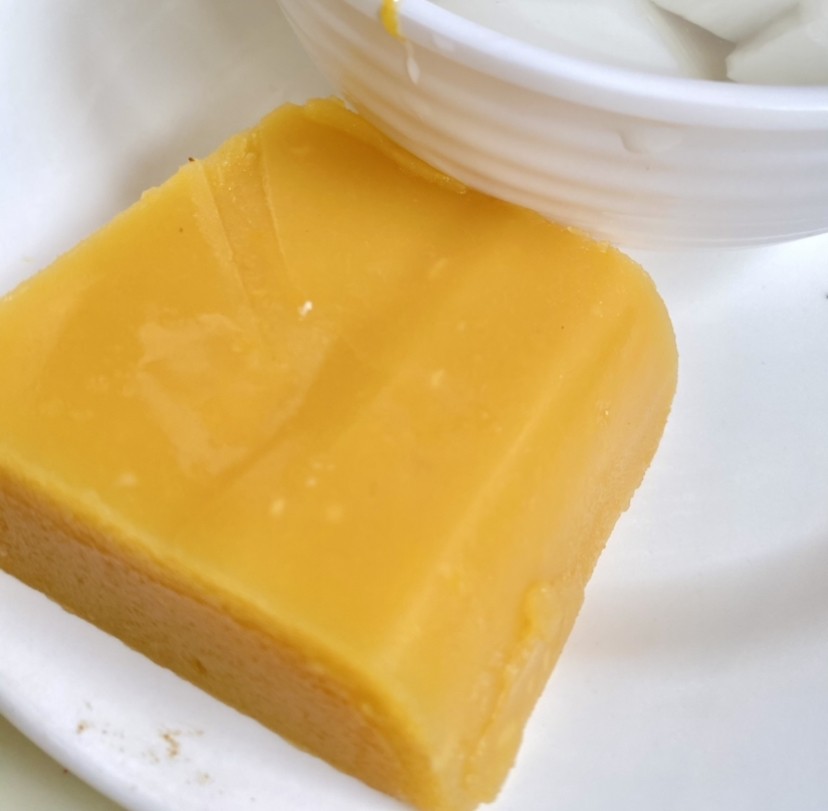
If tanghulu is the loud, crunchy sweet of a Beijing street, wandouhuang (豌豆黄, wāndòu huáng, literally “pea yellow”) is its quiet cousin. It is a smooth, pale-yellow block made from cooked, sieved peas and sugar, served cool and cut into neat squares. It looks like a firm custard, tastes gently of peas and sugar, and melts on the tongue. It is one of the old Beijing snacks that visitors walk past without noticing — and one of the easiest for first-timers to enjoy, because it is not spicy, not chewy and not strange.
This guide explains what wandouhuang is, the difference between the palace and street styles, where you are likely to find it in Beijing, how to order, what to check if you have allergies, and how to make a simple version at home.
What is wandouhuang?
Wandouhuang is a chilled sweet made from dried, skinned peas that are soaked, cooked until soft, sieved or blended into a fine purée, cooked again with sugar until thick, then set in a tray and cut into blocks. There is no flour, no egg and usually no dairy. The texture sits somewhere between a firm jelly and a dense mousse: it slices cleanly but dissolves quickly in the mouth.
The Beijing News counts it among the “thirteen classic old Beijing snacks” (老北京小吃十三绝), and the Beijing tourism website, Visit Beijing, describes it as a palace refinement of a simpler street snack. Expect a light, earthy sweetness rather than a sugary punch — closer to a sweet bean paste than to Western fudge.
If you have already tried tanghulu candied hawthorn skewers or lvdagun, the “rolling donkey” rice roll, wandouhuang is the natural next step through Beijing’s sweet-snack menu.
Palace style vs street style
Two broad versions are described in Beijing sources:
- Fine wandouhuang (细豌豆黄). The palace-style version. According to Visit Beijing and The Beijing News, the peas are cooked soft, pushed through a very fine sieve, sweetened with white sugar (sometimes with osmanthus), set, and cut into small squares under half an inch thick, traditionally topped with a few slices of candied cake (蜜糕). It is smooth, clean-tasting and very pale.
- Rough wandouhuang (糙豌豆黄). The older street version. The Beijing News describes skinned white peas cooked down with water and sugar, then mixed with cooked jujubes (Chinese red dates) before setting. It is coarser, darker and studded with dates, and was traditionally sold at spring temple fairs.
Most shops and restaurants today sell something close to the fine style. If you see small red flecks, you are probably looking at the jujube version.
The Empress Dowager story
Almost every Chinese menu or article mentions the same tale: the Empress Dowager Cixi was resting in Beihai Park, heard a street vendor calling out his wandouhuang, had him brought in, loved the snack and kept him in the palace kitchen. Visit Beijing and The Beijing News both present this as a legend (“据说” / “据传” — “it is said”). Enjoy it as a story rather than history. What the sources do agree on is that restaurants in Beihai Park, including Fangshan (仿膳), became known for the fine style after the Qing dynasty ended.
When people eat it
The Beijing News quotes a Beijing pastry chef explaining the old custom: wandouhuang was eaten on the third day of the third lunar month, so it appeared in spring and stayed on sale until late spring. Today, she notes, it is sold all year round.
So if you are visiting in late October or November, you can still find it — it simply is not a “seasonal special” the way roast chestnuts and autumn persimmons are. Because it is served cool, it also makes a light dessert after a heavy Beijing meal such as Peking duck or lamb hotpot.
Where to find wandouhuang in Beijing
You do not need a special trip. Wandouhuang turns up in several kinds of places:
- Old Beijing snack shops (北京小吃 / 老北京小吃). Shops selling a range of local snacks often have a chilled counter with wandouhuang next to aiwowo (艾窝窝, glutinous rice balls with sweet filling), lvdagun and kidney-bean rolls (芸豆卷).
- Beijing-cuisine (京菜) restaurants. Many list it under 小吃 or 点心 (snacks/pastries), sometimes as part of an “old Beijing snack platter” (老北京小吃拼盘) — a good choice if you want to try several items at once.
- Restaurants associated with palace cuisine. Fangshan in Beihai Park is the name most often linked with the fine style in Chinese sources. Combine it with a Beihai Park autumn walk. Opening times and menus change, so check the restaurant’s current listing on a map app before you go.
- Temple fairs. The rough style was traditionally a temple-fair snack. Beijing’s big temple fairs are mainly around Spring Festival, not in autumn.
- Bakeries and gift boxes. Some traditional pastry shops sell boxed wandouhuang. Check the shelf life on the label; fresh versions are perishable.
Look for a clean, bright yellow surface with no cracks or weeping liquid. Fresh wandouhuang should smell faintly of peas, not sour.
How to order
Wandouhuang is usually sold by the piece, by the box or as part of a platter. Prices vary widely by shop and portion, so check the menu or QR code. Useful phrases:
- 一份豌豆黄 (yí fèn wāndòu huáng) — one portion of wandouhuang
- 小吃拼盘 (xiǎochī pīnpán) — snack platter
- 有豌豆黄吗?— Do you have wandouhuang?
- 是今天做的吗?— Was it made today?
- 打包 (dǎbāo) — to take away
- 要冷藏吗?— Does it need refrigerating?
Many restaurants use QR-code ordering; our guide to Chinese restaurant QR menus walks through it, and photo-translation apps handle printed menus well.
What it tastes like (and how to eat it)
Expect:
- Texture: smooth, dense, slightly firm at first, then melting.
- Flavour: mildly sweet, with a nutty, green-pea earthiness. Osmanthus versions add a floral note.
- Temperature: cool or at room temperature — not hot.
Eat it with chopsticks, a small fork or a toothpick if one is provided. Take small bites; it is filling for its size. It pairs well with jasmine tea or a plain green tea, which cuts the sweetness. If you are curious about older Beijing flavours, the same snack shops often sell douzhi’er fermented mung bean drink — a famously challenging taste, so try a small cup.
Dietary and allergy notes
- Vegetarian and usually vegan: the basic recipe is peas, water and sugar. Some versions may add other ingredients, so ask 有没有放猪油或者牛奶?(“Is there lard or milk in it?”) if you are strict.
- Gluten: the classic recipe contains no wheat, but platters often include items made with flour, and toppings or shared trays may cross-contaminate. Coeliacs should ask and be cautious.
- Legumes: wandouhuang is made from peas. If you have a pea or legume allergy, avoid it. Note that the “snack platter” may also include kidney-bean rolls and sesame or nut fillings.
- Sugar: it is a dessert; portions are small but sweet.
- Food safety: it is served cold and is perishable. Choose busy shops, and do not leave boxed pieces in a warm bag all day. Our street food safety guide has more general tips.
A simple home method
Visit Beijing publishes a home recipe based on three ingredients: skinned dried yellow peas, fine sugar and water. In outline:
1. Use skinned dried peas (去皮干豌豆); pea skins spoil the smooth texture.
2. Rinse, then soak in three to four times their volume of water for several hours (or overnight in the fridge).
3. Boil, then simmer covered until the peas crush easily with a spoon.
4. Blend the peas with their cooking water and sugar into a smooth purée.
5. Cook the purée in a pan, stirring constantly over low heat, until it is thick enough to fall from the spatula in heavy clumps that hold their shape for a moment.
6. Pour into a container, smooth the top, cover and chill for about four hours until set, then cut into squares.
The site notes that cooks now often use a stainless-steel pan, since iron can discolour the purée. Adjust sugar to taste, and add a little dried osmanthus if you can find it.
Common first-timer mistakes
- Expecting a baked cake — it is a set purée, closer to a firm pudding.
- Buying a big box on day one before knowing whether you like it.
- Leaving it unrefrigerated in a warm hotel room.
- Confusing it with yellow “mung bean cake” (绿豆糕), a different, more crumbly pastry.
- Skipping the snack platter — trying wandouhuang alongside aiwowo and kidney-bean rolls is the best way to understand old Beijing sweets.
FAQs
What does wandouhuang taste like? Lightly sweet and earthy, like a smooth, sweet pea purée that melts in the mouth.
Is wandouhuang eaten hot or cold? Cool or at room temperature.
Is it vegan? The traditional recipe uses peas, water and sugar, but ask about lard or milk in commercial versions.
Is it a seasonal snack? Traditionally a spring snack linked to the third day of the third lunar month, but today it is sold year-round.
Did the Empress Dowager really love it? That is a popular legend; Beijing sources present it as “it is said”.
Can I take it home on a plane? Fresh wandouhuang is perishable and best eaten within its labelled shelf life. Check the packaging and your destination’s food import rules before packing it.
Before you go
Save 一份豌豆黄 on your phone, look for it on the chilled counter of an old Beijing snack shop or in a Beijing-cuisine restaurant’s snack platter, and eat it cool with a cup of tea. It is a calm, gentle taste of old Beijing — and a good palate cleanser between hotpot, duck and noodles.
Lovely China was founded in 2025 to publish practical English guides for travellers and expats in China. Questions or a broken link? Email [email protected].
Cover photo: Jiayi120 / Wikimedia Commons (CC BY-SA 4.0).