The sound of suitcases
The first sign that Golden Week was ending came from the courtyard, not the calendar.
All afternoon on Wednesday 7 October, suitcases rolled past my window. In Chengdu, where I have lived for three years, my building’s courtyard is paved with uneven tiles, so you hear the wheels long before you see anyone. A rattle, a pause at the step, a rattle again. Every few minutes another family came back from somewhere: from a hometown, from the mountains, or from the coast, judging by one boy’s sunburn and the bucket and spade tied to his backpack.
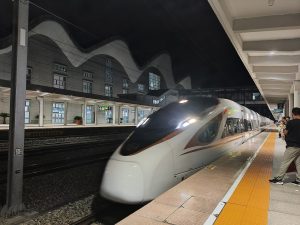
I stayed home for most of this Golden Week. That was partly a choice and partly a failure to book anything in time. The holiday ran from 1 to 7 October this year, and by the time I opened the train app in September, the trains I wanted were already waitlisted. So I did what many people quietly do. I explored my own city on the quieter days, and I hid from it on the busy ones. Now it was the last evening, and everyone seemed to be coming home at once.
Balcony laundry and a calendar check
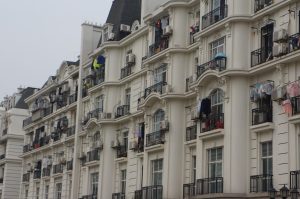
Every Chinese apartment I have lived in has a balcony that is really a laundry room with a view. By four o’clock mine was full: a week of T-shirts, a towel from the hot-spring day trip I finally managed on day five, and the jeans I would wear back to the office.
The building across the courtyard was doing the same thing. Balcony after balcony was hung with shirts and children’s school uniforms. School starts again tomorrow too, and the uniforms looked like a polite warning.
I checked my calendar app, though I already knew what it would say. Thursday 8 October: back to work. Saturday 10 October: makeup workday, the price of the long holiday. If you’ve never lived through one, our explainer on the 10 October makeup workday says it more kindly than I would. The calendar also showed a small grey line for tomorrow afternoon: 寒露 Cold Dew. One of the 24 solar terms, it marks the point when autumn starts to bite. Our Cold Dew guide covers what it means. In Chengdu it usually means people start talking about the damp cold weeks before anyone admits it is cold.
The fridge problem
The last evening of a holiday has its own housekeeping. Mine began with the fridge.
At the start of the week, a colleague had left the city for her hometown and given me everything perishable from her kitchen, so it wouldn’t spoil while she was away. A week later, what was left of her generosity sat in my fridge: half a cabbage, a box of eggs, some pickled vegetables in a jar I didn’t recognise and a small bag of Sichuan pepper strong enough to make my fingers tingle through the plastic.
I made the only thing I can reliably make: eggs fried with tomato, pickles on the side, rice from the cooker. It was not a festival dinner. But it felt right for the last evening of Golden Week, the meal you cook to clear the shelves and reset yourself for ordinary life.
The noodle shop on the corner
Afterwards I went out, because Chengdu on a holiday evening is hard to resist.
The noodle shop at the corner of my lane had reopened. It had shut for the first days of the holiday with a handwritten sign on the shutter, the way small family businesses often do. Tonight the lights were on, steam was coming off the pots, and the owner’s daughter was doing homework at the back table, as she does most evenings.
I didn’t need another dinner, so I ordered the smallest bowl of noodles to justify sitting there. A man at the next table was on a video call, showing someone the noodles as proof of a safe return. A young couple had wheeled their suitcases right up to the table and were eating with their elbows on the handles. Nobody spoke to me, and I spoke to nobody. That kind of shared tiredness is a sort of company too.
The best-known Chengdu dishes are hotpot, mapo tofu and spicy skewers. We have written first-timer guides to all of them, starting with dan dan noodles. But the corner noodle shop on a holiday’s last night says more about the city than any of them.
Walking to the bridge
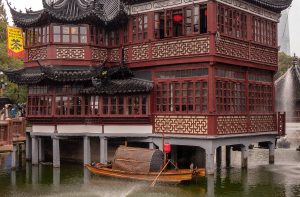
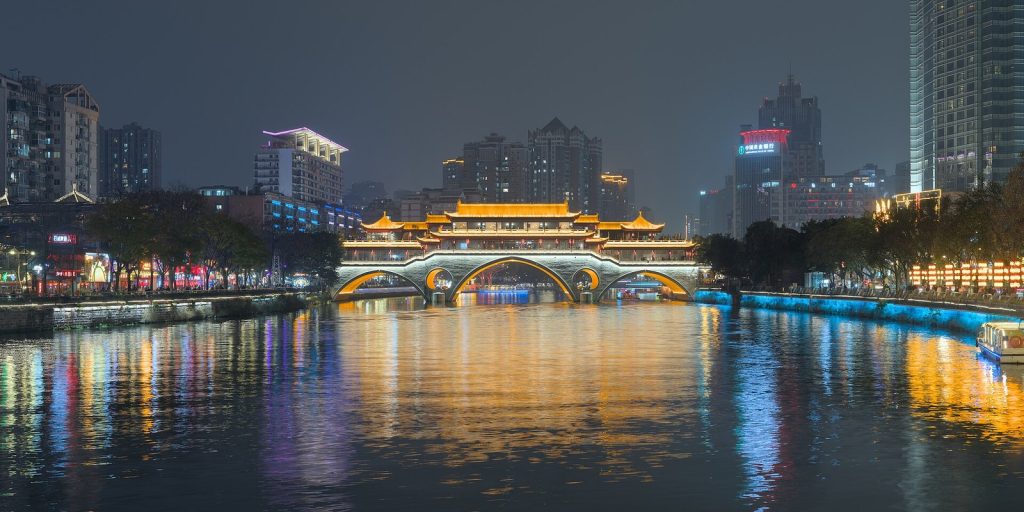
From my flat it is a twenty-minute walk to the Jin River and Anshun Bridge, the covered bridge with golden lights that appears in countless photos of the city. The river paths were busy but not crowded, the way a city feels when people have had enough of crowds for one week. Families walked slowly. Grandparents pushed strollers. A group of students sat on the steps by the water, passing round a speaker that played songs I half recognised.
I stopped in the middle of a smaller bridge upstream and looked at Anshun Bridge glowing over the dark water. A few days earlier, on day three, the same path had been packed with visitors, and I had turned back before I reached the river. Tonight there was space to stand still. I realised that the last evening of Golden Week belongs mostly to the people who live here. The visitors have gone home, and the residents get their city back for one evening before the alarm clocks start.
On my phone, the office WeChat group was waking up: a reminder about Thursday’s meeting, a photo of someone’s train ticket with a weary emoji, a colleague asking whether anyone had the key to the stationery cupboard. Nobody answered that one. It was still a holiday, for another few hours.
What I did before bed
I walked home the long way. At home I did the small things that make the first morning back easier, and I’ll pass them on in case they help you:
- Check tomorrow’s commute. Metro and buses go back to weekday patterns, and the first morning after a long holiday is often busy.
- Charge everything. Phone, power bank, laptop. My office ID card had disappeared into a holiday tote bag, and I found it.
- Pack lunch, or decide where to buy it. Some small canteens and shops near offices reopen a day or two late after the holiday.
- Reply to one message. Just one. The rest can wait until you have a desk and a cup of tea.
- Look at the week ahead. A Thursday, a Friday, and a Saturday at work. It’s a short week that feels long.
If you want a fuller list, our back-to-work checklist for expats has one.
The courtyard went quiet at about ten. The last suitcase I heard was a small one, pulled slowly, maybe by a child too tired to lift it over the step. A parent’s voice said something soft, the wheels stopped, then started again, and a door closed.
FAQ
Is this story true?
It is a composite, first-person story based on common expat experiences in Chinese cities. The narrator and the people in it are fictional. The holiday dates and practical tips are real.
When did Golden Week 2026 end?
The National Day holiday ran from 1 to 7 October 2026, under the State Council notice. Saturday 10 October 2026 is a makeup workday.
Is Anshun Bridge in Chengdu free to visit in the evening?
The bridge sits on the public riverside of the Jin River and can be seen from the riverside paths. Check local information for any events or closures before you go.
What is the first workday after Golden Week 2026?
Thursday 8 October 2026.
Bottom line
The last evening of Golden Week is not a festival. It is suitcases on tiles, laundry on balconies, a small bowl of noodles and a city walking slowly by its river before the alarm clocks ring. For one evening it belongs to the people who live there. If you want to read about the trip home rather than the evening after, try our story of the last train home on Golden Week day six. Lovely China, founded in 2025, welcomes corrections at [email protected].