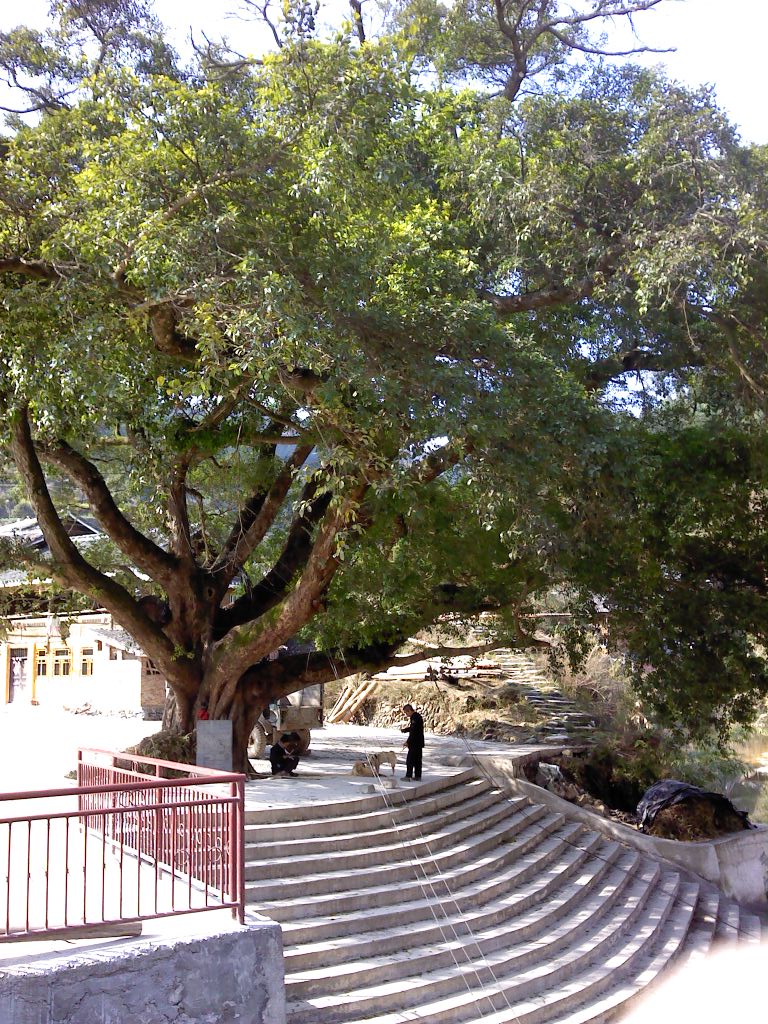
The minibus from Kaili shudders to a halt on the north bank of the Duliu River, brakes hissing in the damp morning air. Steam rises from a bowl of rice noodles a vendor thrusts through the window—slick white strands, chili oil floating like amber tiles, a tangle of pickled long beans on top. Across the water, the south bank wakes slower: a woman squats over a charcoal brazier roasting glutinous rice cakes until the edges blacken and curl, the smell sweet and smoky drifting over the brown water. This is Congjiang. Not a destination you check off, but a place you pass through and decide to stay.
Getting There: The Road In
Most travelers arrive on the long-distance bus from Kaili or Guilin, the national highway G321 carving a narrow path through the Duliu Valley. The ride from Kaili takes about four hours if the driver doesn’t stop for a blown tire or a herd of water buffalo blocking the lane. In the wet season, landslides can close the pass for half a day; in the dry months, dust cakes the window glass so thick you can write your name in it. The train station sits a few kilometers outside the old town—high-speed rail now links Congjiang to Guiyang in two hours and Guangzhou in five—but the bus drops you right at the river’s edge, which is where you want to be.
If you’re coming from the north, the road climbs through karst peaks draped in bamboo, then drops suddenly into the valley where the river makes a sharp horseshoe bend. That bend cradles the town. Drivers honk at every blind corner. Keep your phone charged; the signal drops in the tunnels. A private car from Kaili costs roughly 300 to 400 yuan one way if you share with three others, but the bus—50 yuan, leave when full—lets you watch grandmothers load baskets of fermented fish into the luggage rack.
Moving Around: Two Streets and a Bridge
Congjiang stretches thin along the Duliu, essentially two parallel streets linked by a single arched bridge. The north bank carries the national road: bus station, truck repair shops, a row of hotels with neon signs that flicker through the mist. The south bank holds the life. Narrow lanes climb the hillside behind the waterfront, wooden stilt houses leaning into one another, their balconies hung with drying corn, chili braids, and indigo-dyed cloth.
You can walk the whole town in twenty minutes. Cross the bridge at dusk when the lights come on—red lanterns strung between the railings, the reflection broken by passing boats. Taxis cluster near the bus station; a ride to the south bank market costs 10 yuan. Motorbike taxis (wearing orange vests) zip up the steep alleys where cars can’t go. Negotiate before you climb on. Most drivers speak only Southwestern Mandarin or Dong; point at your phone map and hold up fingers for the price.
Villages Within Reach: Where the Wood Still Breathes
Five minutes by motorbike from the south bank bridge, the asphalt ends and a stone-paved path climbs into Xiaohuang (小黄), a Dong village famous for its grand song choir. No tickets, no turnstiles. An elderly woman in a black headscarf waves you into the drum tower courtyard—a tiered wooden pavilion with upturned eaves, the heart of village life. Inside, men sit on low stools smoking pipes; women sort rice on woven mats. If you arrive during the autumn harvest, the tower echoes with polyphonic singing, voices layered like the roof tiles.
Further up the valley, Zhaoxing (肇兴) spreads across a basin two hours by minibus. It’s larger, more visited, but the five drum towers—each named for a virtue: benevolence, righteousness, propriety, wisdom, fidelity—still anchor daily rhythm. Stay overnight in a family guesthouse: a second-floor room with a balcony overlooking the paddy fields, the sound of water buffalo bells at dawn. The host will wake you with a bowl of sour fish soup and a question: “You eat spicy?”
Closer to town, Basha (岜沙) sits on a ridge accessible by a steep 30-minute hike from the main road. The men here still carry flintlock muskets—ceremonial now, but the gunpowder smell lingers during festivals. Their hair is shaved except for a central coil, a tradition traced to the Ming dynasty. Don’t photograph without asking. A nod and a smile, then raise your camera. They’ll pose, serious, then break into laughter when you show them the screen.
Festivals: When the Valley Burns Bright
The Dong calendar runs on the moon. The biggest celebration falls on the first day of the eleventh lunar month—Dong New Year. Every household slaughters a pig, the meat cured over the hearth for weeks. Families gather at the drum tower before sunrise, offering glutinous rice cakes to ancestors. By midday, the village square fills with lusheng players, the reed pipes droning while young women in pleated skirts dance in concentric circles, silver headdresses catching the light.
In the third lunar month, the “Sisters’ Festival” brings girls from neighboring villages to sing antiphonal songs across the river—flirtation disguised as poetry. Boys answer from the opposite bank. If you’re a foreign man, you’ll be teased mercilessly, handed a bowl of rice wine, and expected to sing back. Learn two lines of a Dong drinking song before you go. Even badly pronounced, it earns respect.
The bullfighting festival in the sixth lunar month isn’t Spanish style—no matadors, no blood. Two water buffalo lock horns in a muddy arena while hundreds cheer from the bamboo railings. The owner of the winning beast distributes the meat to the crowd that evening. If you’re invited to the feast, eat the heart first. It’s considered the seat of courage.
Eating: Sour, Spicy, and Alive
Congjiang food doesn’t announce itself. It sits in aluminum pots at the south bank market, steam rising through the slats. The flavor profile: sour from wild tomatoes and fermented rice water, spicy from small red chilies pounded fresh each morning, numbing from mountain peppercorns harvested in the ninth lunar month. Nothing is subtle.
- Sour fish soup (酸汤鱼): River carp sliced paper-thin, dropped into broth soured with wild tomato and rice vinegar. Served boiling in a stone bowl. Eat the fish first, then drink the broth with a spoon.
- Glutinous rice cakes (糍粑): Pounded in a wooden trough until the grains lose identity. Grilled over charcoal until the crust crackles. Dipped in chili-soy sauce.
- Pickled everything: Long beans, radish, cabbage, bamboo shoots—jarred in brine with ginger and star anise for at least twenty days. Served as a free side dish at every meal.
- Oil tea (油茶): Not tea at all. Tea leaves fried in oil with garlic, ginger, and puffed rice, then whisked with boiling water. Salty, savory, gritty. Drunk from small bowls at breakfast.
- Blood tofu (血豆腐): Pig’s blood set with salt and herbs, cut into cubes, stewed with sour bamboo shoots. Iron-rich, silky, an acquired taste you acquire fast.
At the market, point at what the locals are eating. A plastic stool, a chipped bowl, a pair of chopsticks worn smooth. The vendor ladles, you pay three to five yuan. No menu. If you want to cook, buy fresh river fish (carp or catfish, still flopping), wild tomatoes (small, green-striped, intensely tart), and a brick of fermented rice paste from the woman in the blue apron—she’ll wrap it in lotus leaf.
Home Method: Sour Fish Soup for Two
- 1 whole river carp (about 500g), scaled, gutted, sliced 3mm thick at a 45-degree angle
- 3 wild tomatoes, quartered (substitute: 2 large tomatoes + 1 tbsp rice vinegar)
- 2 tbsp fermented rice paste (米酸)
- 10 small red chilies, half pounded to paste, half left whole
- 5 mountain peppercorns, lightly crushed
- 3 slices ginger, smashed
- 2 scallions, cut into 3cm lengths
- 1 liter water or light chicken stock
- Salt to taste
- Handful of cilantro, roots trimmed
- Bring water or stock to a rolling boil in a clay pot or heavy saucepan.
- Add wild tomatoes, fermented rice paste, pounded chili, whole chilies, peppercorns, ginger. Boil 8 minutes until the broth turns coral-red and smells sharp.
- Slide in fish slices one by one. They cook in 40 seconds. Do not stir—nudge gently with chopsticks.
- Add scallions, turn off heat. Taste for salt.
- Ladle into bowls. Top with cilantro. Serve immediately with steamed glutinous rice.
Restaurant Ordering: What to Say, What to Avoid
Walk into any south bank eatery at noon. The menu, if there is one, is a laminated sheet with photos faded by sun. Order by pointing and numbers. “Yi wan suan tang yu, yi pan ci ba, liang wan you cha”—one bowl sour fish soup, one plate grilled rice cakes, two bowls oil tea. The owner will shout the order to the kitchen in Dong, then bring a pot of weak tea while you wait.
Avoid the “tourist set meals” advertised near the bus station—pre-cooked dishes reheated in a wok, sweetened for palates that don’t know better. Avoid anything labeled “Miao flavor” in a Dong town; it’s usually a generic Sichuan knockoff. If the restaurant has a drum tower replica in the dining room, keep walking. Real food happens where the plastic stools are low and the floor is wet.
Beginner Mistakes: What Gets You Sideways Glances
First mistake: treating villages like museums. You walk into a family’s living room because the door is open. It’s not a display. The door is open because the fire needs air. Ask before you enter. Second: refusing rice wine. When an elder offers a horn cup, you drink. Touch the rim to your lips if you truly can’t, but never set it down untouched. Third: giving candy to children. It teaches begging. Bring a bag of pens or notebooks if you want to give; hand them to a teacher or village head.
Fourth: hiking alone in the wet season without telling your guesthouse. Trails wash out. Fog drops fast. The paths aren’t marked. Fifth: assuming everyone speaks Mandarin. Many elders speak only Dong. Learn “ma lai” (thank you), “gao yao” (delicious), “mo deng” (no problem). A smile and bad pronunciation work better than fluent Mandarin with no smile. Sixth: leaving before the morning market. The best moment in Congjiang is 6 a.m. on the south bank—fog lifting, baskets of silver fish glistening, the sound of a lusheng drifting from a courtyard you can’t see. Sleep in, and you miss the town.