The rain had turned Houjie Avenue into a mirror. Neon from the Haiyatt Garden Hotel fractured across the wet asphalt as a convoy of electric scooters hissed past, their riders hunched under floral ponchos. I stood under the awning of a shuttered electronics repair shop, checking a map on a cracked screen, waiting for the downpour to ease. Across the six lanes, the glow of a 24-hour convenience store promised hot tea eggs and instant noodles. That was my first night in Houjie — not a tourist destination, but a place that runs on shift changes and container schedules.
Getting There Without a Flight
Houjie has no airport of its own. The closest runway is Shenzhen Bao’an, about forty minutes by car when the Guangshen Expressway flows. Guangzhou Baiyun is an hour north if traffic cooperates. Most people I know fly into Shenzhen, clear immigration, then hail a cross-border rideshare or book a private car through the hotel. The driver meets you at arrivals with a placard, loads the luggage, and you’re on the elevated highway watching the Pearl River Delta flash by — factory compounds, then villages, then the high-rise clusters of Dongguan proper.
If you’re already on the mainland, high-speed rail is cleaner. Humen Station sits ten kilometers south. Trains from Guangzhou South take eighteen minutes; from Shenzhen North, twelve. Exit the station, ignore the touts offering “black cars,” and use the official taxi queue or the Didi app. The ride into Houjie center runs along Guantai Road, past the Sheraton and HJ International, then turns onto Kangle Road where the town square opens up. Budget travelers can catch the long-distance bus from Shenzhen’s Bao’an Bus Station or Guangzhou’s Provincial Station — look for “Houjie” on the electronic board, not “Dongguan.” The bus drops at the old station on Houjie Avenue, a five-minute walk from the main shopping stretch.
Orienting Yourself on Two Roads
Everything in Houjie orients around two arteries. Houjie Avenue runs northwest to southeast, six lanes divided by a planted median. It’s the fast road — trucks, buses, commuters bombing between the expressway and the industrial parks deeper east. Kangle Road, one block south, is the heartbeat. Two lanes, packed with pedestrians, delivery trikes, and storefronts spilling onto the sidewalk: phone repair, massage chairs, bubble tea, a cluster of Hunanese restaurants with red lanterns. The town square sits at their intersection, a paved plaza where retirees fly kites at dawn and a speaker system blasts square-dance music at seven each evening.
Parallel to Kangle, a block further south, Guantai Road stretches eight lanes wide. The Sheraton and HJ International anchor the western end. North on Guantai leads to Dongguan’s city center and the Dongguan Railway Station; south funnels toward Humen and the Nansha Bridge. If you’re staying near the square, you can walk to most daytime needs. For the factory zones east of the expressway, or the riverfront parks west toward the Pearl River, you’ll want wheels.
Moving Around: Scooters, Apps, and the Last Kilometer
The electric scooter is king. Every residential compound has a charging shed; every sidewalk has a parking line painted in faded yellow. If you’re staying a week, rent one from a shop near the square — typically a seated two-wheeler with a basket, 30 to 40 yuan per day, deposit held on your phone. Bring your passport; the shop photographs the page. Helmets are mandatory by law, though enforcement comes in waves. Ride on the rightmost lane of the carriageway, not the sidewalk. Signal with your hand, not a blinker — most blinkers are broken or ignored.
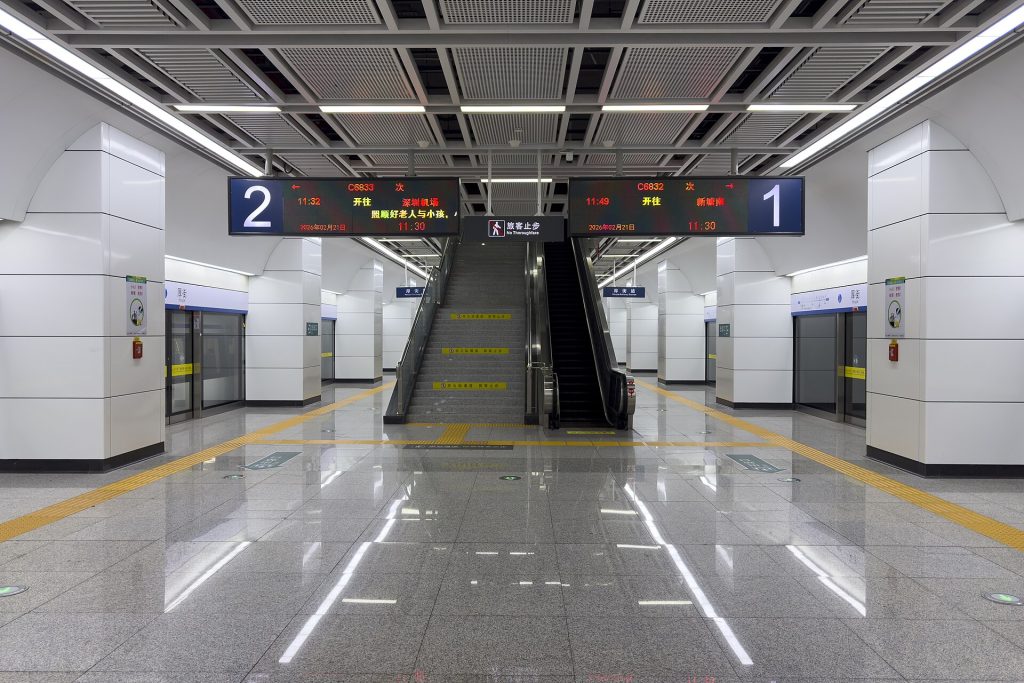
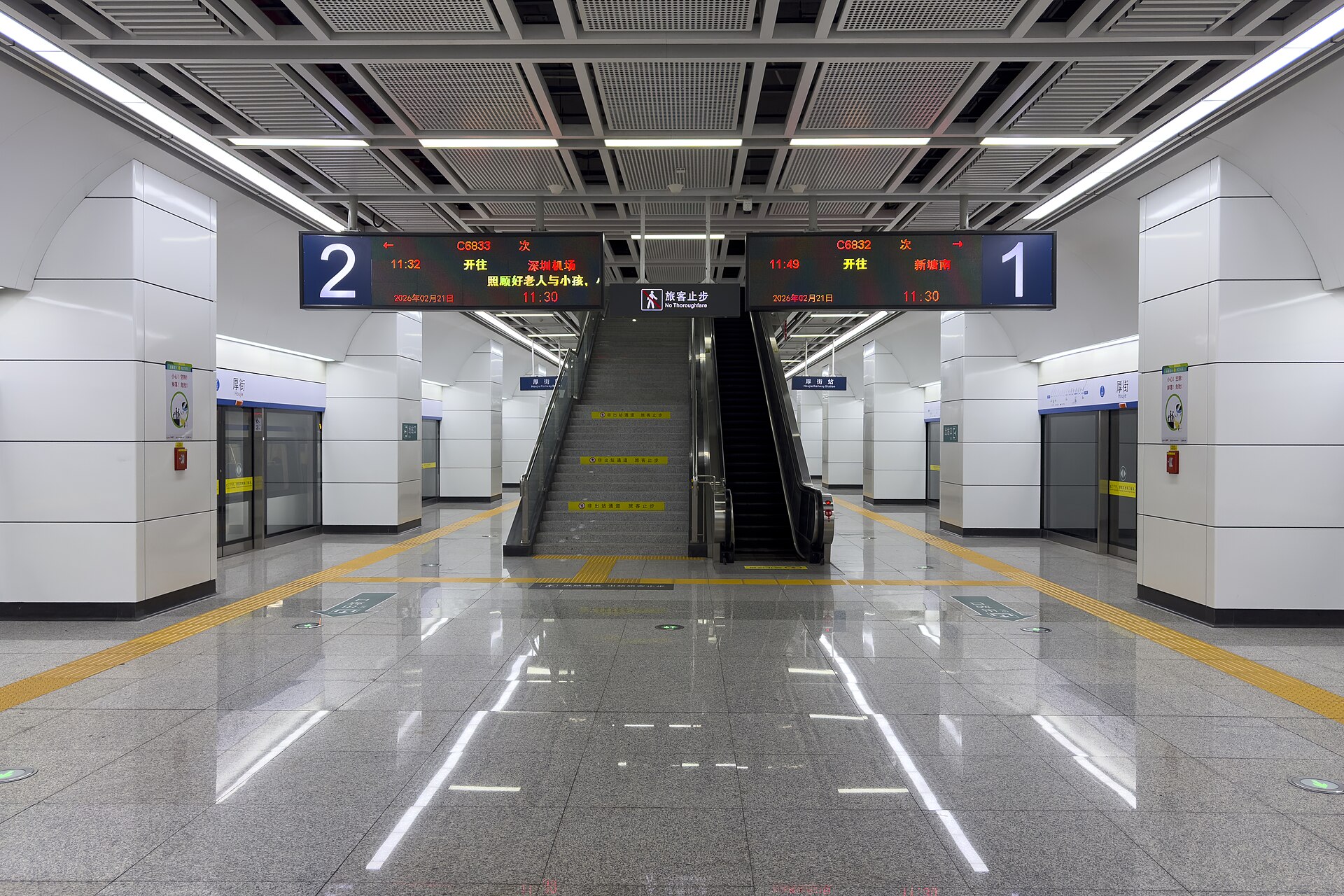
Didi works everywhere. Input the destination in Chinese characters (copy from your hotel confirmation). Drivers rarely speak English. If the pickup pin drifts, call the driver — the app has a translate button that reads your Mandarin aloud. For short hops, Meituan’s shared bikes (yellow frames, orange baskets) unlock with a QR scan. They’re geofenced: the map shows red zones where parking locks the wheel. Drop them at a designated corral, usually near subway entrances or mall corners. Houjie has no metro yet; Line 1 of the Dongguan Rail Transit is under construction with a station planned near the square, but opening dates shift.
Where to Sleep: Business Hotels and Riverside Quiet
Three tiers dominate. The Sheraton and HJ International on Guantai Road cater to corporate travelers — Western breakfast buffets, meeting rooms, English-speaking front desk. Rates climb during the Canton Fair weeks in spring and autumn. Mid-range chains like Atour, Jinjiang Inn, and 7 Days cluster around Kangle Road and the side streets north of Houjie Avenue. Rooms are compact, soundproofing varies, but the beds are clean and the shower pressure strong. Book through Ctrip or Meituan; walk-in prices are higher.
For something quieter, look west toward the Pearl River. A handful of boutique guesthouses sit in renovated village houses near Houjie Park, their courtyards shaded by banyan trees. No elevator, steep staircases, but the host often cooks a Cantonese breakfast — steamed rice rolls, congee with century egg, fried dough sticks. These list on Xiaohongshu or local WeChat groups rather than international platforms. Message the host in Chinese; a translation app works. Expect to pay 180 to 300 yuan per night, cash or Alipay.
Eating: Shift Meals and Late-Night Bowls
Houjie eats on factory time. Breakfast peaks at six: stalls along Kangle Road steam rice rolls (cheung fun) brushed with sweet soy and chili oil, serve bowls of beef brisket noodles with pickled mustard greens, sell warm soy milk in plastic bags tied with rubber bands. By nine, the stalls vanish. Lunch is a rush between eleven and one — Cantonese roast meat rice (char siu, roast duck, crispy pork belly) at the second-floor canteen above the square’s supermarket; Hunanese stir-fry joints where the chili oil stains the tablecloth; Hakka thunder tea rice (lei cha) pounded fresh in a stone mortar.
Dinner stretches later. The square’s perimeter fills with portable grills after eight — skewers of lamb, chicken hearts, tofu skin, lotus root, all brushed with cumin and chili powder. Beer arrives in warm crates; locals pour into small glasses, clink, down it fast. For a sit-down meal, walk one block east to the alley behind the Haiyatt Garden. A row of family-run places serves steamed fish with ginger-scallion oil, clay-pot rice with cured sausage, stir-fried water spinach with fermented bean curd. Order the “white-cut chicken” (bai qie ji) — skin taut, meat cool, dipped in minced ginger and scallion oil.
- Breakfast: Rice roll stall at Kangle Road & Houjie Avenue corner — arrive before 7:30 for the shortest line.
- Lunch: Roast meat rice at “Lao Chen” (老陈烧腊), second floor of the square’s supermarket building.
- Dinner: White-cut chicken and clay-pot rice at “A-Po” (阿婆私房菜), alley east of Haiyatt Garden.
- Late night: Skewer grill on the square’s south side — order a plate of lamb, a plate of tofu skin, two Snow beers.
Things to Do: Parks, Temples, and the River
Houjie Park sits west of the square, a green spine along the old river channel. Morning brings tai chi groups moving in slow unison near the lotus pond; evening brings the square dancers, speakers thumping remixed folk songs. The park’s western gate opens onto a riverside promenade — concrete path, metal railings, views across the Pearl River to Nansha’s skyline. Cargo ships slide past, lit like Christmas trees. Walk north along the promenade fifteen minutes to the Houjie Ancestral Hall, a Qing-era compound with gray brick walls, ceramic ridge beasts, and a courtyard where incense curls before tablets of the Chen clan. The caretaker unlocks the side hall at nine; entry is free, donations welcome.
East of the expressway, the Houjie Culture and Sports Center holds a swimming pool (25 meters, eight lanes, 20 yuan entry), badminton courts, and a library with a quiet reading room — air-conditioned, free Wi-Fi, power outlets at every table. Good for a rainy afternoon. If you have a car, drive twenty minutes south to the Humen Pearl River Bridge viewpoint. The suspension span glows at night; a small plaza below sells grilled oysters and coconut water. Return via the coastal road — fewer trucks, breeze off the water.
Shopping: Wholesale Markets and Convenience Corners
Houjie is not a shopping destination for tourists, but the wholesale markets matter if you’re sourcing. The Houjie International Shoe Materials Market, east of the expressway off Houjie Avenue, spans three warehouses — leather, soles, adhesives, machinery. Business hours are nine to five; sellers speak Cantonese and Mandarin, some broken English. Bring samples, a tape measure, and a calculator. Prices are per kilogram or per meter; minimum orders start at five hundred units.
For daily needs, the 7-Eleven and FamilyMart on every corner stock cold drinks, onigiri, and phone chargers. The square’s basement supermarket (B1 of the Wanda Plaza annex) has fresh produce, imported snacks, and a bakery that pulls pork floss buns from the oven at ten and three. If you need electronics — cables, power banks, SIM cards — the cluster of shops on Guantai Road north of the Sheraton has better prices than the hotel lobby. Bargain hard; the first quote is usually double.
Practicalities: Cash, Connectivity, and the Rhythm of the Town
Alipay and WeChat Pay cover 99 percent of transactions. Link your foreign card in the app before you arrive; the verification SMS sometimes fails on roaming numbers. Carry 200 yuan in small notes for the rare cash-only stall — the skewer grill, the rice roll cart. Free Wi-Fi blankets the square, the park, and most hotels. For mobile data, buy an eSIM online (Airalo, Ubigi) or grab a China Unicom tourist SIM at the Shenzhen airport kiosk — 30 GB for 30 days, roughly 100 yuan.
The town breathes in shifts. First shift ends at four; the scooter tide reverses on Houjie Avenue. Second shift ends at midnight; the square’s grills fire up. Third shift ends at eight in the morning; the breakfast stalls appear. If you’re here for business, schedule factory visits Tuesday through Thursday — Monday is catch-up, Friday is early departure. Weekends are quiet in the industrial parks; the parks and riverside fill with families. The lunar calendar governs the real closures: the week of Spring Festival (first lunar month), the three days of Qingming (early April), the week of National Day (eighth lunar month). Most small restaurants shutter; chains and hotel dining stay open.
One last thing: the rain. Summer typhoons roll in from the South China Sea, turning streets into canals. The drainage handles it, but sidewalks flood to ankle depth. Keep a compact umbrella in your bag, wear shoes that drain, and don’t park your scooter in a low spot. When the sky clears, the air smells of wet concrete and jasmine from the park’s hedges. That’s the Houjie I remember — not a postcard, but a place that works, feeds you, and sends you on your way.