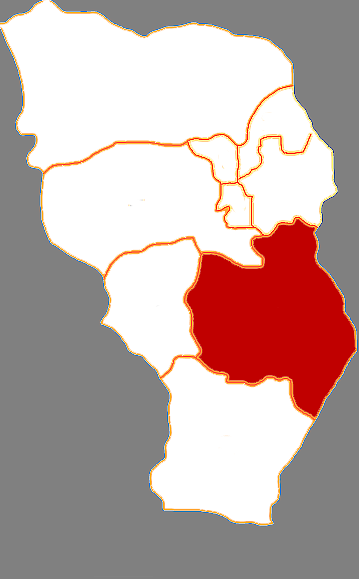
The minibus from Hohhot’s west station rattles north for forty minutes before the concrete gives way to fields of corn and sunflower. Ahead, the Daqing Mountain ridge cuts a dark line across the horizon. The driver calls out “Helin” and the door folds open onto a wide boulevard lined with poplars, their leaves flashing silver in the wind. This is Horinger County — still close enough to the capital for a day trip, far enough that the air smells of dry grass and turned earth instead of exhaust.
Getting There and Moving Around
Most visitors arrive by bus from Hohhot’s Xibuzhan (West Bus Station). Buses leave every twenty minutes or so from the early morning until dusk; the ride takes about fifty minutes and costs roughly the price of a bowl of hand-pulled noodles. If you are driving, take the G6 Expressway north and exit at Horinger — the toll booth sits just past the wind-turbine farm on the ridge. Once in the county seat, the town center is walkable. For the sites farther out, flag down a blue three-wheeled electric tuk-tuk near the main intersection; agree on a flat fee before you climb in, or the meter will climb faster than the hills.
Auweimont Yuanma Cultural Ecotourism Zone
Seven kilometers east of town, the Auweimont park sits in a shallow valley where the steppe rolls up to the mountain foothills. The name “Yuanma” means “original horse,” and the highlight is a herd of compact, shaggy Mongolian horses that roam a fenced pasture. In late summer, the grass reaches stirrup height and the animals graze in loose clusters, manes tangled by the wind. A wooden boardwalk loops past a reconstructed herder’s yurt — felt walls, iron stove, a stack of dried dung bricks by the door. Inside, a local guide pours salty milk tea into small bowls and explains how the saddle, the lasso, and the airag fermenting bag all hang from the same lattice wall.
- When to go: Late June through early September, when the wildflowers — yellow potentilla, purple vetch, white edelweiss — carpet the slopes.
- What to wear: Closed shoes with grip; the boardwalk gets slick after rain, and the pasture hides marmot holes.
- Time needed: Two hours for the loop, longer if you stay for the short horseback lead around the corral (extra fee, cash only).
- Common mistake: Arriving at noon in midsummer. The sun hits the valley hard and the horses seek shade. Come at opening (9 a.m.) or after 4 p.m. for active animals and better light.
Inner Mongolia Grass Museum
Don’t let the word “museum” fool you — this is a living seed bank disguised as a park. The main hall displays glass jars of grass seeds labeled in Latin and Mongolian script: feather grass, needle grass, wild rye, dozens of strains collected from the steppe. Behind the building, test plots grow in neat rectangles, each tagged with a QR code linking to drought-resistance data. The most photogenic corner is the “Blue-Purple Flower Sea,” a ten-hectare field of salvia and lavender that blooms in waves from July into August. Bees work the rows in a low hum; photographers set tripods at the edge where the purple meets the green steppe.
- Entry: Free, but the greenhouse and seed-processing workshop require a guided tour — sign up at the front desk on the hour.
- Bring: A wide-brim hat and water; shade is scarce between the exhibition halls.
- Local tip: The small shop by the exit sells vacuum-packed seed packets (feather grass, alkali grass) that clear customs in most countries — good for a balcony meadow back home.
- Rookie error: Skipping the “Grass House” seedling workshop. It looks like a shed, but inside technicians demonstrate how hydrogel coating lets seeds germinate on bare sand — a technique now used to green highway medians across the region.
Nanshan Scenic Area
South of the county seat, Nanshan rises in a series of rounded ridges crisscrossed by paved paths and stone staircases. Locals treat it as their morning gym: retirees power-walk the switchbacks, teenagers practice calligraphy with water brushes on flat rocks, a few monks from the small temple halfway up chant into the wind. The summit platform holds a bronze relief map of the Daqing range and a coin-operated telescope aimed at Hohhot’s distant skyscrapers. On a clear autumn day you can see the Yellow River glittering north of the city, a thin silver thread across the plain.
- Best season: Mid-September to late October. The scrub oak turns rust-red, the air is crisp, and the summer tour buses have vanished.
- Route: Enter at the south gate (Chengguan Town side). Take the central staircase to the temple, then the ridge trail west to the summit — about ninety minutes one way at a steady pace.
- Facilities: Toilets at the gate and the temple; vendors sell roasted corn on the cob and plastic bottles of sour mare’s milk near the summit.
- Watch out: The stone steps become polished ice in winter. If you visit between the Winter Solstice and the Lantern Festival, bring microspikes or stay on the lower loop.
Eating in Horinger
Helin Fandian (和林饭店) occupies a two-story brick building on the main north-south road, its red lanterns visible from the bus stop. The dining room hums with families sharing metal basins of hand-pulled lamb noodles — broad, chewy ribbons in a clear broth scented with star anise, ginger, and a pinch of dried tangerine peel. The lamb comes from the mountain pastures you just drove through; it arrives in paper-thin slices that cook the instant they hit the boiling stock. Side dishes appear without ordering: pickled radish cubes, cold kelp threads tossed with garlic and chili oil, a plate of steamed buns dusted with sesame.
- Signature dish: Yangrou paomo (lamb soup with torn flatbread). You shred the dense, unleavened bread yourself into a bowl; the server ladles boiling broth and lamb over it. The bread swells but keeps a resilient chew.
- Vegetarian option: Stir-fried wild leek flowers with dried tofu — seasonal, usually only in early summer.
- Drink pairing: A bottle of Mengniu pure milk or, if you’re feeling local, a warm cup of suutei tsai (milk tea with a pinch of salt).
- Ordering pitfall: Pointing at the picture menu and saying “this one” without specifying portion size. The “small” noodle bowl feeds two hungry adults; the “large” feeds a construction crew. Ask for “xiao wan” (small bowl) first.
What Locals Expect and What Newcomers Miss
Horinger runs on a rhythm set by the grass. In the weeks around the Summer Solstice, herders bring flocks down from the high pasture to shear and vaccinate; the county fairground fills with wool bales, veterinary trucks, and pop-up stalls selling leather boots and stainless-steel milk pails. If you wander in during this time, you’ll be waved toward a plastic stool and handed a bowl of airag — slightly fizzy, sour, low-alcohol fermented mare’s milk. Drink it in one go; refusing is polite but noticed. Conversely, the biggest newcomer blunder is treating the steppe as a backdrop. Stepping off the boardwalk into the pasture crushes fragile root mats that take decades to recover. The “No Entry” signs are not suggestions. Another surprise: public toilets at the scenic areas are squat-style and often lack paper. Carry a pocket pack of tissues and a small bottle of hand sanitizer — your knees will thank you.
When the autumn wind strips the leaves from the poplars, the county quiets down. The tuk-tuks park in rows, the museum cuts back to weekend hours, and the lamb noodle shops close early. That is the season to drive the back roads toward the Daqing Mountain passes, where the aspens turn gold against the dark pine, and the only traffic is the occasional herd crossing the asphalt, bells clanking in the dusk.