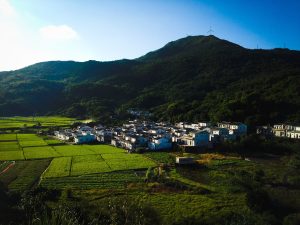
The minibus from Dali drops you at the north gate just as the morning fog lifts off the Cangshan foothills. A vendor waves a steamer basket of rice noodles, steam curling into the cool air, while an elderly woman in a blue Bai headscarf arranges bundles of dried chilies on a wooden cart. No tour buses idle at the curb. No ticket booth blocks the archway. You step onto flagstones worn smooth by generations of sandals and bicycle tires, and the town simply carries on around you.
Finding the Rhythm of a Living Old Town
Jianchuan Ancient City does not perform for visitors. Nine out of ten households behind the gray-tiled roofs are local families — Bai, Han, Yi, Hui — who have never moved out. Laundry hangs across narrow lanes. A radio in a courtyard plays Yunnan folk opera. The smell of woodsmoke and fermented bean paste rises from open kitchen doors. Walk slowly. Let the layout reveal itself: a central north–south spine crossed by alleys that lead to hidden wells, a Confucian temple tucked behind a banyan tree, a mosque with a green dome that catches the late light. If you treat it like a museum, you miss the point. The point is the rhythm — tea poured into small bowls at 7 a.m., mahjong tiles clicking on wooden tables by 10 a.m., the call to prayer echoing at noon.
Getting There Without a Headache
Most travelers arrive from Dali or Lijiang. The expressway cuts the drive to about two hours from Dali Ancient City, three from Lijiang. Buses leave Dali’s Xiaguan station every hour or so; ask for “Jianchuan Cheng” not “Jianchuan Xian” or you’ll end up at the county government compound five kilometers out. A shared minivan from the parking lot beside Dali’s south gate is faster — leaves when full, costs a few dozen yuan. If you’re coming from Shaxi, the mountain road winds for forty minutes through walnut groves. Drivers know the route; negotiate the fare before you climb in. No train station exists yet. The nearest high-speed rail stop is Dali.
Where to Sleep: Courtyard or Converted Shop House
Inside the old town, a dozen family-run guesthouses occupy restored Bai courtyard homes. Look for a wooden gate with carved lintels, a central patio paved in slate, rooms opening onto a balcony that overlooks the lane. The better ones heat water with solar tubes and serve breakfast on a low table in the courtyard — steamed buns, pickled mustard greens, a bowl of rice porridge. Prices rise during the third lunar month festival and the autumn harvest holiday. Book a week ahead for those weeks. Outside the walls, chain hotels face the main road; they have elevators and hot showers but zero atmosphere. If you value quiet over convenience, pick a room at the back of a courtyard, away from the lane where motorbikes rumble past at dawn.
Eating: What Lands on the Table
Bai cuisine here leans salty, sour, and smoky. The signature dish arrives in a clay pot: braised pork belly with pickled mustard greens and fermented black beans, the fat melting into the greens until they turn glossy black. Cold chicken tossed with pounded garlic, ginger, chili, and sawtooth coriander hits the table at room temperature — meant to be eaten with fingers. Fried bee pupae, crisp as shrimp chips, come in a small ceramic dish; locals dip them in salt and Sichuan pepper. For breakfast, order a bowl of “crossing-the-bridge” rice noodles: boiling broth poured over raw quail egg, thin pork slices, chives, and rice noodles, cooking instantly in the stone bowl.
- Clay-pot pork: pork belly, pickled mustard greens, fermented black beans, ginger, star anise, soy sauce, rock sugar.
- Cold chicken: free-range chicken, garlic, ginger, dried chili, sawtooth coriander, vinegar, soy sauce, sesame oil.
- Bee pupae: fresh pupae, salt, Sichuan pepper, oil for flash-frying.
- Crossing-the-bridge noodles: rich chicken broth, rice noodles, quail egg, pork, chives, bean sprouts, chili oil.
Home method for the clay pot: sear pork cubes in cold oil until fat renders. Add ginger, star anise, fermented beans. Stir-fry one minute. Add water to cover, bring to boil, then simmer forty minutes. Tuck in pickled greens, simmer another twenty. No extra salt needed.
In a restaurant, point to the chalkboard menu on the wall — most places have photos. Say “yi guo hong shao rou” for the clay pot, “liang ban ji” for cold chicken. If the server suggests the daily wild mushroom special, take it. Mistake beginners make: ordering sweet-and-sour pork or kung pao chicken. Those belong to a different province. Another mistake: asking for less chili. The heat is structural, not optional. Eat a chili whole with a mouthful of rice; the burn opens the flavor of the fermented beans.
Handicrafts: Watch Before You Buy
Jianchuan woodcarving, Bai tie-dye, and copperware line the lanes near the south gate. The best workshops keep their doors open. You’ll see a master carving a dragon into a walnut panel, chisel tapping rhythmically. Next door, a woman dips folded cloth into indigo vats, unwrapping patterns that look like clouds. Copper smiths hammer tea trays over charcoal braziers. Prices are not fixed. A carved jewelry box might start at three hundred yuan; walk away, return later, and the number drops. But do not haggle for sport. These crafts feed families. If you admire a piece, ask about the technique. The artisan will explain the grain direction, the number of dye baths, the annealing cycles. Buy one thing you genuinely want. Carry it home in your pack, not a shipping box — the scent of walnut shavings and indigo stays in the fibers.
Festivals and the Calendar Locals Follow
The third lunar month brings the Raosanling — three days of singing, dancing, and horse racing at the foot of Shibaoshan. Villagers arrive in embroidered jackets, silver headdresses catching the sun. The eighth lunar month hosts the Torch Festival: pine torches carried through lanes, bonfires in the square, youth leaping flames for luck. Winter solstice means every household slaughters a pig, cures the meat, shares portions with neighbors. If your dates align, stay an extra night. Guesthouses fill fast; the courtyard where you ate breakfast becomes a stage for Bai opera. If you visit in the quiet season — late autumn after harvest, early spring before planting — you’ll have the lanes to yourself. The well water tastes sweeter then, they say.
What Newcomers Get Wrong
They rush. They treat Jianchuan as a half-day stop between Dali and Lijiang, snap the gate arch, buy a magnet, leave. They miss the old doctor who reads pulses in a back-alley clinic, the noodle maker who pulls strands as thick as shoelaces, the Imam who invites strangers to share dates at sunset. They expect English signs. There are none. They expect Western toilets. Squat pans are standard; carry tissue. They photograph people without asking. A smile and a raised camera — wait for the nod. They complain about the altitude headache at 2,200 meters. Drink the yak butter tea the host offers. It works. Most of all, they forget that this place belongs to the people who sweep the lanes at dawn. You are the guest. Walk softly. Listen more than you speak. The town will remember you if you do.