The window was the first to know
I knew before I got out of bed. The window above my desk had fogged at the corners overnight, and the light coming through it looked thinner and whiter than it had all week.
It was Thursday 8 October 2026, the first working day after Golden Week. For seven days my Beijing neighbourhood had run on holiday time: late breakfasts, suitcases rolling out and then back in, children on scooters at hours when they would normally be in class. Now the alarm on my phone said 6:50, and the radiator under the window said nothing at all. In Beijing the heating doesn’t come on just because the weather turns. It comes on when the city says so, and that is still weeks away. Our northern China heating season guide explains the system better than my cold feet can.
I put the kettle on and stood with my hands around the mug longer than I needed to. Then I went to the wardrobe and did something I had not done since March. I took out the scarf.
The courtyard in the morning
My building sits at the end of a lane off a hutong. In summer the courtyard smells of watered plants and someone’s breakfast. This morning it smelled of cold stone.
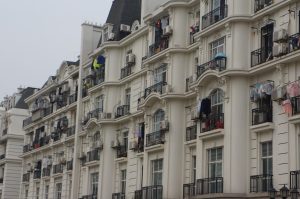
The holiday’s leftovers were still visible. A stack of flattened delivery boxes waited by the bins. A child’s bicycle with a ribbon still tied to the handlebars leaned against the wall. On the balcony opposite, someone had forgotten a row of laundry, and the shirts hung stiff and still in the dead air. The man who sweeps the lane was already halfway along it, pushing his broom in long, even strokes and wearing a padded jacket that had clearly come out of storage that morning too.
What struck me most was the sound. During the holiday, mornings had been slow and scattered. This one had a rhythm again: doors closing, quick footsteps, the beep of electric scooters unlocking, a school bell somewhere beyond the rooftops. The city was going back to work, and everyone’s breath showed in the air.
The first barrel of the season
At the corner where the lane meets the bigger street, there was something new.
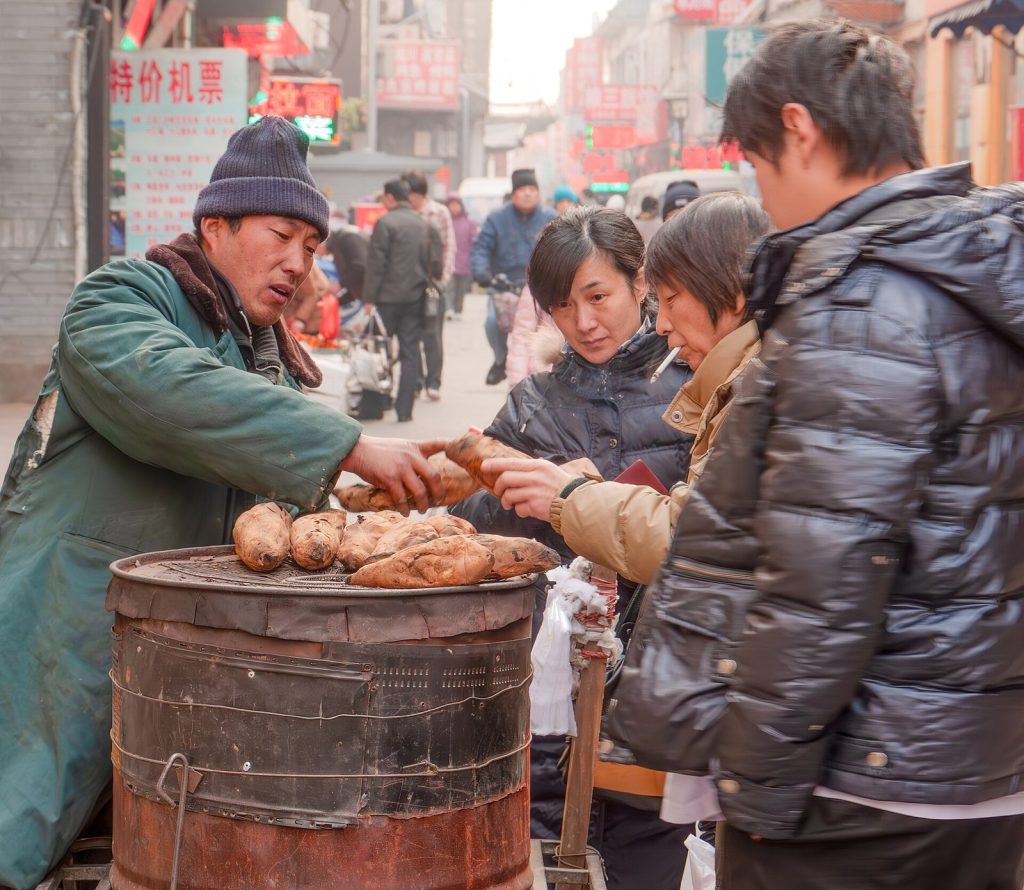
A sweet potato barrel had appeared overnight, or at least overnight as far as I was concerned. It was the familiar kind: a squat metal drum blackened from years of use, with a ring of sweet potatoes laid on the grill around the top and a thin plume of heat rising from the middle. The man tending it had a knitted hat pulled low and a towel over one shoulder. He turned the potatoes one by one with bare fingers, quickly, the way people handle things they have been handling for decades.
I had walked past that corner every day for two weeks and seen only a bicycle rack. Now there was a short queue: a delivery rider with his helmet pushed back, two schoolgirls sharing one bag, and an older woman with a cloth shopping trolley who seemed to know the vendor. They spoke in the quick, joking shorthand of people who see each other every winter.
In my four years in Beijing, I have come to read the arrival of these barrels as a more honest calendar than the official one. Roasted sweet potatoes (烤红薯, kǎo hóngshǔ) are not a festival food. Nobody gives them as gifts. They just turn up on street corners when the air turns, and they disappear again sometime in spring. If you want to know more about this snack, our roast sweet potato street snack guide covers the basics.
I was going to be late if I joined the queue, so I promised myself I would come back in the evening.
The subway, back to normal
The subway station was full again. During Golden Week, the morning trains had carried tourists with maps and families with snacks. Today they carried people in work lanyards, half-asleep, holding coffee in one hand and their phones in the other. The security belt moved at its usual weekday speed. Somebody’s thermos set off a polite inspection.
What I noticed was the coats. Yesterday people were in T-shirts and light jackets. Today half the carriage wore something padded, some of it clearly bought years ago and still creased from the wardrobe. A young man opposite me had a down jacket zipped to the chin and shorts underneath, which seemed like a compromise between two seasons. No one looked surprised. In Beijing, autumn rarely arrives as a slow fade. More often it comes overnight.
If you are new here and caught out by the change, our piece on the first autumn cold snap for new expats is the practical version of this paragraph.
Souvenirs on the desk
At the office, the first hour was more about catching up with people than with work. Small boxes of holiday snacks appeared on the shared table: dried fruit from a hometown, pastries from a trip south, a bag of chestnuts someone had bought on the way in. Everyone asked everyone where they had gone. Some people had been to famous places and complained about the crowds. Others had stayed home and quietly looked rested.
The calendar on my screen showed a full week compressed into three days. Saturday 10 October was a makeup workday, the price of a long holiday. Our explainer on the 10 October makeup workday puts it more gently than my colleagues did. Most of us agreed that the first day back is mainly for answering messages and remembering passwords.
A solar term in the afternoon
Around the middle of the afternoon, my phone’s calendar showed a small grey note: 寒露, Cold Dew. It is one of the 24 solar terms, the traditional markers of the farming year. The Hong Kong Observatory’s calendar puts its start at 14:29 on 8 October 2026. Our Cold Dew guide explains what it means: dew so cold it seems ready to turn to frost, and the point when autumn starts to bite.
It felt almost too neat. The holiday had ended, the scarves had come out, and the old calendar was saying the same thing in its own quiet voice.
The walk home
By the time I left the office, the light was already going. October evenings in Beijing turn blue early, and that blue was colder now. Shop windows looked brighter against it. The traffic had its weekday roar back.
The barrel was still at the corner. The queue had changed shape: office workers on their way home, a couple with a toddler bundled into a stroller, and the same delivery rider, I think, or one who looked just like him. The vendor had lit a small lamp clipped to his cart. Steam came off every potato as he lifted it, split the skin with his thumb to show the orange inside, and dropped it into a paper bag.
I waited my turn and pointed to a medium one, because pointing is a universal language. He weighed it, turned the scale so I could see it, and I paid by scanning the QR code taped to the side of the barrel. The bag was almost too hot to hold. I didn’t mind.
I ate it on the walk back down the lane, peeling the skin away in strips as the man with the broom had swept the lane that morning: carefully, without hurry. It was sweet, soft and slightly smoky, and it warmed my hands better than any glove.
Back in the courtyard, someone had finally brought in the frozen laundry. A light was on in every window. The holiday was over, the cold had arrived, and the corner had its barrel back. In my experience, that’s how a Beijing winter begins. There are no announcements, just small signs that the city has changed its clothes overnight.
If you want to read about the night before, try our story of the last evening of Golden Week. For a practical take on today, our back to work after Golden Week checklist is the companion piece.
About this story
This is a composite, first-person story drawn from common experiences of foreign residents in Beijing. The narrator, the vendor and the other people in it are fictional, and nothing here quotes a real person. The dates are real: Golden Week ran from 1 to 7 October 2026, Thursday 8 October was the first workday back, Saturday 10 October is a makeup workday, and the Hong Kong Observatory gives the start of Cold Dew as 14:29 on 8 October 2026. Lovely China, founded in 2025, welcomes corrections at [email protected].