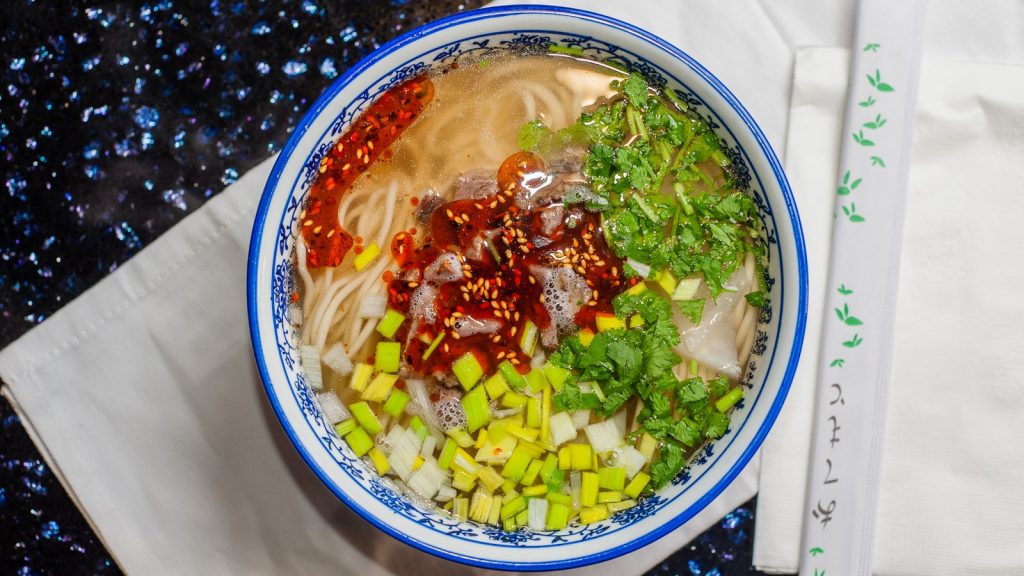
Stepping into a Lanzhou beef noodle shop—often marked by vibrant green signage and the rhythmic thud of dough hitting a flour-dusted counter—is a quintessential culinary experience in China. Whether you are seeking a quick, hearty breakfast before catching a high-speed train or trying to warm up during the brisk travel months of November and December 2026, a steaming bowl of Lanzhou lamian (hand-pulled noodles) hits the spot perfectly. However, the rapid-fire ordering process, the highly specific noodle terminology, and the unwritten rules of the noodle counter can easily overwhelm a first-timer. Here is your practical guide to ordering and customizing your bowl like a seasoned local.
The Anatomy of a Perfect Bowl
Before you order, it helps to understand what you are actually getting. An authentic bowl of Lanzhou beef noodles is judged by a strict standard known across China as “One clear, two white, three red, four green, five yellow” (一清二白三红四绿五黄).
One clear: The rich, aromatic beef and bone broth must be perfectly clear, simmered for hours with dozens of spices.
Two white: Slices of crisp, sweet white radish floating in the soup.
Three red: A generous dollop of bright red, fragrant roasted chili oil.
Four green: A vibrant handful of chopped cilantro and garlic scapes (or leeks) scattered on top.
Five yellow: The hand-pulled noodles themselves, which have a slight yellowish tint and a characteristic chewiness thanks to the addition of jian (alkaline water).
Unlike the intensely numbing and spicy bowls of Chongqing xiaomian or the thick, savory, dry meat sauce found in Beijing zhajiangmian, Lanzhou lamian is fundamentally about the delicate balance of the clear, restorative broth and the freshly pulled dough.
Step 1: Navigating the Shop and the Queue
Lanzhou noodle shops are fast-paced, high-turnover establishments. You do not sit down and wait for a waiter to bring you a menu. Instead, the process works like a well-oiled machine.
When you walk in, head directly to the cashier. Order your base bowl of noodles and any side dishes (like extra beef or a marinated egg). You will pay upfront and receive a small paper ticket.
Take this ticket and walk over to the open kitchen window. Here, you will find the noodle master pulling dough at lightning speed. Hand your ticket to the staff at the window. This is the crucial moment where you must verbally state your noodle thickness and your topping preferences. If you say nothing, they will default to a standard thickness and a standard scoop of chili oil. Once your bowl is handed to you, carefully carry it to any open seat in the dining room.
Step 2: Choosing Your Noodle Thickness
The true art of Lanzhou lamian lies in the pulling. A skilled noodle master can stretch the same block of dough into multiple distinct shapes and thicknesses based entirely on your verbal request. As a first-timer, knowing a few of these terms will completely transform your meal.
Mao Xi (毛细 – Hair Thin): These are the thinnest noodles available. They soak up the broth quickly and are very soft. You must eat them fast before they turn mushy.
Xi (细 – Thin): This is the standard, default thickness. If you do not specify a shape at the window, this is exactly what the chef will make. It offers a balanced chew.
Er Xi (二细 – Second Thin): Slightly thicker and chewier than the standard. This is heavily favored by locals who want a more substantial bite and a noodle that holds its texture well in the hot broth.
Jiu Ye (韭叶 – Leek Leaf): These noodles are flattened out rather than pulled round. They are about the width of a leek leaf, offering a different, ribbon-like mouthfeel.
Kuan (宽 – Wide): A wide, flat noodle.
Da Kuan (大宽 – Extra Wide): A massive, belt-like flat noodle. It requires effort to chew and offers the maximum surface area for the chili oil to cling to.
For your first visit, starting with Xi (standard thin) or Er Xi (second thin) is highly recommended.
Step 3: Customizing Broth, Beef, and Chili
When you hand your ticket to the kitchen window, you also need to call out your broth and topping preferences.
The Chili Oil (Lazi)
Lanzhou chili oil is deeply fragrant and relies on roasted chili flakes. It is less about burning your tongue and more about adding a smoky depth to the clear broth. By default, the cook will add a large spoonful. If you have a low spice tolerance, tell the chef “Shao la” (less spicy) or “Bu yao lazi” (no chili oil). If you want extra, ask for “Duo lazi.” It is always best to start milder than the house default; you can often find extra chili oil in a jar on your table to add later.
The Beef (Rou)
A standard bowl comes with only a few paper-thin slices of beef—just enough for flavoring. To eat like a local, you should order an extra side plate of sliced beef (usually called jia rou) at the cashier. When you sit down, dump this entire plate of cold beef slices directly into your hot soup to warm them up before eating.
The Greens (Xiangcai / Suanmiao)
The broth is generously topped with cilantro and chopped garlic scapes. If you possess the gene that makes cilantro taste like soap, you must quickly tell the chef “Bu yao xiangcai” (no cilantro) when handing over your ticket.
Step 4: Etiquette and Eating Like a Local
In a bustling noodle shop, you are expected to eat efficiently. It is entirely acceptable, and in fact encouraged, to slurp your noodles. Slurping helps cool the hot noodles down as they enter your mouth and shows appreciation for the meal.
Related Lovely China reading
For payments, start with Alipay and WeChat Pay hub and WeChat Pay vs Alipay for tourists. For trains, keep high-speed rail first-timers guide and 12306 passport signup for foreigners handy. City hubs: Beijing first-visit guide, Shanghai first-visit guide. Connectivity: roaming vs local SIM honest guide, pocket Wi-Fi vs eSIM for China, offline maps for foreigners. Bookmark China travel tools page.
Practical checklist
- Confirm official rules on the relevant government, park, airline, or bank page near your travel week
- Screenshot bookings, tickets, and QR codes while you still have stable Wi-Fi
- Save hotel and attraction names in Chinese characters in your phone notes
- Carry passport, a backup payment method, and a small cash float (why cash is still needed)
- Test one small mobile payment before you rely on wallets at a gate or taxi
- Keep the China travel tools page page bookmarked for related Lovely China hubs
FAQ
Is this food advice official?
No. Lovely China orients travellers. Verify live rules on official pages, apps, and counters near your travel week.
Will every city behave the same?
No. Airports, stations, parks, and markets differ. Use local signage and staff instructions when they conflict with a general guide.
What should I screenshot before I lose Wi-Fi?
Bookings, tickets, hotel Chinese address, pickup pins, and payment success screens.
Notes for late 2026 travellers
November and early December bring cooler mornings, earlier sunsets, and comfortable walking weather across much of eastern and central China. Pack layers and leave extra time on clear weekends at popular sights.
This article does not invent ticket prices, opening hours, processing times, consular fees, or official statistics. When a number matters, verify it on the official site, app screen, or ticket board near your travel week.
If an official rule page disagrees with this guide, follow the official page. Lovely China orients English-speaking travellers; we are not an immigration, banking, or medical authority.