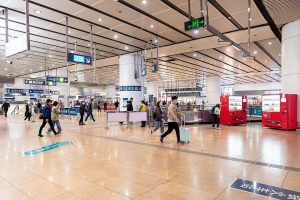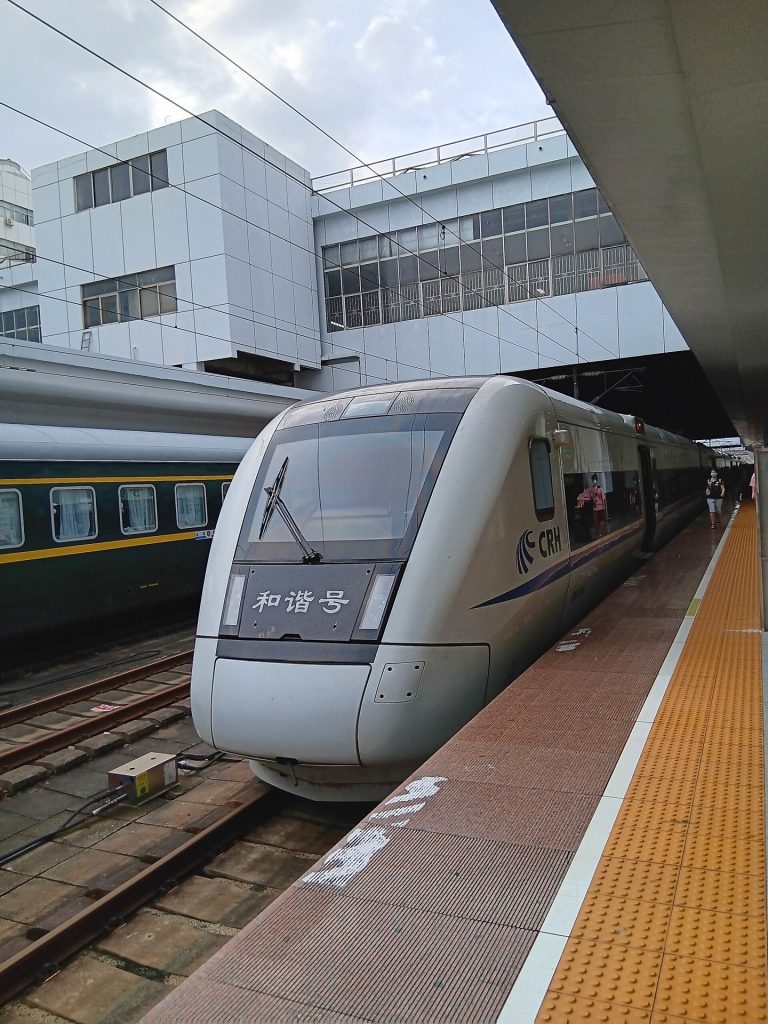
Finding your place on a China high-speed train is a reading task more than a running task. The ticket already tells you the date, train number, station, boarding gate or ticket-check entrance, carriage, and seat. The hall screens repeat most of that. The side of the train repeats the carriage number. What first-timers miss is which field to trust, when a platform changes, and how much of their “early arrival” disappears in security. This is a wayfinding piece, not a repeat of the general first-timers overview, the seat-class explainer, or the missed-train article.
Keep high-speed rail first-timers guide for the wider first ride, 12306 e-ticket gates with a foreign passport for passport e-ticket gates, 12306 window vs aisle seats if you still need window versus aisle, and what to do if you miss a high-speed train if you are already too late.
Read the ticket fields in order
On a 12306 order or a printed slip you will usually see, among other labels:
- 日期 — the date. Confirm it is today.
- 车次 — the train number, such as a G- or D-series code. This is the identity of the service, not a platform number.
- 出发站 — the departure station, in Chinese. Be in that building, not a similarly named one in the same city.
- 检票口 — the ticket-check gate or entrance, often a number or a number plus letter. Hall screens will point you there; it can change.
- 车厢 — the carriage number.
- 座位 — the seat, often a row number plus a letter, sometimes with 靠窗 (window) or 过道 (aisle).
English or pinyin may appear, or it may not. If a label is unfamiliar, photograph the whole ticket and match characters to the overhead boards rather than guessing from a single number. 12306 English interface tips helps with interface language; the boards in the hall still win.
The train number gets you to the correct service. The 检票口 gets you to the correct queue. The carriage number gets you to the correct door. The seat number finishes the job. Do not treat the gate number as a platform number you can ignore if a different staircase looks closer.
Screens, gates, and the walk to the train
Arrivals and departures boards list train numbers, destinations, times, and gate or platform information in bilingual or mixed text. Find your 车次 first, then read sideways to the gate. If two trains share a similar time, the number is the distinguisher.
Platform-open and gate-open times are not a single national rule. They vary by station and by service. We will not invent a minutes-before figure. Follow the board in front of you, and do not wait on the wrong side of a still-closed gate because a blog said “they open twenty minutes prior” at another city.
Once you pass the check, follow signs to the platform. Stand where the carriage number is marked on the ground or on a pillar if those marks exist; if they do not, look along the train body. Each car usually wears a number by the door. Car 08 will not be next to the nose just because you wish it were. Walking the length of a long Fuxing set with a suitcase is possible and annoying; starting at the right zone is kinder.
If a last-minute change appears—new 检票口, new platform, a delayed departure—trust the live screen and the staff announcement over the screenshot you took an hour ago. Recheck the train number so you do not board a neighbouring service that is also going “south.”
Inside the carriage
Seat letters follow the layout of that car. Window and aisle are usually obvious once you are in the row; if you booked a specific side, 12306 window vs aisle seats is already the place for that choice. Put large bags on the rack or in a designated end space, not in the aisle. If someone is in your seat, show the ticket calmly; staff can resolve a genuine double assignment.
Do not linger in the doorway photographing the number while other passengers are trying to board. Step in, confirm the car, then settle.
Leave time for security, then keep some leftover
A common first-timer error is to count only the advertised travel time to the station, then discover security, a long hall, and a gate at the far end. Another is to sit in a station café until a few minutes remain, then find the gate has changed. Arrive early enough that, after security, you can still walk, read a board twice, and use a restroom without a sprint.
If you are already at the wrong station or the gate has closed, stop and use what to do if you miss a high-speed train rather than forcing a ride on the next train with the old ticket. Official 12306 and station signage remain the source of truth. Recheck the order the night before, and again when you enter the hall, so the only surprise left is which end of the platform has the cleaner waiting air in early December.
A compact boarding order
Date, train number, station, gate, carriage, seat—in that sequence, checked once at home and once under the hall board. If any field disagrees with a screenshot, follow the live board. That small ritual is usually enough to turn a huge station into a straight line.
Related Lovely China reading
For payments, start with Alipay and WeChat Pay hub and WeChat Pay vs Alipay for tourists. For trains, keep high-speed rail first-timers guide and 12306 passport signup for foreigners handy. City hubs: Beijing first-visit guide, Shanghai first-visit guide. Connectivity: roaming vs local SIM honest guide, pocket Wi-Fi vs eSIM for China, offline maps for foreigners. Bookmark China travel tools page.
Practical checklist
- Confirm official rules on the relevant government, park, airline, or bank page near your travel week
- Screenshot bookings, tickets, and QR codes while you still have stable Wi-Fi
- Save hotel and attraction names in Chinese characters in your phone notes
- Carry passport, a backup payment method, and a small cash float (why cash is still needed)
- Test one small mobile payment before you rely on wallets at a gate or taxi
- Keep the China travel tools page page bookmarked for related Lovely China hubs
FAQ
Is the 检票口 the same as the platform number?
Not necessarily. 检票口 is the ticket-check gate or entrance on your ticket and on hall screens; it can change. Find your train number first, then follow the live board to the current gate, then match the carriage number on the train body.
Do gates always open a fixed number of minutes before departure?
No. We do not invent a national platform-open time. Follow the board in the station you are in, and keep leftover time after security for a gate change.
What should I screenshot before I lose Wi-Fi?
The 12306 order showing date, train number, departure station, gate, carriage, and seat, plus a second look at the hall board when you arrive.
Notes for late 2026 travellers
November and early December bring cooler mornings, earlier sunsets, and comfortable walking weather across much of eastern and central China. Pack layers and leave extra time on clear weekends at popular sights.
This article does not invent ticket prices, opening hours, processing times, consular fees, or official statistics. When a number matters, verify it on the official site, app screen, or ticket board near your travel week.
If an official rule page disagrees with this guide, follow the official page. Lovely China orients English-speaking travellers; we are not an immigration, banking, or medical authority.