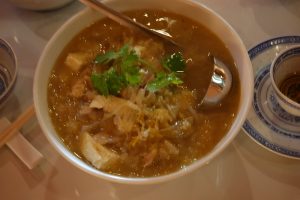
Beijing chao gan (炒肝) is a breakfast dish that startles English speakers twice: first when they translate the name as “fried liver,” and again when a bowl arrives that is clearly a thickened stew. There is no dry wok-fried liver plate hiding under the name. What you get, in a proper old-style breakfast shop, is pork liver and pieces of large intestine in a garlicky, starchy, brown-gold gravy, usually eaten with steamed baozi. It is rustic, aromatic, and not for everyone. That honesty is the point of a first-timer guide.
This is a classic Beijing breakfast, not an obscure dare. If offal is not for you, skip it and go to Beijing jianbing breakfast first-timers. If you are simply unsure, order a small bowl, eat two spoons, and decide.
What is in the bowl
Traditional chao gan uses slices of pork liver and sections of pig large intestine, simmered in a broth thickened with starch and finished with a noticeable amount of garlic, sometimes with ginger, soy, and a sheen of the cooking liquid. The liver should taste clean and slightly mineral, not bitter or muddy. The intestine should be tender, not rubbery, and the gravy should coat a spoon without turning into jelly.
Shops vary. Some bowls are lighter and more garlic-forward. Some are darker and more intense. We will not invent a single “authentic” recipe or a price. Look at the bowl next to you, and look at the menu board.
The dish is usually a breakfast or mid-morning food, not a midnight feast, though some shops keep daytime hours. Late December mornings in Beijing are cold (Beijing late December and New Year planner); a hot bowl in a steamy room is part of the pleasure.
How to order without theatrics
You can point to 炒肝 on the wall. If there are sizes, start with the small one. Many people add baozi — plain, meat, or vegetable buns — and treat the gravy as something to sip and to dip. You do not need a tablecloth or a script.
If you do not eat pork, this is not your dish. If you eat pork but not intestine, ask whether a liver-only bowl exists. Some shops will oblige; many will not. A courteous “no, thank you” is enough if the answer is no.
Eat it hot. The starch sets as it cools, and the garlic is kinder when the bowl is steaming. If the first smell is too strong, wait thirty seconds and try a piece of liver with gravy rather than a standalone piece of intestine.
What “good” feels like, without a fake ranking
There is no official best shop in this article, and no address list. Useful signs are ordinary: a line of locals in the morning, a kitchen that looks busy rather than theatrical, and bowls that go out fast enough to be hot. Hutong breakfast counters and old commercial streets are the usual habitat. A glossy mall food court may serve a version; it may also be a mild cousin of the real thing.
If the liver tastes sharply bitter, or the gravy is glue, you met a weak bowl, not “the true Beijing taste.” You are allowed not to finish it. Pay, thank the staff, and go into the cold for a jianbing if you still need something milder.
How it sits in a Beijing food day
Chao gan is a one-bowl event. It is not a gateway to ten other offal dishes unless you want that path. It pairs naturally with soy milk, buns, and a planned morning at a nearby hutong or a later subway ride to a major sight. It does not pair well with a rushed Forbidden City ticket and a taxi that is already waiting.
Bring a tested payment method. Many breakfast counters are QR-first (paying street vendors that only take a QR code) and may also take cash. We do not invent their rules.
If you are visiting in January, close to Spring Festival, breakfast shops can be busier, but this is still everyday food rather than a festival ritual. No one is required to eat chao gan for luck. You eat it because you want to understand a Beijing morning in a cup of gravy.
A first bowl of chao gan is a vocabulary lesson: the name misleads, the texture is a stew, and the city is unsentimental about breakfast. Try it once, with buns, and you will know whether Beijing’s more fragrant morning belongs on your second trip as well.
Ground-level reminders for this topic
Stay flexible when a counter, app screen, or staff instruction disagrees with a blog. Lovely China orients travellers; live official pages and bilingual signs win. Keep China travel tools page, essential apps for foreigners, and Alipay and WeChat Pay hub bookmarked so logistics stay boring while you focus on the angle of this guide: what Beijing chao gan (炒肝) is, how to order it, and what first-timers should expect: it is a thickened offal stew, not a fried dish, despite the name. Where-style guidance without fake addresses..
Related Lovely China reading
For payments, start with Alipay and WeChat Pay hub and WeChat Pay vs Alipay for tourists. For trains, keep high-speed rail first-timers guide and 12306 passport signup for foreigners handy. City hubs: Beijing first-visit guide, Shanghai first-visit guide. Connectivity: roaming vs local SIM honest guide, pocket Wi-Fi vs eSIM for China, offline maps for foreigners. Bookmark China travel tools page.
Practical checklist
- Confirm official rules on the relevant government, park, airline, or bank page near your travel week
- Screenshot bookings, tickets, and QR codes while you still have stable Wi-Fi
- Save hotel and attraction names in Chinese characters in your phone notes
- Carry passport, a backup payment method, and a small cash float (why cash is still needed)
- Test one small mobile payment before you rely on wallets at a gate or taxi
- Keep the China travel tools page bookmarked for related Lovely China hubs
FAQ
Is chao gan fried liver?
The name 炒肝 looks like ‘fried liver,’ but the dish is a thickened stew of pork liver and large intestines in a garlicky starch broth, not a dry stir-fry. Order it only if you are comfortable with offal.
What is it usually eaten with?
Many breakfast shops serve it with steamed baozi. A small bowl is a sensible first order.
Where is the official best shop?
There is no official ranking here. Look for a busy traditional breakfast counter and read the menu. We do not invent addresses or prices.
What if I do not eat offal?
Skip it and choose another Beijing breakfast, such as jianbing, which we cover in a separate guide. You do not need to finish a bowl to be polite if it is not for you; just be straightforward and courteous.
Notes for late 2026 travellers
Late December 2026 and the New Year week into 2027 bring colder mornings, earlier sunsets, and holiday crowds in many city hubs. Pack real winter layers in the north, and leave extra time on weekends and around 1 January.
This article does not invent ticket prices, opening hours, processing times, consular fees, or official statistics. When a number matters, verify it on the official site, app screen, or ticket board near your travel week.
If an official rule page disagrees with this guide, follow the official page. Lovely China orients English-speaking travellers; we are not an immigration, banking, or medical authority.