The minibus shuddered to a halt beside a wind-scoured stretch of the Gobi, and the driver pointed toward a low mound of eroded rammed earth barely distinguishable from the surrounding gravel. That was Suoyang City — once a garrison town that guarded the Hexi Corridor, now a silhouette against a sky the color of bruised lapis. I had arrived in Guazhou County, the westernmost slice of Gansu Province, where the Silk Road narrows between desert and mountain and the past sits exposed under a relentless sun.
Getting There Without a Tour Bus
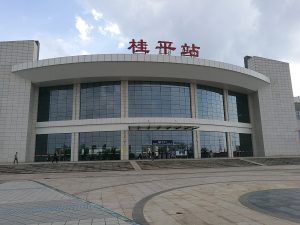
Most foreigners reach Guazhou as a day trip from Dunhuang, but the county has its own high-speed rail station, Guazhou Railway Station, on the Lanzhou–Xinjiang line. Trains from Lanzhou take roughly four hours; from Liuyuan South, the next major stop west, it is twenty minutes. If you fly, Dunhuang Mogao International Airport is the closest runway — about ninety minutes by road. Taxis wait at the station forecourt, but drivers rarely speak English. Have the Chinese characters for your destination written on your phone: 渊泉镇 for the county seat Yuanquan, 锁阳城 for Suoyang City, and 榆林窟 for the Yulin Caves.
Public buses connect Yuanquan with the two main heritage sites, yet schedules shift with the season. In spring and autumn a morning departure from the county bus station (near the intersection of Guazhou Avenue and Xinhua Road) reaches Suoyang in an hour; the last return leaves the ruins around 4 p.m. The Yulin Caves lie farther south, nearer the Qilian foothills, and the bus runs only when enough passengers gather. Many travelers hire a private car in Yuanquan for the day — negotiate around 400 to 600 yuan for both sites, including waiting time. Confirm the driver knows the cave ticket office location; the turnoff is unmarked from the main highway.
Suoyang City: Walking the Wall Line
The ruins spread across a flat terrace where the Shule River once branched. You enter through a gap in the northern rampart where a ticket booth and a shade pavilion sit. Inside, the city plan is still legible: a rectangular outer wall, an inner citadel, and the faint grid of streets marked by lines of melted adobe bricks. Information panels in Chinese and English explain the Tang and Western Xia layers, but the real story is under your boots — pottery shards glazed green, fragments of copper coins, the occasional bead. Wear closed shoes; the ground is littered with sharp shale and thorny camelthorn.
- Bring a wide-brim hat and at least two liters of water — there is no shade beyond the entrance pavilion.
- Morning light hits the western wall best for photography; late afternoon casts long shadows across the citadel mound.
- Allow ninety minutes to walk the full perimeter at a slow pace.
- Do not climb the fragile ramparts; a park ranger patrols on a motorbike and will whistle you down.
Yulin Caves: The Quieter Sister of Mogao
Forty kilometers south of Yuanquan, the Yulin Caves hug a sandstone cliff above a dry riverbed. Only a handful of the forty-odd grottoes are open at any time, rotated for conservation. A guide — mandatory and included in the ticket — leads small groups with a flashlight. The murals here feel more intimate than Dunhuang’s grand halls: Tang dynasty bodhisattvas with rounded cheeks, Western Xia donor portraits in vivid mineral blues, a rare depiction of a Sogdian merchant caravan. Photography inside is prohibited; the flashlight beam is the only light allowed on the pigments.
- Book the earliest slot (usually 9 a.m.) to avoid the heat that builds in the cliff face by noon.
- Wear a light jacket; the cave interiors stay cool even in midsummer.
- Tip the guide 20 to 50 yuan if they answer questions in English — most speak only Mandarin, but a few studied tourism in Lanzhou.
- Combine the visit with a stop at the nearby Han Dynasty Great Wall beacon tower, a short drive east along a dirt track.
Yuanquan Town: Eating and Sleeping
The county seat is a grid of wide boulevards lined with poplars, built around a central square where retirees fly kites at dusk. Accommodation clusters near the railway station: the Guazhou Hotel (瓜州宾馆) offers clean rooms with reliable hot water; a handful of newer express chains — Jinjiang Inn, 7 Days — sit across the street. For food, walk two blocks west to the night market that sets up after sunset along Jiefang Road. Stalls serve hand-pulled lamb noodles (羊肉拉面), cumin-dusted grilled mutton skewers, and cold skin noodles (凉皮) tossed with chili oil, vinegar, and garlic. A bowl of noodles and a skewer cost roughly 25 yuan. Vegetarians can ask for “su mian” (素面) — plain wheat noodles with tomato-egg sauce — but confirm no meat broth was used.
If you have an evening, climb the small hill behind the county museum (瓜州县博物馆) for a view of the town lights bleeding into the desert. The museum itself holds a modest collection of Silk Road coins, Buddhist sutra fragments, and a recreated Tang-era postal relay station. It opens 9 a.m. to 5 p.m., closed Mondays; entry is free with passport.
Seasonal Rhythms and Practical Warnings
Spring (the third to fifth lunar months) brings wild apricot blossoms in the river valleys and daytime highs around 20 °C — ideal for hiking the beacon towers. Summer pushes past 35 °C; the ground radiates heat through thin soles, and sandstorms can close the Yulin access road for hours. Autumn (eighth to tenth lunar months) is the golden window: clear skies, cool nights, and the poplar corridors turning amber. Winter drops below -15 °C at night; only the hardiest travelers stay, and some cave tours suspend operation.
- Carry cash (small denominations) — many ticket booths and food stalls do not accept mobile pay from foreign cards.
- Download offline maps; mobile signal vanishes between Yuanquan and the caves.
- Toilets at both heritage sites are squat-style, no paper provided. Pack tissues and hand sanitizer.
- If you plan to continue west to Dunhuang or east to Jiayuguan, buy train tickets the moment they release (30 days ahead) — seats on the high-speed D trains sell out fast during holiday periods.
What Newcomers Get Wrong
First-timers often treat Guazhou as a checkbox between Dunhuang and Jiayuguan, allotting half a day. The desert distances demand more: travel time, waiting for the cave guide, the slow walk across Suoyang’s silent streets. Another mistake is assuming English signage covers everything — beyond the main panels, directional signs are Chinese-only. Learn the characters for “exit” (出口), “water” (水), and “toilet” (厕所). Finally, do not expect nightlife. After the night market packs up around 10 p.m., Yuanquan goes quiet. That silence, broken only by wind in the poplars, is exactly why the Silk Road travelers once paused here — to rest, resupply, and watch the stars wheel over the Gobi.