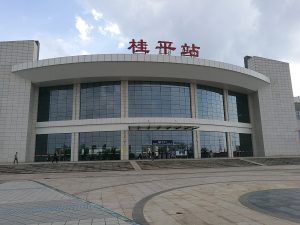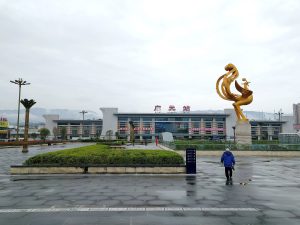
The high-speed train from Nanning slides into Guigang station in forty minutes, depositing you onto a wide plaza where a handful of taxis idle under a row of kapok trees. There is no tour‑group flag, no souvenir kiosk, just a steady stream of commuters heading toward the elevated walkway that crosses Jiangbei East Road. You step into the humid air, buy a bottle of iced lemon tea from a vending machine, and realize the city does not perform for visitors — it simply carries on.
Getting there and moving around
Most travelers arrive on the bullet line that stitches Nanning, Guigang, and Guiping together. The station sits on the northern edge of the urban core, a clean modern box with a single exit that funnels you straight onto a bus lane. If you come by long‑distance coach, the General Bus Station on Heping Road handles routes to Guangdong and Yunnan, while the South, East, and West stations serve county‑level towns and the industrial parks along the Yu River.
- High‑speed rail: frequent departures from Nanning East (about 40 minutes) and Liuzhou (just over an hour).
- City buses: routes 1, 2, 8, and 12 link the railway station, the riverfront parks, and the older downtown around Zhongshan Road. Fare is two yuan, exact change or a transit card.
- Ride‑hailing: Didi works reliably; a cross‑town trip rarely exceeds twenty yuan.
- Shared bikes: blue‑and‑white dockless bicycles cluster near park gates and university campuses — scan, ride, lock anywhere legal.
Traffic thickens around 6 p.m. when factory shifts end, so allow extra time if you have a train to catch. The city is flat and compact enough that a bicycle covers most sights in half an hour.
Parks and riverfront walks
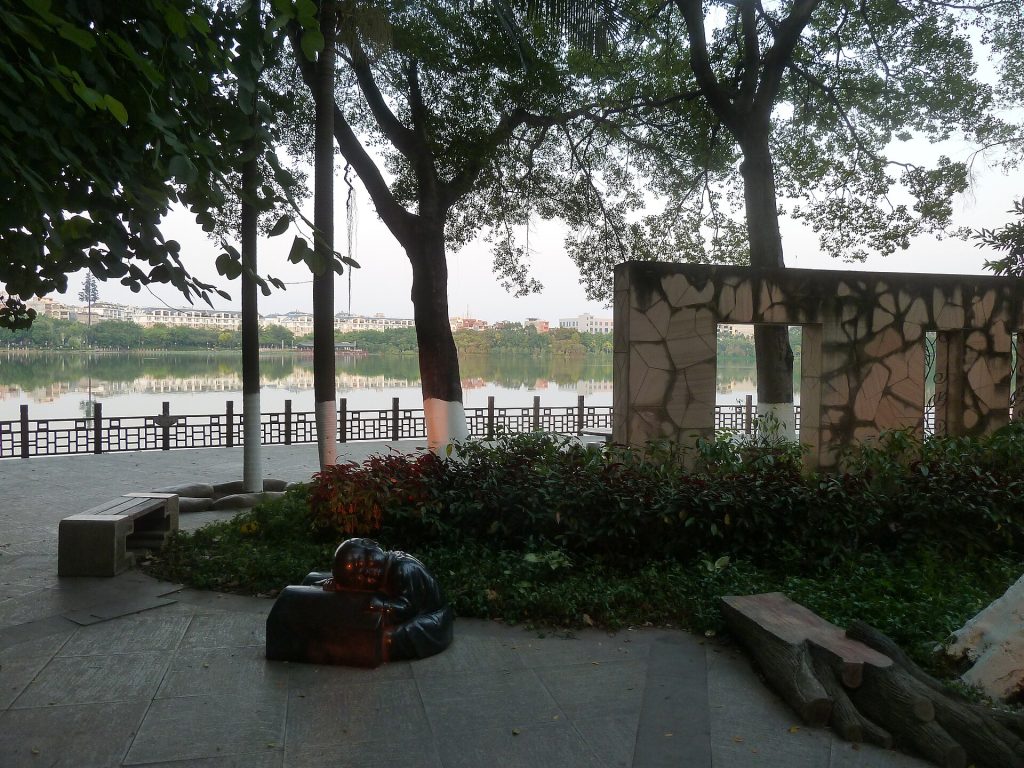
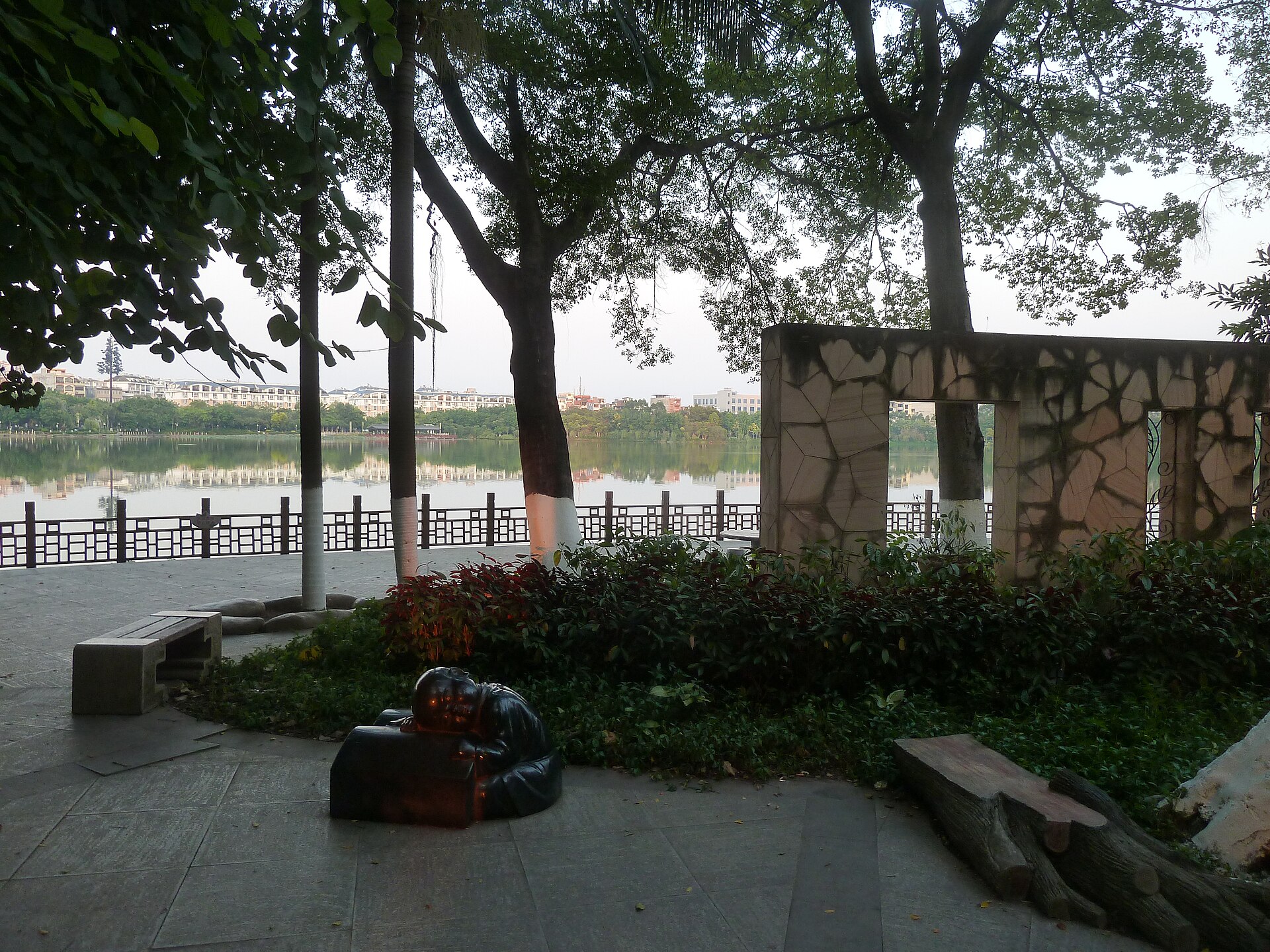
Guigang’s claim to leisure is a string of linear parks that follow the Yu River and its tributaries. Start at Binjiang Park, where a broad promenade runs beneath banyan roots that dip into the water. Elderly men practice calligraphy with oversized brushes on the pavement; the characters vanish in the morning heat. Continue north to the Wetland Park, a reclaimed marsh where egrets stalk between lotus stands. In late summer the lotus flowers open pink and white, and the air carries a faint vegetal perfume.
- Binjiang Park: open all day, free entry; best at dawn for tai chi groups and at dusk for families flying kites.
- Yu River Wetland Park: boardwalk loops of two to three kilometers; bring mosquito repellent in the warmer months.
- People’s Park (Renmin Gongyuan): small hilltop pavilion with a view of the railway bridge; popular for weekend dance squares.
Locals treat these spaces as outdoor living rooms. You will see grandparents minding toddlers on scooters, couples sharing earbuds, and students rehearsing English speeches under the trees. Join a morning stretch circle if you want an easy way to meet people — just mimic the movements and smile.
Day trip to Guiping
Twenty minutes on a G‑train drops you in Guiping, a county‑level city that feels older and more deliberate. The main draw is Xishan (West Mountain), a limestone ridge crowned with temples and a giant sleeping Buddha carved into the cliff face. Take the cable car up or hike the stone steps — about 1,200 of them — past shrines where incense coils hang like amber spirals. From the summit you can trace the Zhujiang River curling through karst peaks toward the horizon.
- Train: Guigang → Guiping, departures every 30‑40 minutes; second‑class seat around fifteen yuan.
- Xishan cable car: round‑trip roughly sixty yuan; runs 8 a.m.–5 p.m., last car down at 5 30 p.m.
- Lunch: try a bowl of Guiping rice noodles (米粉) at a stall near the mountain’s south gate — broth simmered with pork bones, star anise, and a spoonful of fermented bean paste.
If you have an extra hour, walk the old street behind the train station where wood‑carved shopfronts sell dried plum candy and hand‑rolled tobacco. The pace slows here; shopkeepers sip tea from lidded cups and wave you in without pressure to buy.
Eating in Guigang
The city does not advertise a signature dish, but the night markets along Zhongshan Road and near the South Bus Station serve honest Guangxi home cooking. Order a plate of stir‑fried river snails (田螺) — slurped straight from the shell with a toothpick — and a side of sour bamboo shoot stewed with pork belly. The bamboo brings a bright acidity that cuts the richness. For breakfast, hunt down a bowl of rice noodle soup topped with pickled mustard greens, crushed peanuts, and a drizzle of chili oil; the broth remembers every hand that stirred it.
- River snails: flash‑fried with garlic, ginger, perilla leaves, and a splash of rice wine. Eat hot; they turn rubbery as they cool.
- Sour bamboo & pork belly: slow‑braised until the meat yields to chopsticks; serve over steamed rice.
- Breakfast noodles: hand‑pulled rice vermicelli, clear bone broth, toppings added to order.
- Fruit: mangoes and longans pile high on pushcarts in late summer; vendors will slice and bag them for a few yuan.
Vegetarians can ask for “su” versions — most stir‑fry stalls keep tofu and seasonal greens on hand. Avoid the grilled skewers after 10 p.m. if your stomach is unfamiliar with heavy cumin and chili dust; the morning after can be unforgiving.
What newcomers get wrong
First, they expect English signage. Outside the railway station and a handful of chain hotels, you will read Chinese only. Download an offline map and save the Chinese names of your destinations (贵港站, 滨江公园, 西山) before you arrive. Second, they assume the city shuts down early. The river parks stay lively until midnight in warm weather, and noodle shops keep burners lit for night‑shift workers. Third, they try to “do” Guigang in half a day. The place rewards lingering — sitting on a stone bench with a plastic stool, watching a kite fight the wind, letting the humidity settle on your skin. If you treat it as a checklist, you will miss the rhythm that makes it feel like somewhere rather than nowhere.
Practical reminders
- Cash: small vendors still prefer notes or WeChat/Alipay QR codes; carry a few tens and twenties.
- Language: a pocket phrasebook with “我要一碗粉” (one bowl of noodles) and “去滨江公园” (to Binjiang Park) goes far.
- Weather: spring brings drizzle; summer is hot and thunderous; autumn is dry and comfortable; winter rarely drops below ten degrees Celsius.
- Connectivity: 4G covers the whole urban area; free Wi‑Fi in the station concourse and major parks.
When the train whistle sounds again and you roll back toward Nanning, the kapok trees will still be shedding red petals onto the plaza. You might not tell friends you “did” Guigang, but you will remember the taste of sour bamboo on your fingers and the sound of brush strokes disappearing on hot concrete.