The minibus from Lanzhou’s south station shudders over the Yellow River bridge, then climbs into hills where the air thins and smells of pine and coal smoke. Two and a half hours later the driver calls “Linxia!” and the doors fold open onto a street where Arabic script shares signage with Chinese characters, and the call to prayer drifts from a minaret tucked between apartment blocks. This is the prefecture capital, a place where Hui, Han, Tibetan, Salar, and Dongxiang families have shared alleyways for generations.
Arriving and Getting Oriented
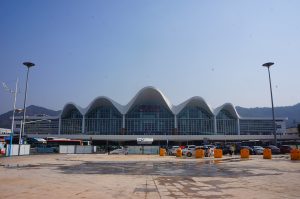
Two long-distance terminals serve the city. The West Terminal, run by the state carrier, sits on the newer ring road; taxis queue in a formal line and a digital board flashes destinations. The South Terminal on Jiefang Road is older, louder, and operated by private drivers who shout departure times from open doors. Fares to Lanzhou differ by only a few yuan. Buses from Lanzhou South leave roughly every half hour from early morning until late afternoon; the ride takes about two and a half hours. From Xiahe, hourly departures run from morning to early afternoon and need two to three hours. The Xining route stretches to five hours, while the mountain road to Menda Tianchi takes four. There is no train station and no commercial airport — the road is the only way in.
- Lanzhou South Bus Terminal → Linxia: ~2.5 hours, departures every 30 minutes, 7 am–5 pm
- Xiahe Bus Station → Linxia: 2–3 hours, hourly morning to early afternoon
- Xining → Linxia: ~5 hours, few daily departures
- Menda Tianchi → Linxia: ~4 hours, seasonal schedule
Once inside the city, public buses numbered 1 through 12 connect the main sights for one or two yuan. Taxis start at a flag-fall of around eight yuan and rarely exceed twenty for cross-town trips. Many visitors rent an electric scooter from a shop near the South Terminal — thirty yuan a day, helmet included — which turns the steep lanes into a pleasure instead of a calf workout.
Mosques Worth the Walk
Linxia is sometimes called “Little Mecca of China,” and the density of mosques bears that out. The most visible is the Da Gongbei complex on the hill north of the river. Its green dome and twin minarets glow at dusk, visible from the riverside park where elders fly kites. Inside, the prayer hall holds a forest of carved wooden columns; the mihrab is inlaid with turquoise and lapis lazuli tiles that catch the late light. Non-Muslims may enter the courtyard but should keep voices low, remove hats, and avoid the carpeted prayer area during the five daily salat.
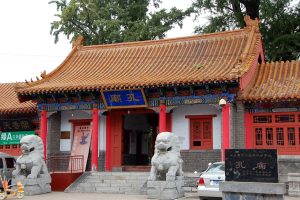
Half a kilometer south, the Nanguan Mosque sits in a warren of lanes behind the old city gate. Its minaret leans like a tired sentinel, and the ablution fountain in the courtyard still uses a hand pump. Friday midday sees the square packed; if you arrive then, stand at the back and watch the rhythm of bowing and prostration — it is a lesson in discipline older than any guidebook. The smaller Hongyuan Mosque, near the market, has a women’s prayer hall with its own entrance, a reminder that Hui practice has long accommodated gendered space without segregation from community life.
- Da Gongbei: hilltop, green dome, open courtyard, best at sunset
- Nanguan Mosque: historic quarter, hand-pump ablution, busy Friday noon
- Hongyuan Mosque: market area, separate women’s hall, quieter weekdays
Markets, Stupas, and the River Loop
The daily market on Jiefang Road starts before dawn. By 7 am the pavement disappears under pyramids of dried chilies, sacks of hand-rolled noodles, and trays of steamed buns stuffed with mutton and cumin. Tibetan women in brocade aprons sell yak butter and coral jewelry beside Hui vendors hawking halal sausages coiled like springs. Move upstream along the Daxia River promenade and the noise fades. Whitewashed Tibetan stupas crown the opposite ridge, their spires catching wind-driven prayer flags. A paved loop follows the river for three kilometers — joggers, grandparents with caged songbirds, and couples sharing roasted sweet potatoes share the path.
If you have half a day, hire a driver for the forty-minute climb to Bingling Temple. The grottoes, carved into cliffs above the Liujiaxia Reservoir, hold Tang-dynasty Buddhas that have watched the water rise and fall for thirteen centuries. Boats leave the dam pier when a group of eight assembles; the ride through turquoise canyons is worth the wait. Bring water and a windbreaker — the gorge funnels cold air even in high summer.
Eating: What Lands on the Table
Linxia’s cuisine is halal by default, wheat-heavy, and built around mutton, beef, and root vegetables. The signature dish is hezhou lamb — slow-braised shank in a broth scented with star anise, cassia bark, and dried tangerine peel. The meat falls off the bone; the broth is sipped from a bowl with a splash of black vinegar and a pinch of chili oil. Hand-pulled noodles (lamian) arrive in that same broth, topped with cilantro, garlic shoots, and a spoonful of fermented chili paste. Cold dishes include liangfen — mung-bean jelly cut into ribbons, dressed with sesame paste, aged vinegar, and crushed peanuts — and thin-sliced beef tendon tossed with scallions and Sichuan peppercorns.
Breakfast is a ritual. Locals queue at steam carts for sanzi, twisted wheat threads deep-fried to a lace-crisp, eaten with a bowl of millet congee and a side of pickled radish. Bakeries pull nang — sesame-studded flatbreads — from tandoor ovens every twenty minutes; the best are still warm enough to burn fingertips.
In a restaurant, point to the picture menu or say “yangrou lamian” for noodles, “kao yangrou” for grilled skewers, “liangfen” for the cold jelly. A plate of skewers costs twenty to thirty yuan; a bowl of noodles, twelve to fifteen. Tea houses serve endless cups of brick tea with rock sugar — refill is free, but leave a few coins on the tray.
Beginner Missteps
First-timers often schedule Friday midday at the mosques, not realizing the courtyards swell to capacity and tourists are gently ushered out. Come Thursday evening or Saturday morning instead. Another mistake: assuming every eatery opens all day. Many family-run noodle shops close between 2 pm and 5 pm for the owner’s rest; the busiest stalls at the night market don’t fire woks until after sunset. Dress is conservative — shoulders and knees covered — especially when entering religious sites. Photography inside prayer halls is frowned upon; ask before raising a camera. Finally, the altitude sits around 2,000 meters. Visitors from the coast sometimes push the river loop too hard on day one and spend day two nursing a headache. Hydrate, move slow, and let the call to prayer set the pace.
Seasonal Rhythm
Spring brings the peach blossoms on the hills and the Mawlid processions — lanterns, drum teams, and families distributing sweet rice porridge to passersby. Summer is the season for the river loop at dusk, when the air cools and the stupas glow against a indigo sky. Autumn harvest fills the market with walnuts, apples, and the first pressed sesame oil. Winter is quiet; the minibus to Bingling may not run if ice clogs the reservoir, but the city’s tea houses stay warm, and a bowl of hezhou lamb broth chases the chill better than any heater.