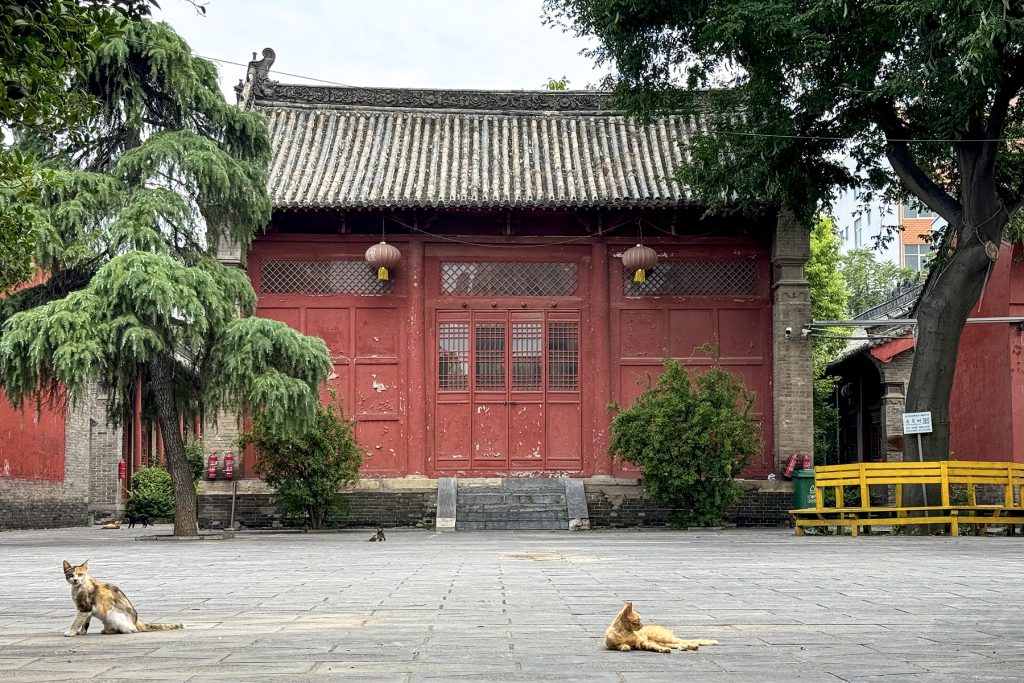
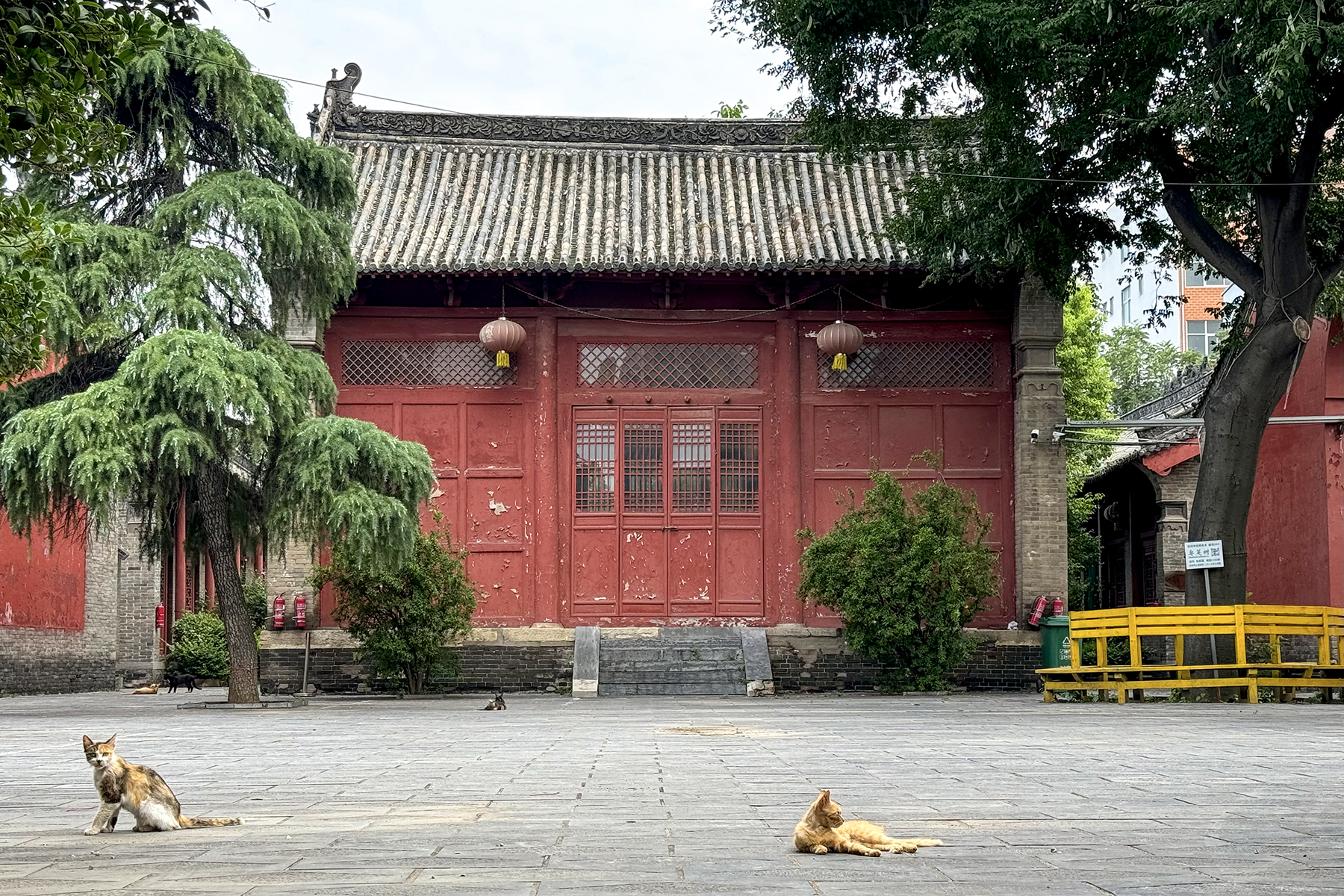
The minibus rattles to a halt beside a steaming pot of hulatang at the corner of Renmin Road. Steam curls into the cool morning air, thick with pepper and beef bone broth. An elderly vendor ladles the soup into a blue-rimmed bowl, drops in a spoonful of chili oil, and slides it across the counter without a word. You sip, the heat spreading through your fingers, and watch the city wake — cyclists threading through the mist rising off the Ruhe River, the distant clang of a temple bell from Fengxue Shan. This is Ruzhou: unhurried, fragrant, and quietly proud of its kilns.
Getting Oriented
Ruzhou sits in western Henan, folded between the Songshan foothills to the north and the Funiu range to the south. The Ruhe River cuts a silver line through the center, dividing the older neighborhoods — narrow lanes, tiled roofs, the scent of coal briquettes in winter — from the newer districts where porcelain showrooms glow beside wide boulevards. Most visitors arrive via Pingdingshan, forty minutes by high-speed rail or an hour on the expressway. From the station, a taxi to the city center costs roughly thirty yuan; local buses numbered 1, 6, and 9 connect the main sites for pocket change.
Spring and autumn are the sweet spots. In the third lunar month, plum blossoms dust the hills pink-white, and the porcelain festival fills the exhibition halls with collectors. By the ninth month, persimmons hang like lanterns in courtyard trees, and the air turns crisp enough for long hikes. Summer brings sudden thunderstorms that turn mountain paths slick; winter sees temperatures drop below freezing, though the kilns stay warm year-round.
Fengxue Temple: The Quiet Giant
Seven kilometers southwest of town, Fengxue Temple hides in a cleft of Fengxue Mountain. Founded in the Northern Wei, expanded under the Tang, it ranks among the Four Great Temples of Central China — yet it receives a fraction of Shaolin’s crowds. The approach winds through a gorge where cypress roots grip limestone. You pass the Bell Tower first, its bronze tongue still rung at dawn, then the Hall of Heavenly Kings, where the guardians’ painted eyes follow you past the threshold.
The real prize sits higher: the Seven Ancestors Pagoda, a Tang-era brick tower tapering to a lotus bud finial. Its eaves curve like frozen waves. Climb the interior staircase — narrow, steep, smelling of incense ash — and the view opens onto the Ruhe valley, a patchwork of wheat fields and tile roofs. Monks still chant in the Mahavira Hall at 4:30 a.m. If you stay overnight in the temple guesthouse (simple rooms, shared bath, vegetarian meals), you can join them. Bring a flashlight; the mountain paths have no lamps.
Ru Porcelain: Touching the Song Dynasty
Ru ware — celadon so pale it mimics “the sky after rain clearing” — was fired here for the Song court. Only a handful of authentic pieces survive in museums worldwide. The modern kilns in Ru Porcelain Town, twenty minutes east by car, recreate the glaze using local clay and a reduction firing that starves the kiln of oxygen. Visit the Ru Official Kiln Site Museum first: shards under glass show the signature sesame-seed spur marks on the base, the faint crackle network called “cicada wings.”
Then walk the production lane. Artisans throw forms on kick wheels — brush washers, narcissus bowls, incense burners — their hands moving in rhythms unchanged for centuries. You can try glazing a bisque piece yourself: dip, rotate, let the excess drip. The workshop fires it overnight; you collect it the next afternoon, wrapped in newspaper. The glaze may pool thicker on one side, a flaw the Song connoisseurs would have rejected but your fingers will recognize as human.
- Clay: local kaolin mixed with feldspar and quartz, aged six months in shaded pits.
- Glaze: iron oxide (1–2%), wood ash, limestone — no modern fluxes.
- Firing: 1280–1300°C in a dragon kiln, reduction atmosphere held for twelve hours.
- Cooling: natural, three days before the kiln door opens.
Mistake beginners make: buying the first “Ru porcelain” shop near the highway. Those are often stoneware with green spray paint. Look for the kiln’s own mark — a square seal impressed into the foot — and ask to see the firing record. Real pieces ring like a chime when tapped; fakes thud.
Plum Blossom Jade & the “Ru Tie” Scroll
The second treasure, plum blossom jade, occurs only in the riverbeds around Ruzhou. Its milky white base carries dendritic manganese patterns — branching like ink plums on rice paper. Lapidaries in the Jade Market (behind the Cultural Center) slice rough nodules on diamond saws, revealing landscapes inside. A palm-sized cabochon might cost two hundred yuan; a bracelet of matched beads, ten times that. Bargain hard but respectfully — the cutter’s dust cough is real.
The third treasure, “Ru Tie,” is not jade or clay but calligraphy: a collection of Northern Song imperial letters and poems carved into stone stelae, housed in the Ruzhou Museum. The ink rubbings smell of wormwood and pine soot. You don’t need to read classical Chinese to feel the brush pressure in Wang Xizhi’s copies — the way a stroke thickens, hesitates, flies. The museum labels are bilingual; allow ninety minutes.
Eating Like a Local
Breakfast is hulatang, always. The best bowls simmer since midnight: beef bones, gluten knots, kelp, vermicelli, a blizzard of white pepper. Locals add vinegar and chili oil at the table, never before. For lunch, seek a courtyard restaurant serving Ruzhou braised chicken — whole bird, soy, star anise, rock sugar, cooked until the meat falls from the bone and the sauce glazes your fingers. Dinner means hotpot in winter: mutton sliced paper-thin, chrysanthemum leaves, frozen tofu that drinks the broth.
- Hulatang: beef bone stock, gluten, kelp, vermicelli, white pepper, ginger, chili oil, vinegar.
- Braised chicken: free-range hen, dark soy, light soy, rock sugar, star anise, cinnamon, ginger, scallion, Shaoxing wine.
- Mutton hotpot: thin-sliced shoulder, chrysanthemum greens, frozen tofu, glass noodles, dipping sauce (sesame paste, fermented tofu, chili oil, cilantro).
Restaurant ordering tip: point to a table where locals are eating and say “yiyang” — same as that. Menus often lack pictures. Avoid places with English translations laminated on the cover; they cater to tour groups and salt the food accordingly.
Mountain Walks & River Nights
Songshan’s northern spur, Songji Mountain, rises behind the city. A paved trail climbs from the Forest Park gate to the summit in ninety minutes — stone steps, iron handrails, pavilions every few hundred meters. Elderly couples power-walk it daily; teenagers blast pop from phones. At the top, a platform frames the city grid, the river’s curve, the kiln chimneys puffing white. Come at dusk in autumn: the persimmon trees below glow like embers.
For solitude, take the old pilgrim path up Fengxue Mountain’s back ridge. No handrails, faint trail markers, the occasional monkey troop. You’ll pass a hermit’s hut — tea kettle on a clay stove, no visitors welcome — and emerge at a cliffside shrine where pilgrims tie red ribbons. Descend before dark; the forest swallows light fast.
Evenings belong to the Ruhe River promenade. Locals fly kites shaped like centipedes, dance in synchronized squares, grill squid on charcoal carts. Join a circle of retirees playing mahjong on folding stools — they’ll teach you the tiles if you buy the beer. The river reflects the porcelain-town lights: kiln towers lit amber, the museum’s glass wall glowing jade-green. No one rushes home.
Practical Missteps
Don’t assume English works beyond the museum and major hotels. Download offline maps; street signs use pinyin without tone marks. Carry small bills — vendors rarely break hundred-yuan notes. The train station has no luggage storage; if you’re day-tripping from Pingdingshan, pack light.
Don’t schedule kiln visits on Mondays; most workshops close for equipment maintenance. Don’t wear white shoes to the jade market — the cutting slurry stains everything a permanent gray-green. And don’t skip the temple’s vegetarian noodles because you “want real food.” The hand-pulled strands in mushroom broth, topped with pickled mustard greens, are the realest meal in town.
When the last bus leaves for Pingdingshan, the city exhales. Kiln masters bank their fires. The hulatang vendor upends her pot, scrapes the sediment, and walks home through lanes smelling of woodsmoke and wet clay. You’ll still have dust under your fingernails from the glaze workshop, a red ribbon tied to your backpack, and the taste of white pepper on your lips. That’s the souvenir.