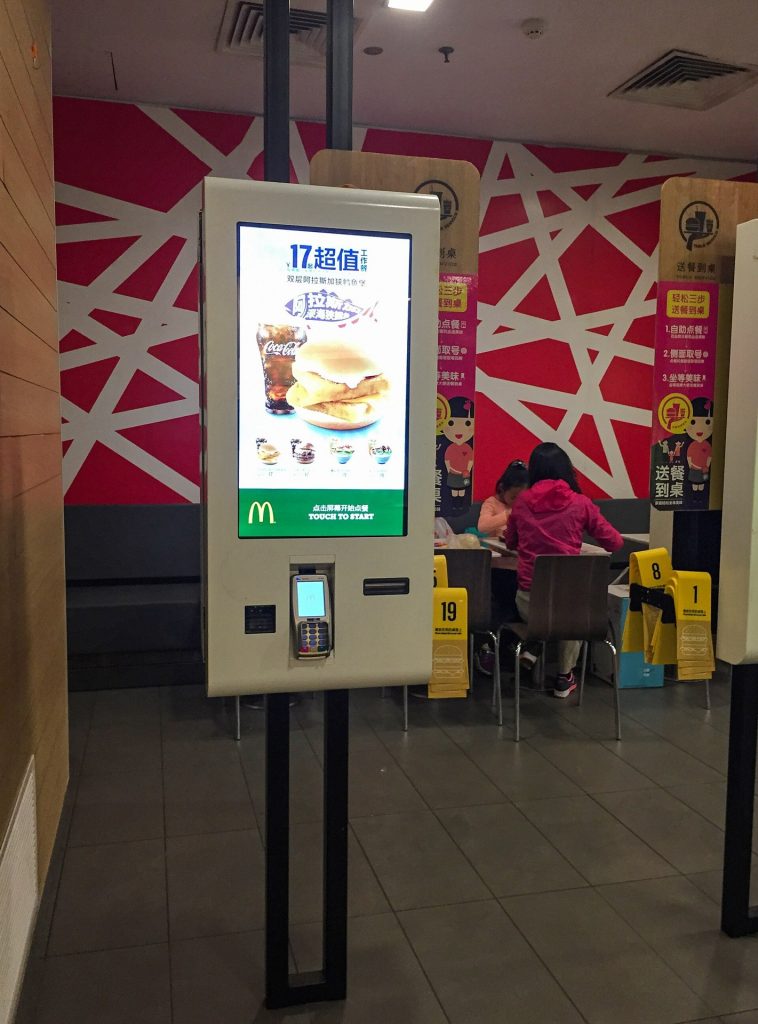
A modern Chinese chain restaurant can look, from the door, as if there is no one to talk to. A bank of touch-screen kiosks faces the entrance, or a paper stand on the table tells you to scan a QR code and order in a Mini Program. For a traveller whose wallet is a foreign-card Alipay or WeChat Pay setup, this is usually manageable—if you treat the screen as a machine that may need a human backup, not as a test you must pass alone.
This guide is about lobby kiosks and table QR self-ordering. It is not paying street vendors that only take a QR code, which is about tiny stalls that only display a printed code. It is not when your foreign card is declined in China, and it is not a WeChat AA split-bill article. We will not invent button names that will be wrong next month.
Two common layouts
In many fast-casual chains and food courts, you walk up to a tall screen, tap through pictures of dishes, pay at the end, and take a ticket or a queue number to a collection counter. In sit-down restaurants, especially mid-range places, you sit first, scan a code on the table, order from your phone, and pay in the same flow or when you are ready to leave.
The QR path often opens a WeChat or Alipay Mini Program (WeChat mini-program login for foreigners). If your WeChat is new, or a program insists on a local phone number or a real-name step, do not fight the loop in the middle of a dinner rush. Look for a staffed till. The point of the visit is dinner, not a perfect app session.
Camera translation helps on either layout (translation apps honest guide, camera and offline translation apps if you use a camera pack). Photograph the screen or hover the translator over the dish names, then choose by picture and by a short Chinese name you can show a person later. Beware of auto-translate poetry: “fragrant slippery something” may simply be a fish or a tofu dish. If chilli icons or red markers appear, take them seriously.
Payment at the last step
Kiosks and table QR pages in China usually expect Alipay or WeChat Pay, sometimes a Chinese bank app, and only sometimes a raw foreign card terminal. If you already set up a tourist-friendly wallet, this is the moment it earns its keep (Alipay and WeChat Pay hub, WeChat Pay vs Alipay for tourists, Alipay setup for foreigners, WeChat Pay foreign card guide).
What can still go wrong is ordinary and unglamorous:
- The kiosk offers a wallet you did not install.
- The Mini Program accepts a local wallet but rejects a foreign-card tourist profile at the last confirmation.
- The screen needs a Chinese mainland number for an SMS check.
- The table code is tied to a membership login you do not have.
None of these is a reason to invent a workaround that evades rules. The calm path is to cancel or abandon the unpaid order if the interface allows it, then walk to a person. Say you would like to order at the counter, show the dish names you already chose, and pay there with the same wallet, another wallet, or cash if cash is accepted (why cash is still needed, WeChat Pay when small vendors prefer cash). If a companion’s mainland wallet can pay, that is a practical courtesy, not a requirement.
Do not stand in front of a kiosk retrying a failing card in a tight loop. Repeated declines help no one, and the next person in line would like the screen.
Ordering details that matter more than the buttons
Watch whether you are ordering for here or to go, and whether the system wants a table number. On a table QR, you are often already identified by the sticker you scanned—paying for the wrong table is an avoidable embarrassment. Check the quantity, the spice level if a slider appears, and whether a side, a rice, or a drink was added by default.
Set-menu pictures can hide soups or cold dishes you did not intend to buy. If the total looks like two meals, scroll up before you pay. We will not invent typical prices; your screen is the only honest number.
If you need a fapiao for work, ask at the counter rather than hunting for an invoice toggle you may not recognise (Alipay and WeChat Pay hub for the wallet; the fapiao habit is easier with a staffed sale). If you are splitting a meal with Chinese friends, let them lead on whatever group-pay tool they already use, and settle afterwards if a tourist wallet cannot join the official split function.
When the machine is the only path
Related Lovely China reading
For payments, start with Alipay and WeChat Pay hub and WeChat Pay vs Alipay for tourists. For trains, keep high-speed rail first-timers guide and 12306 passport signup for foreigners handy. City hubs: Beijing first-visit guide, Shanghai first-visit guide. Connectivity: roaming vs local SIM honest guide, pocket Wi-Fi vs eSIM for China, offline maps for foreigners. Bookmark China travel tools page.
Practical checklist
- Confirm official rules on the relevant government, park, airline, or bank page near your travel week
- Screenshot bookings, tickets, and QR codes while you still have stable Wi-Fi
- Save hotel and attraction names in Chinese characters in your phone notes
- Carry passport, a backup payment method, and a small cash float (why cash is still needed)
- Test one small mobile payment before you rely on wallets at a gate or taxi
- Keep China travel tools page bookmarked for related Lovely China hubs
FAQ
Will my foreign-card Alipay or WeChat Pay work on a kiosk?
Sometimes yes, sometimes the Mini Program or kiosk rejects a tourist profile at the last step. If payment fails, cancel the unpaid order if you can and go to a staffed counter. Do not loop on a declining card.
The screen is only in Chinese. What should I do?
Use a language pack if one exists, otherwise use camera translation and dish pictures. Note the Chinese name so you can show a person later. A staffed till is always a valid backup.
Is a table QR the same as a street-vendor QR code?
Not quite. Table QR and lobby kiosks are restaurant ordering systems, often inside a Mini Program. Street-vendor codes are usually a printed wallet collection on a stall. Both may fail for a tourist wallet, and both have a human backup when one exists.
Can I split the bill on the kiosk?
Do not count on a tourist wallet joining a group-split function. Let a companion with a working local wallet lead if needed, or pay your share another way after the meal.
Notes for late 2026 travellers
Late December 2026 and the New Year week into 2027 bring colder mornings, earlier sunsets, and holiday crowds in many city hubs. Pack real winter layers in the north, and leave extra time on weekends and around 1 January.
This article does not invent ticket prices, opening hours, processing times, consular fees, or official statistics. When a number matters, verify it on the official site, app screen, or ticket board near your travel week.
If an official rule page disagrees with this guide, follow the official page. Lovely China orients English-speaking travellers; we are not an immigration, banking, or medical authority.