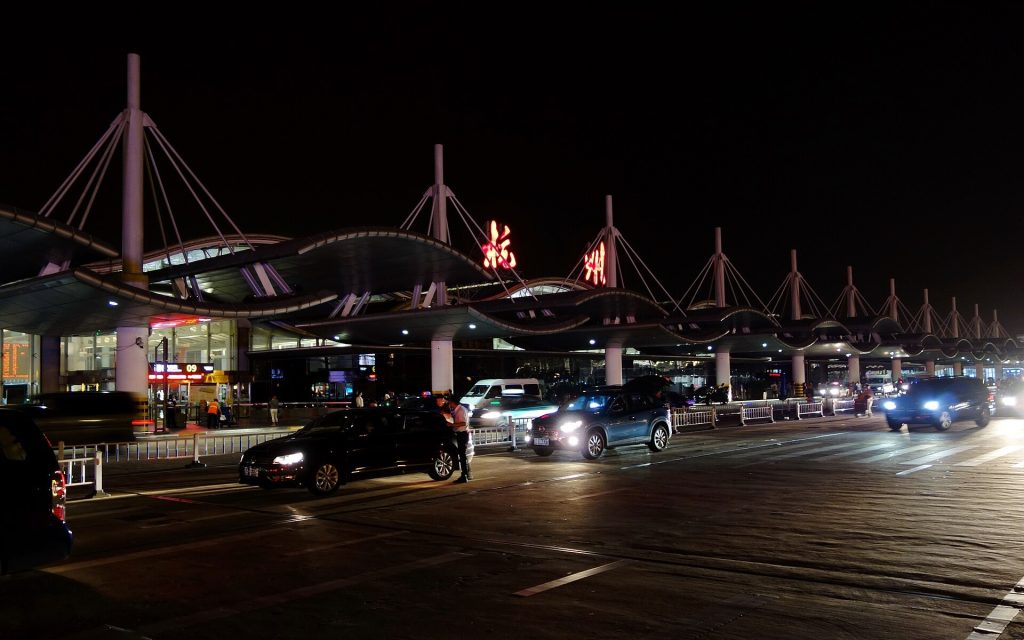
Hangzhou Xiaoshan International Airport (HGH) is Hangzhou’s main civil airport, on the Xiaoshan side of the city. It is not Shanghai, and it has no maglev. The Shanghai Maglev runs from Pudong, a different airport in a different city (Shanghai Maglev and metro, Pudong airport to city). If you landed here, your job is simpler: choose rail, an official taxi, or Didi, and get to a hotel address you can show in Chinese.
This is a first-arrival transfer guide. It is not Hangzhou late December and New Year planner, which plans the days after you have dropped your bags, and it is not a West Lake walking article. Recheck the official Hangzhou Metro map and the airport’s own transport page near your travel week; line names, last trains, and pickup points do change.
Rail into the city
In recent years Hangzhou Metro has operated an airport rail link that official maps often label as Line 19, also described as an Airport Express. That kind of link is the first option to check if you land during metro hours, have manageable luggage, and are staying near a metro station in the urban area. We will not freeze a line number, a fare, or a last-train clock in this article. Stand in front of the official map in the arrivals hall, or open the official Hangzhou Metro information, and confirm:
- The current line name and the station name inside the airport terminal you actually arrived at.
- Where that line takes you, and which interchange you need for your hotel (for example toward East Railway Station, the lakeside area, or a business district).
- The last train on the night you land, not a remembered weekday timetable from a previous trip.
Tickets are usually sold at machines or via a mobile-pay / metro-app flow. Foreign visitors should have a backup: a staffed window if one is open, a tourist card or QR method that actually works for them (tourist metro cards vs mobile pay), and a small cash float if a machine is unfriendly (why cash is still needed, Alipay and WeChat Pay hub). Screenshot a working payment before you go through the gate.
If your hotel is far from any metro station, or you have two large cases and a late-night clock, rail may be the wrong kind of cleverness. Choose a car instead.
Official taxis and Didi
Follow signs to the official taxi rank. Ignore touts in the arrivals hall who offer a “convenient” price. Official taxis are metered; sit down, buckle, and show the hotel’s Chinese name and address, saved offline (offline maps for foreigners, Amap Baidu English mode). Payment may be a QR code the driver displays, a meter you pay by wallet, or cash (taxi cash vs QR for foreigners, Didi ride-hailing for foreigners is the ride-hailing cousin rather than the taxi itself).
Didi is often the more English-friendly car option if your app and identity checks already work (Didi ride-hailing for foreigners, Didi identity verification for foreign visitors). The important local detail is the pickup point. Airports usually print a zone, a door number, or a named curb. Wait there, not at a random kerb that looks quieter. If the app’s pin and the airport sign disagree, trust the official pickup sign and adjust the pin, or call the driver through the app.
A private “express” car offered by a stranger is not a bargain; it is how luggage and routes go sideways. If you are tired, official is enough.
Buses, late nights, and payment
Airport buses may still run toward major rail stations or urban stops. If you consider one, take the destination, the last departure, and the ticket method from the official airport board, not from memory. We will not invent a route list.
If you land after the last metro, switch early to a taxi or Didi rather than waiting at a shuttered gate (catching the last metro after a late-night arrival). Night surcharges, if any, will be on the official meter or in the app’s estimate—not in a blog table.
Have at least one mainland wallet ready, a foreign card as a weak backup, and some cash (WeChat Pay vs Alipay for tourists, when you still need cash). Hotel desks in Hangzhou will want a passport for registration (hotel registration for foreigners). Save the hotel phone number so a driver can call if the pin is messy.
Related Lovely China reading
For payments, start with Alipay and WeChat Pay hub and WeChat Pay vs Alipay for tourists. For trains, keep high-speed rail first-timers guide and 12306 passport signup for foreigners handy. City hubs: Beijing first-visit guide, Shanghai first-visit guide. Connectivity: roaming vs local SIM honest guide, pocket Wi-Fi vs eSIM for China, offline maps for foreigners. Bookmark China travel tools page.
Practical checklist
- Confirm official rules on the relevant government, park, airline, or bank page near your travel week
- Screenshot bookings, tickets, and QR codes while you still have stable Wi-Fi
- Save hotel and attraction names in Chinese characters in your phone notes
- Carry passport, a backup payment method, and a small cash float (why cash is still needed)
- Test one small mobile payment before you rely on wallets at a gate or taxi
- Keep China travel tools page bookmarked for related Lovely China hubs
FAQ
Is there a maglev from Xiaoshan Airport into Hangzhou?
No. The Shanghai Maglev is at Pudong, in another city. From HGH, look at official metro or Airport Express rail, official taxis, Didi, and posted airport buses.
Which metro line should I take?
Confirm the current line name, station, interchange, and last train on the official Hangzhou Metro map and airport signs near your travel week. Recent maps have often shown an Airport Express or Line 19 link, but this article does not freeze a number or a timetable.
Where should I pick up a Didi?
At the official pickup zone posted in the arrivals hall. Wait at the signed door or curb, not at a random quieter kerb, and ignore unofficial touts.
What if I land after the last metro?
Switch early to an official taxi or Didi. Do not wait at a shuttered rail gate. Have a hotel address in Chinese, a working wallet, and a small cash float ready.
Notes for late 2026 travellers
Late December 2026 and the New Year week into 2027 bring colder mornings, earlier sunsets, and holiday crowds in many city hubs. Pack real winter layers in the north, and leave extra time on weekends and around 1 January.
This article does not invent ticket prices, opening hours, processing times, consular fees, or official statistics. When a number matters, verify it on the official site, app screen, or ticket board near your travel week.
If an official rule page disagrees with this guide, follow the official page. Lovely China orients English-speaking travellers; we are not an immigration, banking, or medical authority.