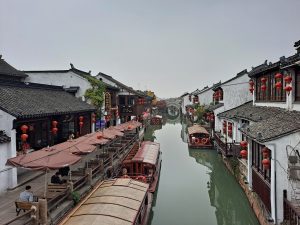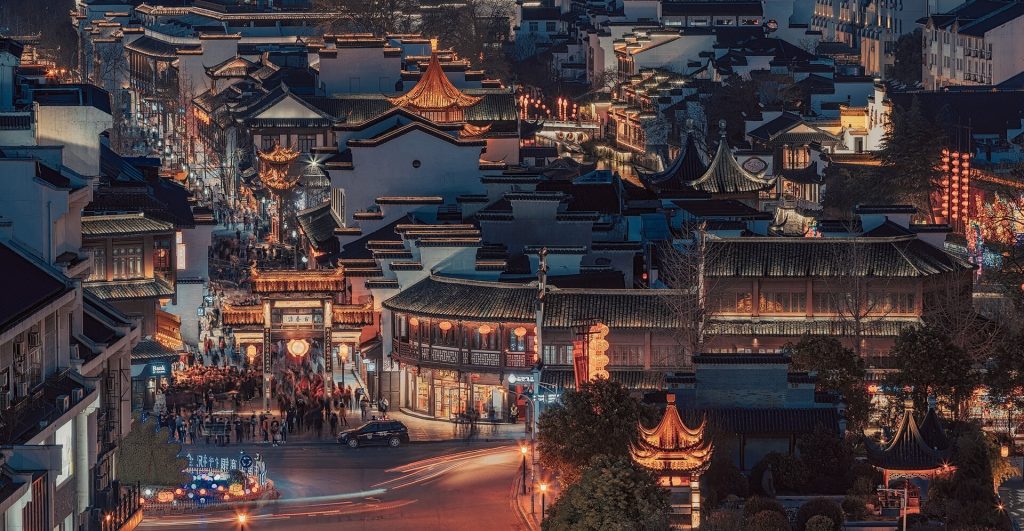
The river takes the light first. On a late-December evening in Nanjing, the Qinhuai (秦淮河) is already dark water under a pale sky, and the lanterns along the Confucius Temple stretch (夫子庙) come on as if someone were testing the year, one bulb at a time. You feel the damp before you feel a real freeze. The cold sits in the stone, in the bridge parapet, in the sleeves you should have buttoned.
This is not a ticket guide, and it is not a planner. If you need trains, hours, and a daylight route, use Nanjing first-visit guide and the late-December Nanjing plan you may already have open. An autumn or November evening in the same streets has its own weather and its own story (November evening Nanjing Confucius Temple story). Suzhou’s canals, if you were there on another night, teach a similar lesson at a different pitch (a December evening on Suzhou’s Pingjiang Road). Tonight is only this river, in this month, at the hour when the tour flags thin and the food smells do not.
The hour the lanes change their mind
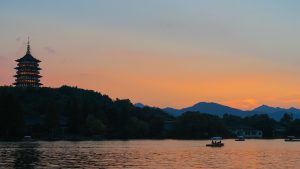
Late December dusk arrives early. If you come at four, you may still be walking in a residual afternoon: school groups, shopping bags, cameras pointed at the same ceremonial gate. If you come after the light has gone, the stone looks wetter than it is, the painted beams go warmer, and the water starts to do the work of a second street, doubling every lantern slightly out of register.
A weekday is quieter than a Saturday. New Year week, when 1 January is a public holiday, can bring the noise back; the river does not exist outside the calendar. You will want a real coat. Jiangnan cold is not a Beijing wind, but it climbs from the water and stays in your hands. The scarf you packed for a photograph will not do the whole loop. Shoes should forgive puddles. The phone battery will fade if you keep it out for every reflection; keep it inside the coat until you actually want the picture (power bank airport security rules).
Start where the streets are still commercial if you need supper and a sense of the crowd, then walk toward a quieter parapet as the lights settle. You do not have to “complete” the river. A short stretch, done slowly, is the visit.
Lanterns, food, and the temptation to rush
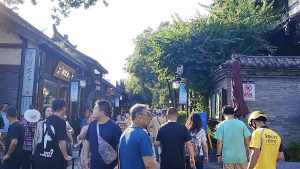
The Confucius Temple area is famous, which means it is also a place of identical souvenir stalls and of smells that are better than the stalls look: oil, sugar, vinegar, something frying, something sweet cooling on a tray. You can eat well here, or you can eat standing up and not remember it. A sit-down room a lane back from the brightest corner will treat you more kindly than a skewer eaten in a bottleneck of umbrellas. If you want a Nanjing flavour that is not fried on the night market, that can wait for a proper table and a dish such as salted duck on another hour (Nanjing salted duck (yanshui ya) for first-timers). Tonight, a bowl or a small plate is enough.
Pay with a method you already know works, and do not discover a failed wallet between a bridge and a stall that has no patience (Alipay and WeChat Pay hub). Keep a little cash for the odd window that still wants it.
People stop on bridges. That is fine, until they stop in the middle with a tripod of elbows. Step aside, take the picture, and give the parapet back. The river is more itself when you are not in anyone’s way. Voices carry on water; a lowered voice is not formality, it is just accurate.
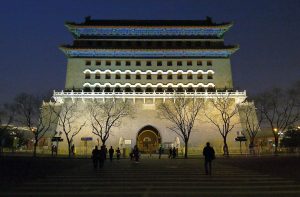
You may see temple rooflines and honour gates lit as if they were scenery. They are also part of a working district and, in daylight, of a cultural site with its own rules. In the evening you are mostly among other walkers. Be the visitor who does not shout across a courtyard, and who does not treat a still-open hall as a stage set if you step inside.
Weather, pace, and the way back
The air can feel almost mild under a gallery and sharp again on an unsheltered span. That contrast is the evening. If it rains, which it may, the lanterns improve and the stone worsens. A compact umbrella helps more than a new plan. If it is only damp, you will still notice the river more than you notice the sky.
Walk until the crowds thin or until your hands say so, then turn back by the same bridges rather than inventing a longer loop in the dark. Official transport—metro stations on the official map, a working Didi, an official taxi—should be a decision you already located on a screen before the battery dipped (Didi ride-hailing for foreigners, offline maps for foreigners). The river is not a place to discover that your hotel’s Chinese address lives only in an email you cannot open.
Related Lovely China reading
For payments, start with Alipay and WeChat Pay hub and WeChat Pay vs Alipay for tourists. For trains, keep high-speed rail first-timers guide and 12306 passport signup for foreigners handy. City hubs: Beijing first-visit guide, Shanghai first-visit guide. Connectivity: roaming vs local SIM honest guide, pocket Wi-Fi vs eSIM for China, offline maps for foreigners. Bookmark China travel tools page.
Practical checklist
- Confirm official rules on the relevant government, park, airline, or bank page near your travel week
- Screenshot bookings, tickets, and QR codes while you still have stable Wi-Fi
- Save hotel and attraction names in Chinese characters in your phone notes
- Carry passport, a backup payment method, and a small cash float (why cash is still needed)
- Test one small mobile payment before you rely on wallets at a gate or taxi
- Keep China travel tools page bookmarked for related Lovely China hubs
FAQ
Is this a ticket or opening-hours guide to the Confucius Temple area?
No. It is an evening walking piece about atmosphere, pace, and practical comfort on a late-December night. For trains, daylight routes, and a seasonal plan, use a Nanjing first-visit or late-December planner article instead, and confirm any ticketed site on its official page.
When is the best hour to walk the Qinhuai in late December?
Dusk comes early. Coming after the light has gone usually means fewer daytime tour flags and stronger lantern reflections on the water. A weekday is often quieter than a Saturday, and New Year week can be busier. Wear a real coat; the cold is damp and rises from the river.
Is this the same walk as a Suzhou canal evening?
They share damp-cold Jiangnan weather and lantern light on water, but they are different cities and different streets. Qinhuai and the Confucius Temple area have their own scale and commercial energy. A Suzhou canal evening is a sister experience, not a substitute.
How should I get back to the hotel after the walk?
Decide the metro station, official taxi rank, or Didi plan before your phone battery dips in the cold, and save the hotel’s Chinese address offline. The river is a poor place to discover that the address lives only in an email you cannot open. Check in first if you have just arrived with luggage.
Notes for late 2026 travellers
Late December 2026 and the New Year week into 2027 bring colder mornings, earlier sunsets, and holiday crowds in many city hubs. Pack real winter layers in the north, and leave extra time on weekends and around 1 January.
This article does not invent ticket prices, opening hours, processing times, consular fees, or official statistics. When a number matters, verify it on the official site, app screen, or ticket board near your travel week.
If an official rule page disagrees with this guide, follow the official page. Lovely China orients English-speaking travellers; we are not an immigration, banking, or medical authority.