西湖藕粉 (West Lake lotus root starch, often called ou fen) is a Hangzhou sweet, not a savoury main. A spoonful looks translucent and slightly elastic, like a pale jelly-soup, and it tastes mild, gently starchy, and often floral if osmanthus (桂花) has been added. Travellers who came to the lake for vinegar fish or Dongpo pork sometimes meet this bowl at the end of the meal, or in a teahouse between walks, and are surprised that it is closer to a warm dessert than to a “famous fish.” That surprise is the point of this first-timer guide.
It is not Hangzhou West Lake vinegar fish for first-timers, not Hangzhou Dongpo rou for first-timers, and not a bowl of Hangzhou pian’er chuan noodles for first-timers. Those are savoury Hangzhou classics with their own pages. It is also not a Longjing tea-tasting article, even when a teahouse serves ou fen beside a pot of tea. We will not invent prices, and we will not certify a single official recipe.
What arrives in the bowl
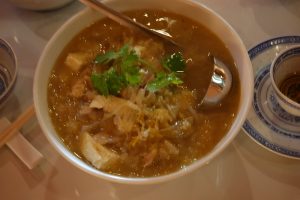
In a restaurant or teahouse, West Lake lotus root starch is usually a small bowl, served warm. The texture should be smooth and lightly glutinous, not grainy and not as firm as a set pudding. A well-made bowl has a sheen; a poorly mixed one has lumps of dry powder that never dissolved. Osmanthus, if present, shows as tiny gold flecks and a light perfume. Some houses add a little sugar, lotus seeds, or osmanthus syrup; others keep it almost plain and let you sweeten it yourself. Ask if you need to know.
The flavour is mild. Sweet comes first, then a soft vegetal note from the lotus root starch itself. It is not chilli heat, not the sweet-sour of vinegar fish, and not the rich soy of Dongpo pork. If you do not like sweet soups, this may not be your bowl. If you do, it is a gentle pause after a cold West Lake walk, especially in late December when a warm spoonful is more welcome than it is in August.
You eat it with a spoon, while it is warm. If it sits, it can thicken or form a skin; give it a stir. It is a small course. Order it as a shared sweet at the end, or as a teahouse interlude, not as the protein in a meal.
How to order without folklore
Look for 西湖藕粉 or 藕粉 on the menu, sometimes with 桂花 in the name if osmanthus is the house style. Show the characters if the English line is vague; how to order from a Chinese menu helps when the menu is only in Chinese. If you are in a teahouse, you can often order a pot of tea and ou fen without a full banquet. If you are at a Hangzhou cuisine restaurant, it may sit in the dessert or “soft dishes” section rather than beside the fish.
Say if you want it less sweet, if that is an option in that house; do not expect a universal sugar scale. If you cannot eat flowers or a particular garnish, ask. Osmanthus is common, not compulsory.
Shops around the lake and in the city also sell packets of the powder as a souvenir. A packet is not the same as a teahouse bowl. At home or in a hotel kettle situation, you generally mix the starch with the method on the packet, often involving a little cool liquid first so it does not clump when hot water hits it. We will not invent a gram-by-gram official method; follow the packet in your hand, and do not treat a hotel-room experiment as a test of Hangzhou’s restaurants.
Communal table manners still apply if the bowl is shared, though this is usually served as individual bowls; shared dishes and lazy Susan etiquette is there if the rest of the meal is family-style.
What it is not, and when it fits a trip
It is not 西湖醋鱼, despite the shared West Lake name. It is not a breakfast noodle. It is not a health claim we will invent; enjoy it as a sweet. It is not an ice cream, even though the word “starch” can confuse a first reading of a menu in English.
Dietary honesty: this is a starch-based sweet, often made with sugar and sometimes osmanthus. If you need a vegan or vegetarian table for the rest of the meal, vegetarian or vegan in Chinese restaurants is the wider guide; ou fen is often plant-based, but you should still ask about garnishes and whether a house uses a non-vegetarian stock or topping, rather than assuming.
It fits a late-December Hangzhou day after a damp lake walk, a pause in a teahouse, or the last plate of a Hangzhou cuisine lunch. It does not replace lunch. If you already ordered vinegar fish and Dongpo pork, this is a better ending than a third heavy savoury dish.
Pay as the house asks, usually by QR, and keep a cash backup. Recheck nothing official here except your own appetite and the menu in front of you. Lovely China describes the table; we do not own a recipe. If a teahouse serves it differently from the bowl you imagined, eat the bowl in front of you.
Related Lovely China reading
For payments, start with Alipay and WeChat Pay hub and WeChat Pay vs Alipay for tourists. For trains, keep high-speed rail first-timers guide and 12306 passport signup for foreigners handy. City hubs: Beijing first-visit guide, Shanghai first-visit guide. Connectivity: roaming vs local SIM honest guide, pocket Wi-Fi vs eSIM for China, offline maps for foreigners. Bookmark China travel tools page.
Practical checklist
- Confirm official rules on the relevant government, park, airline, or bank page near your travel week
- Screenshot bookings, tickets, and QR codes while you still have stable Wi-Fi
- Save hotel and attraction names in Chinese characters in your phone notes
- Carry passport, a backup payment method, and a small cash float (why cash is still needed)
- Test one small mobile payment before you rely on wallets at a gate or taxi
- Keep the China travel tools page page bookmarked for related Lovely China hubs
FAQ
Is West Lake lotus root starch a savoury fish dish?
No. 西湖藕粉 is a mild, usually sweet, warm starch soup, often with osmanthus. It is not West Lake vinegar fish, even though they share a place name. Order it as a small sweet or a teahouse bowl, not as your protein.
What should it taste and feel like?
Smooth, lightly glutinous, and gently sweet, sometimes floral from osmanthus. It should not be grainy or full of dry lumps. Eat it warm with a spoon, and stir if it starts to thicken as it cools.
Can I just buy a souvenir packet instead of ordering it in a teahouse?
You can, but a packet mixed in a hotel kettle is not the same as a teahouse bowl. If you try a packet, follow the instructions on that packet. We do not publish an official recipe.
How is this different from other Hangzhou food guides on the site?
Vinegar fish, Dongpo pork, and pian’er chuan are savoury classics already covered. This page is only the sweet lotus root starch bowl and how a first-timer should order it.
Notes for late 2026 travellers
Late December 2026 and the New Year week into 2027 bring colder mornings, earlier sunsets, and holiday crowds in many city hubs. Pack real winter layers in the north, and leave extra time on weekends and around 1 January.
This article does not invent ticket prices, opening hours, processing times, consular fees, or official statistics. When a number matters, verify it on the official site, app screen, or ticket board near your travel week.
If an official rule page disagrees with this guide, follow the official page. Lovely China orients English-speaking travellers; we are not an immigration, banking, or medical authority.